Artwork
The Cornell Farm
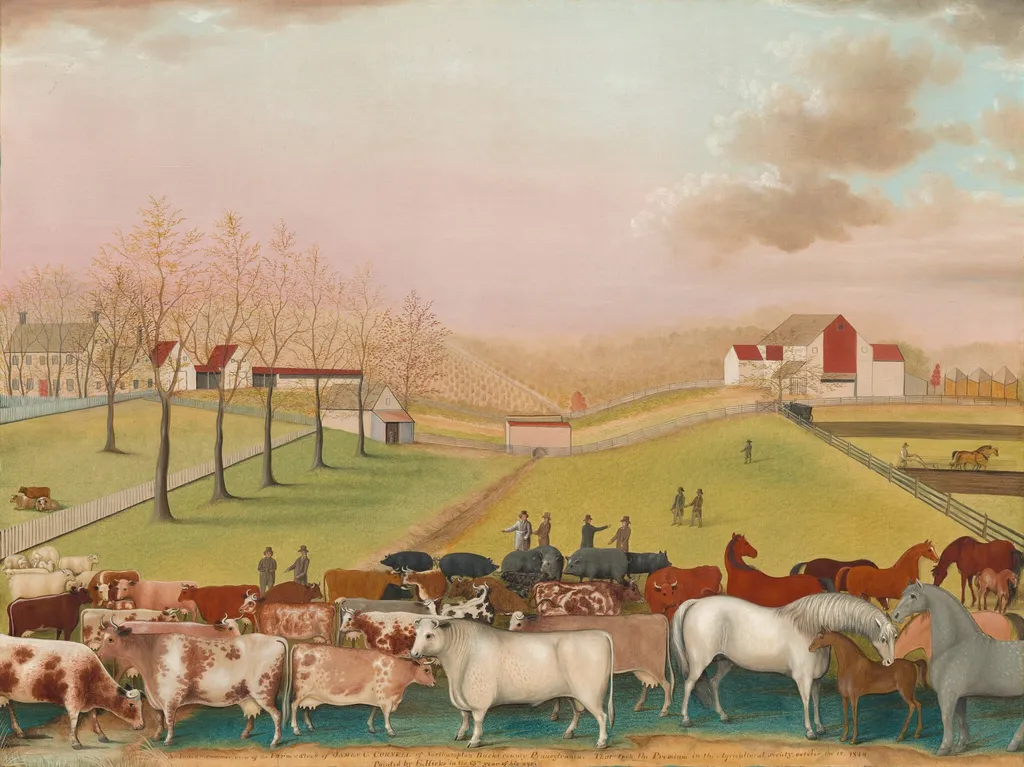
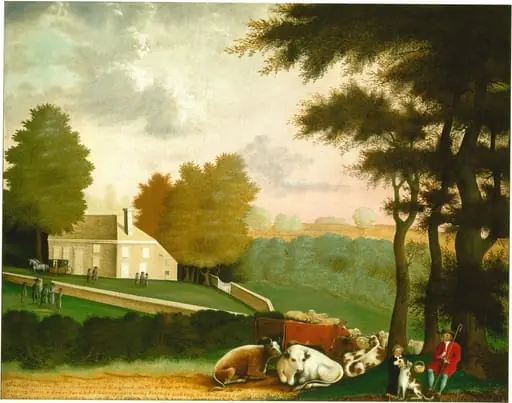
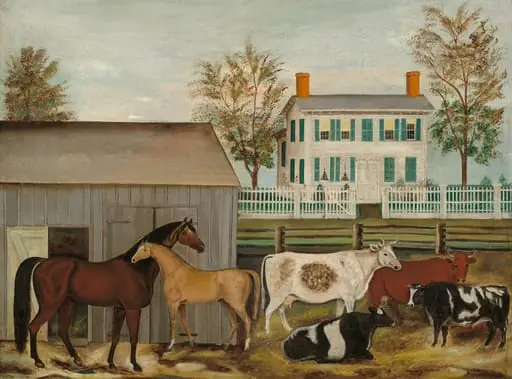
The Cornell Farm is an oil painting by the American Folk Art artist Edward Hicks. It dates from 1848 and is held in the collection of the National Gallery of Art.
- Inscription
- Inscribed:across bottom: An Indian summer view of the Farm & Stock of JAMES C. CORNELL of Northampton Bucks county Pennsylvania. That took the Premium in the Agricultural society, october the 12, 1848 / Painted by E. Hicks in the 69th year of his age.
About this work
Subject & Meaning
It features a prominent tree, a barn, house, and a herd of cattle arranged in a foreground band, while the background includes an orchard and distant landscape.
The painting shows the farmstead and livestock of James C. Cornell, a Pennsylvania farmer, set in an idyllic countryside. It features a prominent tree, a barn, house, and a herd of cattle arranged in a foreground band, while the background includes an orchard and distant landscape. Hicks inscribed the work with a reference to an 1848 agricultural competition, underscoring the scene's connection to rural productivity and community recognition.
The composition balances simple, almost naïve figures with decorative patterns in fences and foliage, conveying both a literal record of a working farm and an idealized vision of agrarian prosperity.
Technique & Style
The work is an oil on canvas, painted in 1848 by Edward Hicks. Its composition is organized into a horizontal band of livestock across the foreground, framed by symmetrically placed buildings, the house and barn, whose bright red and white hues create a patterned, decorative effect. Hicks's handling balances flat silhouettes and folk-naive forms with softer paint blending in the orchard, suggesting spatial recession beyond the immediate scene.
The inscription along the bottom records the painting's agricultural context and Hicks's age at execution, underscoring its documentary and commemorative intent.
History & Provenance
Edward Hicks completed The Cornell Farm in 1848, in his sixty-ninth year. The artist created the oil on canvas for James C. Cornell of Northampton, Bucks County, Pennsylvania, to depict the farm and livestock that had won a premium at the local Agricultural Society on 12 October of that year. Hicks inscribed these details directly along the bottom of the composition.
Following the commission, ownership remained within the Cornell family, passing from James to his son Theodore, and subsequently to his grandson Russell. The painting later entered the possession of Mr. and Mrs. J. Stanley Lee, with Mrs. Lee being Hicks's great-granddaughter. In 1954, the Lees sold the work to collectors Edgar William and Bernice Chrysler Garbisch, who donated it to the National Gallery of Art in 1964.
The Cornell Farm (1848) is an oil on canvas landscape by Edward Hicks that entered the National Gallery of Art collection as a gift from Edgar William and Bernice Chrysler Garbisch in 1964. Its provenance records that Hicks painted the work for James C. Cornell of Northampton, Bucks County, Pennsylvania; the painting remained in the Cornell family until sold in 1954 to the Garbisches, who donated it to the museum. The work was first exhibited at the Bucks County Bi-Centennial Celebration in Doylestown, Pennsylvania, in 1882 and has subsequently been shown in numerous museum displays and exhibitions.
Context
Edward Hicks created The Cornell Farm in 1848 without formal academic training, adopting the direct approach characteristic of a primitive or folk painter. The work is historically significant for its inscription, which notes that the depicted livestock won a premium at the Agricultural Society on October 12, 1848, and that the painting was executed in the artist's 69th year. Art historical analysis highlights how Hicks balances naive silhouettes of figures and buildings with a sophisticated sense of depth, achieved by softly blending paints over the orchard to suggest space beyond the immediate view.
The composition features a horizontal band of prize-winning animals presented as individual portraits, alongside a symmetrical arrangement of a red house and white barn that demonstrates the artist's delight in ornamental patterns. The painting has maintained a presence in public discourse since its first exhibition at the Bucks County Bi-Centennial Celebration in 1882.
Overview
Edward Hicks completed The Cornell Farm in 1848, an oil on canvas landscape. This painting captures the agricultural property and livestock belonging to James Cornell in rural Pennsylvania. The National Gallery of Art acquired the work in 1964, where it remains part of the permanent collection. Hicks was 69 years old when he created this particular rendition of the scene.
Legacy
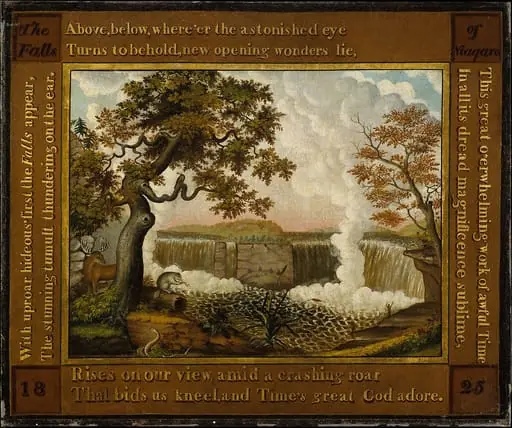
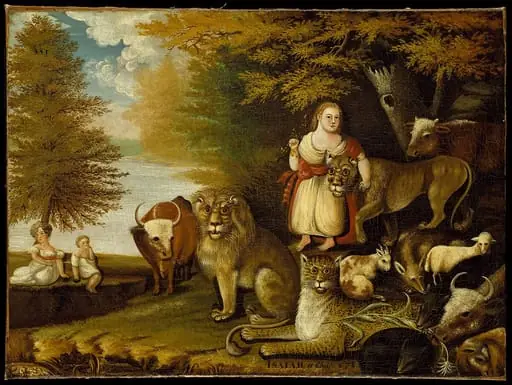
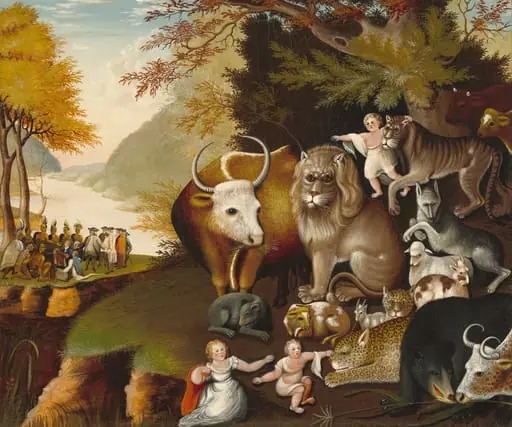
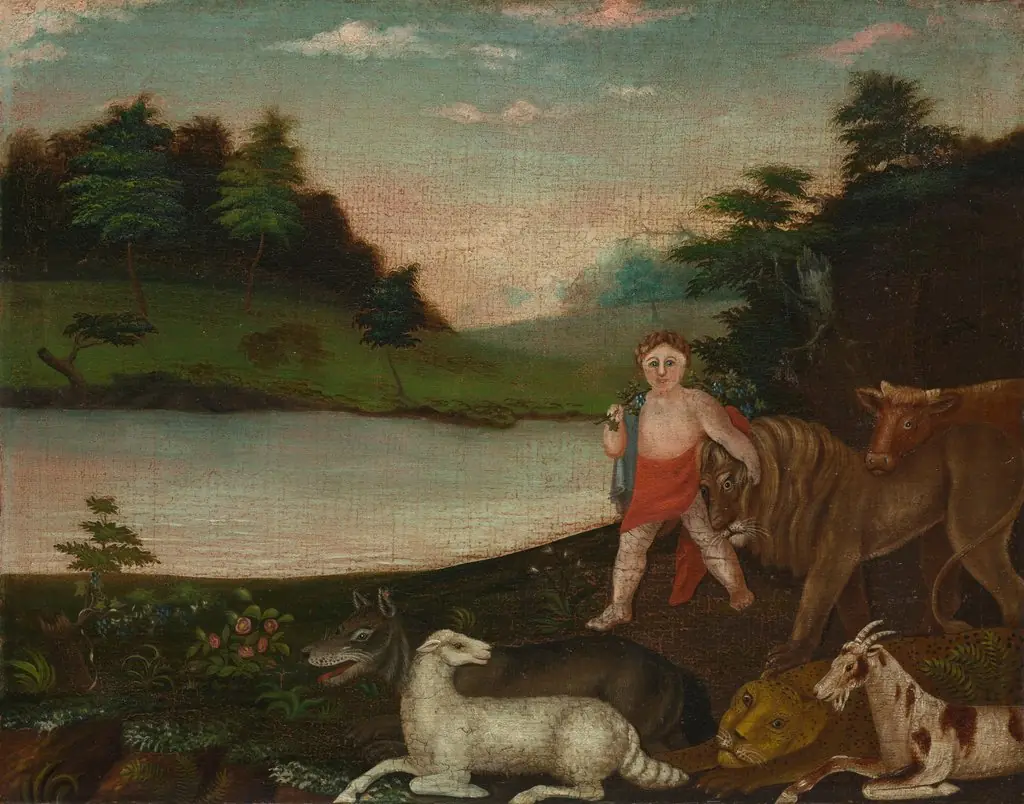
Hicks is also recognized for his series of paintings titled The Peaceable Kingdom, which similarly explore themes of harmony and an idealized natural world. Like The Cornell Farm, examples of The Peaceable Kingdom can be found in the collection of the National Gallery of Art, offering further insight into the artist's recurring subjects and stylistic approach.
Own this work as a print
Artist & collection

Artist
Edward Hicks spent his life caught between two worlds. A Quaker preacher by Sunday and a painter by weekdays, he painted signs and carriages to support his family while quietly building a body of peaceful, crowded…

 The Barnyard
 View of Benjamin Reber's Farm
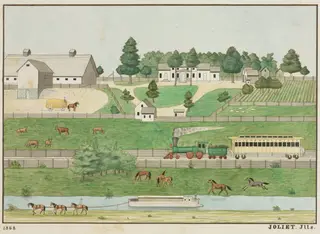 Landscape, Joliet, Illinois
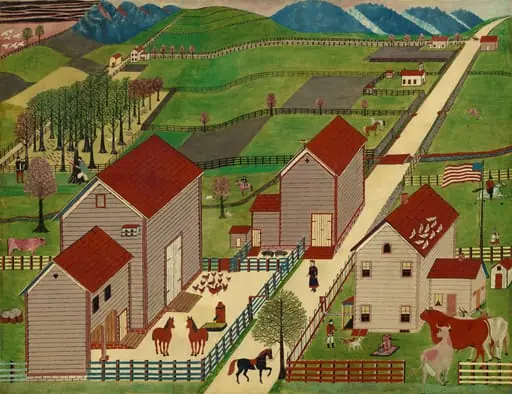 Mahantango Valley Farm
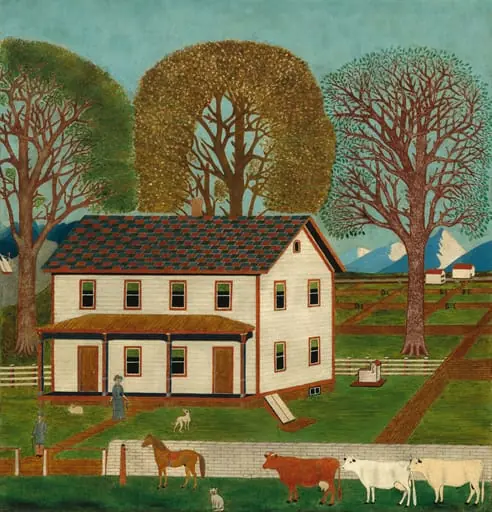 Farmhouse in Mahantango Valley
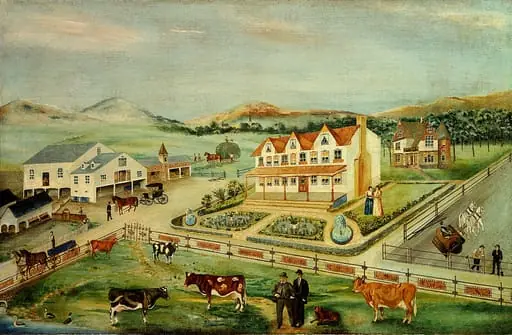 Bucks County Farm Outside Doylestown, Pennsylvania
 Landscape with Cattle, Sheep and Distant Figure
 Cattle's Return
 Peisaj
 Meetinghouse Hill, Roxbury, Massachusetts
- Landscape with a Farm