Artwork
The Peaceable Kingdom
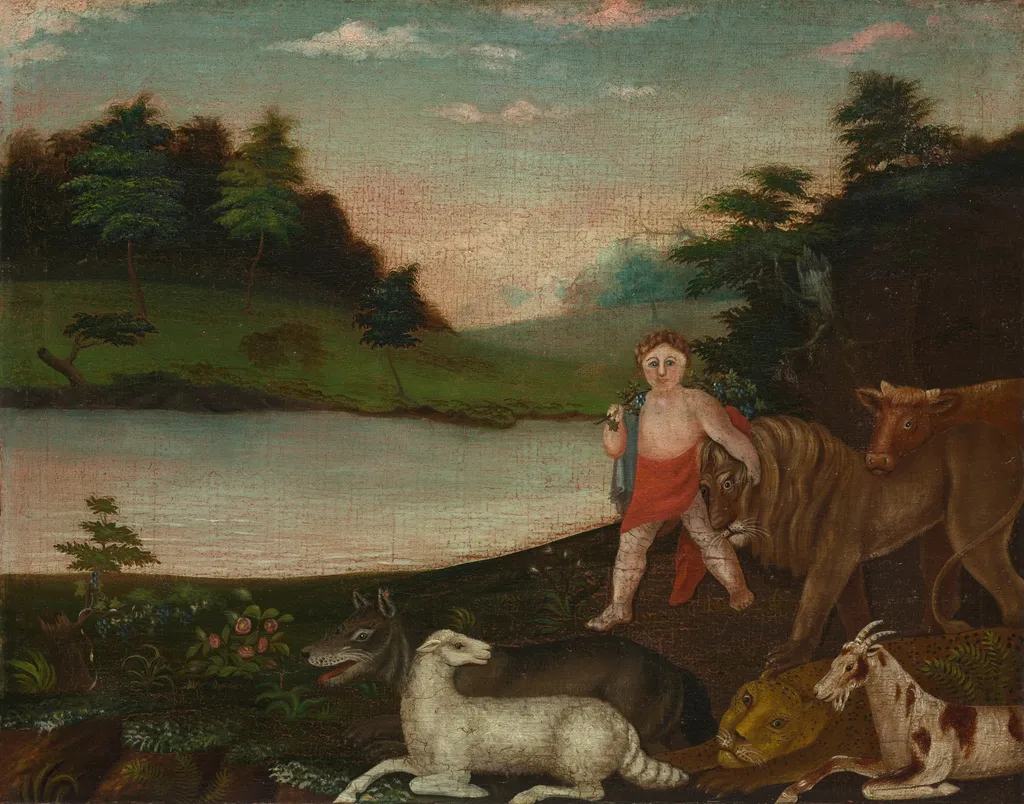
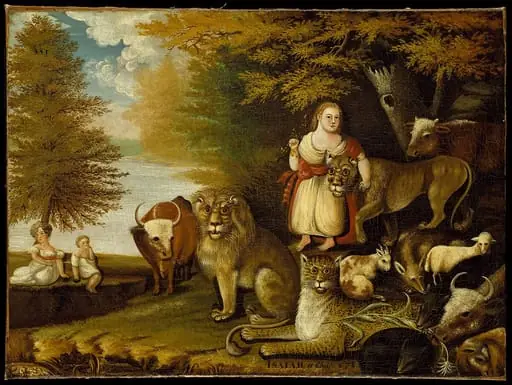
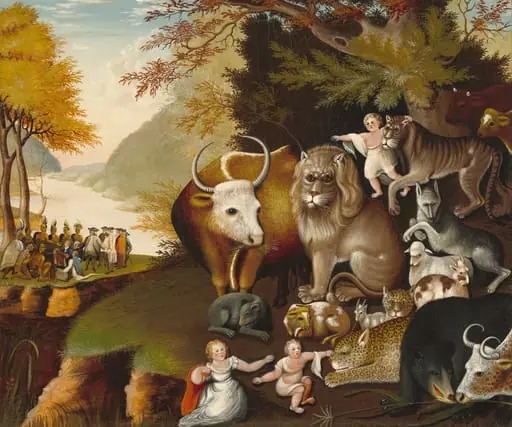
The Peaceable Kingdom is an oil painting by the American Folk Art artist Edward Hicks. It dates from 1817 and is held in the collection of the Cleveland Museum of Art.
About this work
Technique & Style
7 centimeters, yielding a modestly scaled, roughly horizontal format suited to the intimate, devotional character of the composition.
The Peaceable Kingdom is an oil painting executed on canvas, a combination of medium and support consistent with Edward Hicks's broader practice of working in oil paint. The canvas measures approximately 47.6 by 59.7 centimeters, yielding a modestly scaled, roughly horizontal format suited to the intimate, devotional character of the composition. Produced in the United States in 1817, the work reflects Hicks's naive, folk-influenced style, characterized by flattened perspective, simplified figural groupings, and a decorative arrangement of animal and human forms arranged across a shallow picture plane.
The handling is direct and unpretentious, prioritizing legible narrative over academic finish, with broad, simplified passages of paint that emphasize pattern and symbolic clarity.
The painting is held in the collection of the Cleveland Museum of Art.
History & Provenance
Edward Hicks painted The Peaceable Kingdom in 1817, as recorded in the artist’s own date inscription on the work.
The earliest recorded owner was the artist himself, whose estate retained the painting after his death in 1849. By 1945 it had entered the collection of the Cleveland Museum of Art, where it remains held (accession no. 1945.38). The museum’s records identify the work’s American origin and its dimensions of 47.6 cm × 59.7 cm, confirming its status as an early example of Hicks’s Peaceable Kingdom series.
The work is held by the Cleveland Museum of Art, where it is catalogued as accession 1945.38.
It has been exhibited at the Cleveland Museum of Art in the past; it appeared in the 1945 annual exhibition of American art and was later shown in 1976 as part of the museum’s collection display.
Legacy
Edward Hicks's The Peaceable Kingdom, painted in 1817, established a visual language of harmony that resonated through American religious and folk art traditions. The work's imagery was widely reproduced in 19th-century devotional prints and quilts, embedding its motif of peaceful coexistence into popular culture. Its presence in the Cleveland Museum of Art's collection since 1945 has ensured continued scholarly attention to Hicks's contribution to early American painting.
The painting's thematic influence extended to later folk artists who adopted its compositional elements to convey moral narratives, cementing its legacy as a foundational reference in the genre.
Overview
Edward Hicks’ oil painting entitled The Peaceable Kingdom, completed in 1817, depicts a tranquil pastoral scene in which a variety of animals coexist without conflict. The work is part of the collection of the Cleveland Museum of Art, where it remains on display as an example of early nineteenth‑century American genre painting.
Subject & Meaning
At the centre of the composition a child in a red robe stands amid a group of animals, a lion, cow, goat, sheep and deer, each positioned close together yet appearing at ease. The juxtaposition of predator and prey, together with the innocent figure, conveys a visual allegory of harmony and moral idealism, echoing biblical visions of a world restored to peace.
Own this work as a print
Artist & collection

Artist
Edward Hicks spent his life caught between two worlds. A Quaker preacher by Sunday and a painter by weekdays, he painted signs and carriages to support his family while quietly building a body of peaceful, crowded…