Artwork
The Grave of William Penn
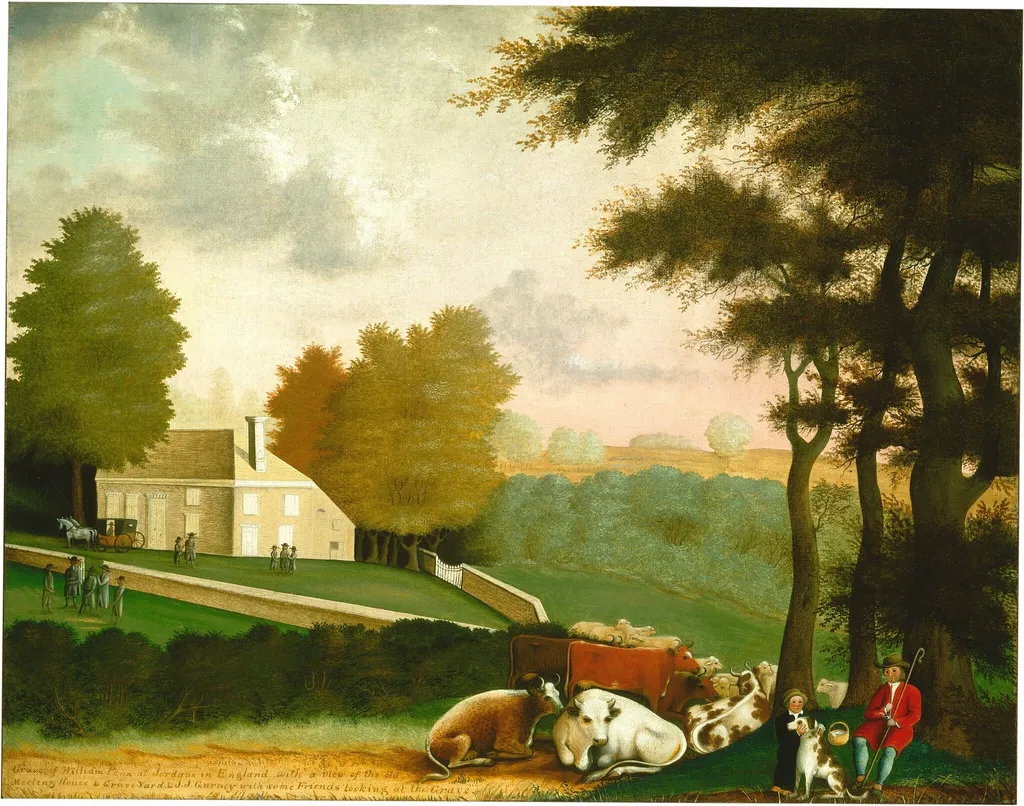
The Grave of William Penn is an oil painting by the American Folk Art artist Edward Hicks. It dates from 1848 and is held in the collection of the National Gallery of Art.
- Inscription
- Inscribed:lower left: Grave of William Penn at Jordans in England with a view of the old / Meeting House & Grave-Yard, & J. J. Gurney with some Friends looking at the Grave.
About this work
Technique & Style
As a work by the American folk painter Edward Hicks, the piece utilizes oil paint to render these formal elements within a horizontal format.
Created in 1848, The Grave of William Penn is an oil painting executed on a canvas support. The work measures 60.4 cm in height and 75.5 cm in width. Stylistically, the composition features a landscape setting that includes specific depictions of a house and a tree.
As a work by the American folk painter Edward Hicks, the piece utilizes oil paint to render these formal elements within a horizontal format. The physical medium consists of oil applied to the canvas, characteristic of the artist's output during this period.
History & Provenance
The Grave of William Penn (1848) is an oil on canvas painting by Edward Hicks, originally linked to Philadelphia merchant Richard Price or his father-in-law Joshua Longstreth, to whom Hicks appears to have been commissioned to portray the site of Penn's burial. After Price's descendant Miss Marian Beans sold the work, it passed through the dealers Robert Carlen and Edith Gregor Halpert's Downtown Gallery before entering the stock of M. Knoedler and Co. and then Joseph Katz in 1944. The painting was acquired in 1947 by Edgar William and Bernice Chrysler Garbisch, who bequeathed it to the National Gallery of Art in 1980.
The painting is held in the collection of the National Gallery of Art in Washington, D.C., having entered the institution in 1980 as a bequest from Edgar William and Bernice Chrysler Garbisch. Prior to this acquisition, the work passed through several dealers, including Robert Carlen in Philadelphia, Edith Gregor Halpert's Downtown Gallery, and M. Knoedler and Co. in New York during the 1940s. Joseph Katz also owned the piece briefly between 1944 and 1947 before selling it back to Knoedler, who subsequently sold it to the Garbisches for their estate at Pokety Farms in Cambridge, Maryland.
Early ownership is attributed to Richard Price of Philadelphia or his father-in-law, Joshua Longstreth, based on curatorial correspondence. The provided sources do not list specific public exhibition records for the work.
Legacy
The Grave of William Penn entered the National Gallery of Art's collection in 1980 after a series of sales that traced its ownership from Hicks's original patron Richard Price through dealers Robert Carlen and M. Knoedler and Co. to the Chrysler Garbisch family, whose bequest transferred the work to the museum. Its provenance, documented in curatorial correspondence, illustrates the painting's journey from a private context to a publicly exhibited piece, reinforcing scholarly interest in Hicks's work. The work's presence in a major American museum has contributed to renewed examinations of Hicks's role in American folk art and early 19th-century visual culture.
Overview
Edward Hicks's 1848 oil on canvas, The Grave of William Penn, depicts the final resting place of the Quaker founder of Pennsylvania. The composition centers on a simple white structure, likely a meeting house or marker, situated beside a large, leafy tree. In the foreground, a gravestone inscribed with "Wm.
Penn" stands beneath the tree's overhanging branches, anchoring the scene in a quiet, contemplative atmosphere. Hicks, a prominent American folk painter and Quaker minister, created this work late in his career, a period during which he frequently revisited themes of peace, religious harmony, and the idealized early history of Pennsylvania. The painting reflects his deep reverence for William Penn's legacy, particularly Penn's advocacy for religious freedom and his peaceful treaties with the Lenape people.
Rather than a literal topographical record, the image serves as a devotional memorial, emphasizing the spiritual significance of Penn's life and the Quaker values he embodied. The work exemplifies Hicks's characteristic style, combining naive perspective with a serene, moralizing narrative that celebrates the founding principles of the colony.
Subject & Meaning
The painting serves as a visual homage to William Penn, the Quaker founder of Pennsylvania, whom Hicks held in high regard. By depicting a simple, serene setting with a gravestone, the artist conveys a profound sense of memory and reverence. The quiet stillness of the scene suggests a personal reflection on Penn's legacy and the enduring spirit of his principles, rather than a literal historical depiction.
Context
Edward Hicks, himself a Quaker minister and self-taught artist, frequently incorporated themes of peace, community, and historical figures important to his faith into his work. The Grave of William Penn exemplifies this practice, offering a contemplative tribute to a pivotal figure in Quaker history. The painting functions as a visual meditation, connecting Hicks's spiritual beliefs with the historical foundations of his community.
Own this work as a print
Artist & collection

Artist
Edward Hicks spent his life caught between two worlds. A Quaker preacher by Sunday and a painter by weekdays, he painted signs and carriages to support his family while quietly building a body of peaceful, crowded…

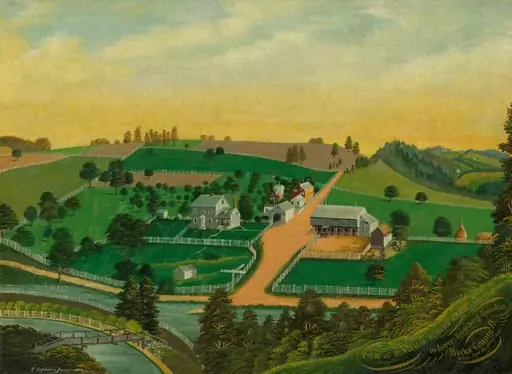 View of Benjamin Reber's Farm
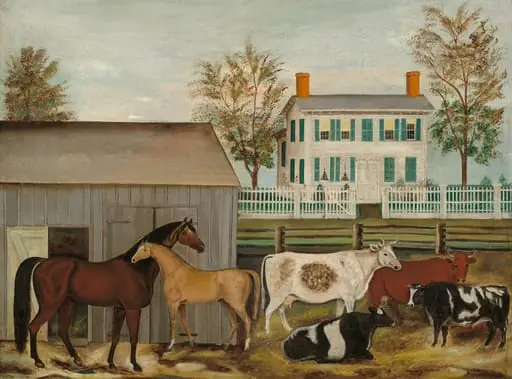 The Barnyard
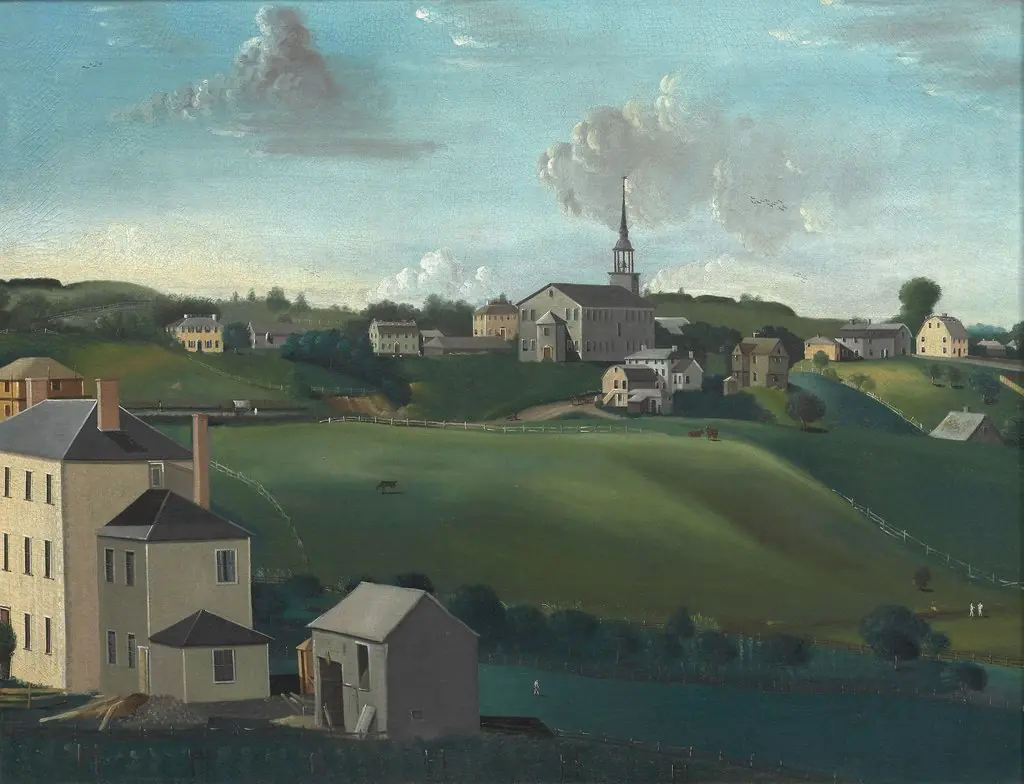 Meetinghouse Hill, Roxbury, Massachusetts
 The seven sisters of Tottenham
 Meetinghouse Hill, Roxbury, Massachusetts
 Farmhouse in Mahantango Valley
 Landscape with a Farm
 New England Village
 Milford, North Wales, Pennsylvania
 Long Island Farmhouses
 New England Country Seat