Artwork
Wildflowers
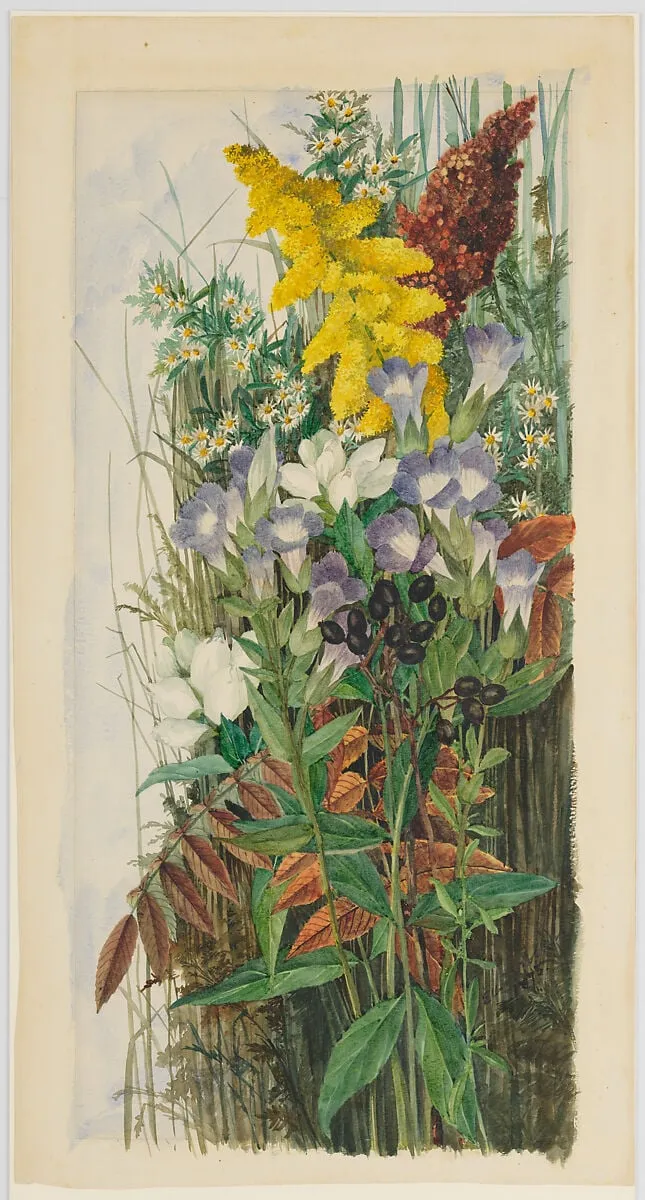
Wildflowers is a watercolor work on paper by the American Impressionist artist Ellen Robbins. It dates from 1875 and is held in the collection of the Metropolitan Museum of Art.
About this work
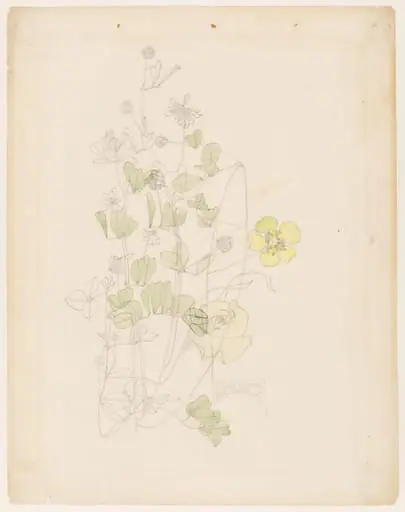
Ellen Robbins packed this 1875 sheet with daisies, buttercups and a sprig of clover.
Ellen Robbins packed this 1875 sheet with daisies, buttercups and a sprig of clover. Their stems bend under the weight of dew. Pinks and yellows pop against the creamy paper.
Robbins squeezed watercolor into gum arabic to keep colors bright. She built up petals in layers, a trick called glazing. The edges stay soft, as if the flowers just grew there.
Look closer: one violet hides behind a dandelion. Check it out at The Metropolitan Museum of Art.
Overview
Wildflowers is a watercolor painting by the American botanical illustrator Ellen Robbins, created in 1875. Measuring 17 13/16 x 8 7/16 inches (45.2 x 21.4 cm), the work is executed in watercolor, graphite, and gum arabic on off-white wove paper, and is held in the collection of the Metropolitan Museum of Art under object number 1998.3. The painting exemplifies Robbins's reputation as one of the foremost American still life painters of the nineteenth century, a status affirmed by art historian Samuel Benjamin, who considered her "one of the finest still life painters in America." The vertical format and meticulous botanical observation reflect both the scientific interests and the aesthetic sensibilities of American watercolor painting in the post-Civil War period, a medium in which Robbins was a pioneering professional woman.
Subject & Meaning
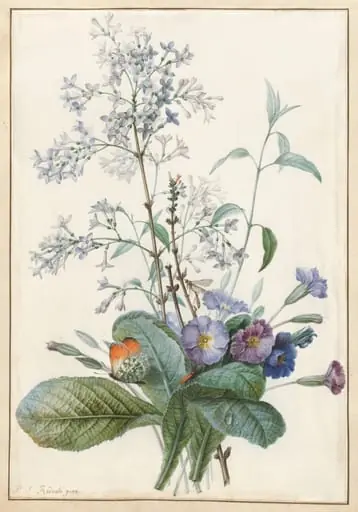
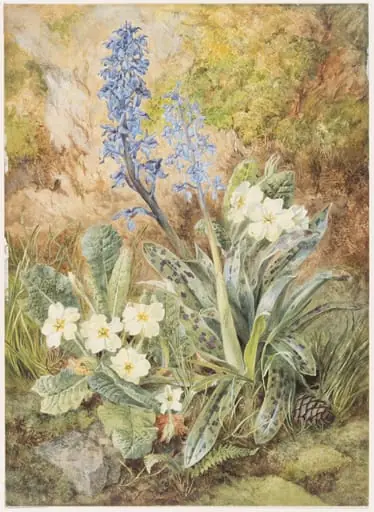
The painting presents a dense, tall arrangement of wildflowers and plants without human or animal figures, concentrating entirely on the natural specimen. At the center, clusters of small yellow flowers dominate the upper middle, flanked by white daisy-like blossoms with yellow centers. Below these sit pale purple and white bell-shaped flowers, possibly gentians, while dark berries on thin stems appear in the lower center. Tall grasses and reeds frame the arrangement on both sides, with feathery green foliage filling the interstices throughout. The background shifts from a pale, washed blue sky on the left to darker, shadowy vertical strokes suggesting dense vegetation on the right. The iconography aligns with Robbins's lifelong devotion to native American flora, particularly wildflowers, which she had collected and painted since her youth. The absence of cultivated garden flowers in favor of uncultivated specimens carries implicit associations with natural authenticity and the American landscape, themes that resonated with contemporary preferences for indigenous subjects over European conventions. The composition's verticality and density suggest an almost devotional attention to the variety and specificity of natural forms.
Technique & Style
Robbins employed watercolor with graphite underdrawing and gum arabic on off-white wove paper, a combination that allowed both precise detail and atmospheric effect. The technique demonstrates precise botanical accuracy in the flower heads and individual leaves, while the background and lower areas show looser, more fluid washes where colors bleed and blend. The paper's white shows through in places, creating luminosity that enhances the naturalistic effect. The palette ranges from bright yellow and soft purple to deep green, russet brown, and black, with careful modulation between these tones. The edges of the painted area are irregular, with visible paper margins that suggest an informal, sketch-like quality despite the overall finish. This combination of tight detail and atmospheric looseness characterizes Robbins's mature style, which one contemporary observer noted was so realistic that bees might light on her flowers. The vertical format, unusual for still life, may reflect the influence of Japanese scroll paintings or the natural growth patterns of the plants themselves, though Robbins's primary concern remained faithful observation rather than formal innovation.
History & Provenance
The painting was created in 1875, a period when Robbins had achieved considerable professional success and was spending summers in Maine at the Appledore House hotel of writer Celia Thaxter, where she painted the flowers of its famous garden. The Metropolitan Museum of Art acquired the work in 1998 through the Maria DeWitt Jesup Fund, with the object number 1998.3, and it is now housed in The American Wing. The specific provenance chain prior to museum acquisition is not recorded in the available sources. The date of 1875 places the work in Robbins's mature period, when she had moved beyond the bound books of flower illustrations that had established her early career and was producing individual works for sale through Boston galleries, particularly Doll & Richards on Summer Street, where her paintings reportedly sold out within weeks. No specific exhibition history for this individual work is documented in the provided sources.
Context
Ellen Robbins (1828-1905) was born in Watertown, Massachusetts, into a family that fell into straitened circumstances after her father's death and the burning of his factory. Largely self-taught after brief study with Stephen Salisbury Tuckerman, she became one of the contributors to the first annual exhibition of the American Watercolor Society in 1867/1868, placing her at the forefront of the medium's rising prestige in America. Her career trajectory, from producing books of flower illustrations sold for $25 each to achieving international recognition, exemplifies the opportunities available to women artists in the decorative and botanical fields during the nineteenth century. The art historian Samuel Benjamin's assessment of her as among America's finest still life painters contrasts with another scholar's comparison of her "harsh edges and forthright local color" to the work of Childe Hassam, a younger artist who would later join her at the Isles of Shoals and even play practical jokes on the more prim Robbins. Her work became fashionable in both America and England, and she diversified into textile designs, china painting, and chromolithographic commissions for Louis Prang in the late 1860s. The 1896 publication of her "Reminiscences of a Flower Painter" in New England Magazine provides rare firsthand documentation of a woman artist's career and working methods.
Legacy
Robbins's legacy rests on her achievement as a professional woman artist in a period when such careers were exceptional, and on the technical virtuosity that made her botanical works prized by collectors including Henry Ward Beecher. Her paintings of wildflowers and autumn leaves, noted for their deceptive realism, influenced the appreciation of native American flora in visual culture and contributed to the broader nineteenth-century interest in natural history illustration. The survival of Wildflowers in the Metropolitan Museum of Art ensures her continued presence in the canon of American art, though scholarly attention has been uneven. Her work is now recognized as part of the American Wing's collection of nineteenth-century watercolors, a medium that gained institutional recognition partly through the efforts of artists like Robbins who demonstrated its potential for serious artistic statement. The painting's accessibility through the Met's Open Access program extends its reach to contemporary audiences and researchers, while her 1896 memoir remains a significant primary source for understanding the working conditions and professional strategies of women artists in the period. Her association with the Isles of Shoals artist colony links her to a significant chapter in American art history, though her more conservative temperament distinguished her from the livelier social circle around Celia Thaxter.
Artist & collection

Artist
Ellen Robbins (1828 – 1905) was a 19th-century American botanical illustrator known for paintings of wildflowers and autumn leaves.