Artwork
Interior with Woman at the Spinning Wheel
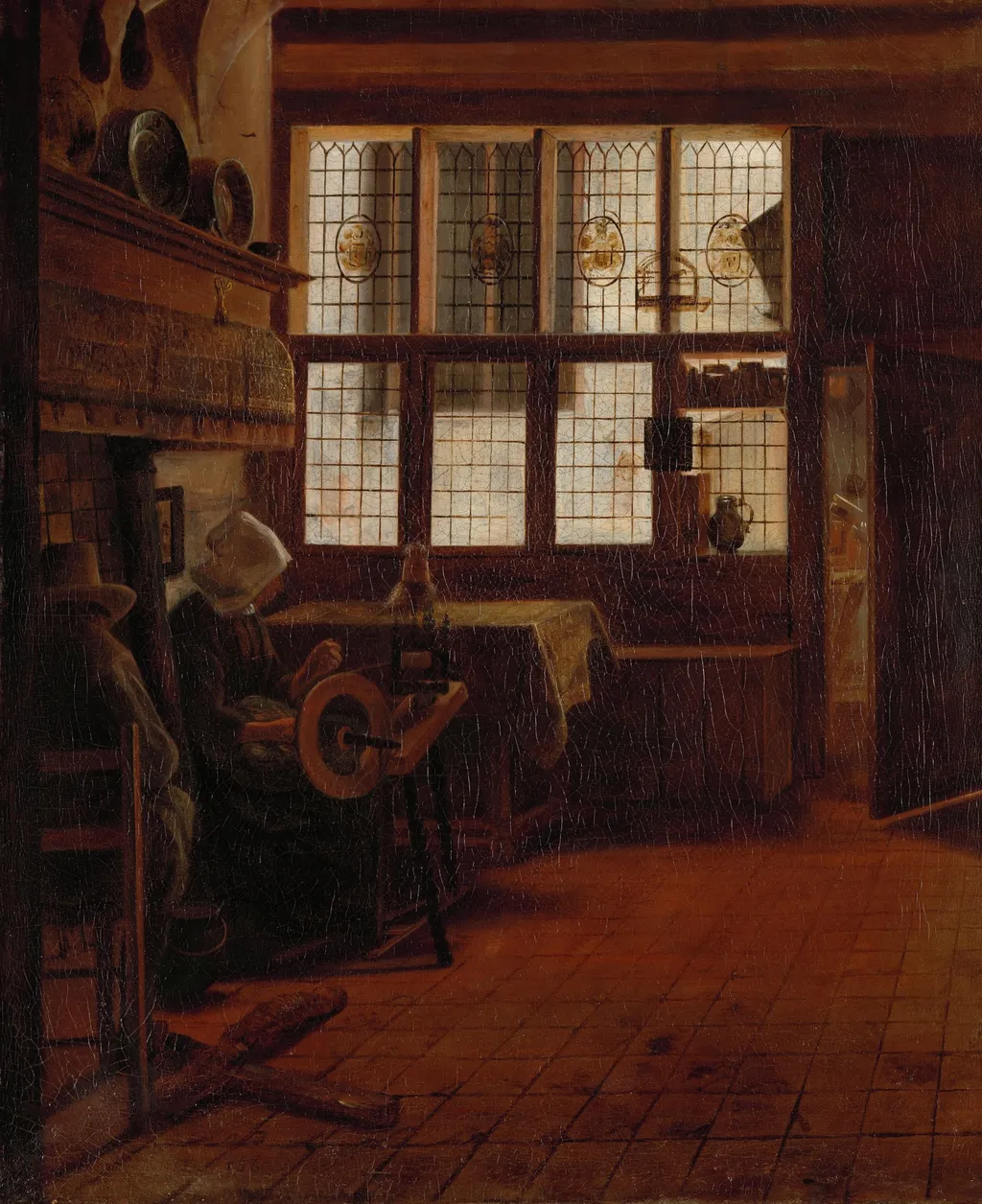
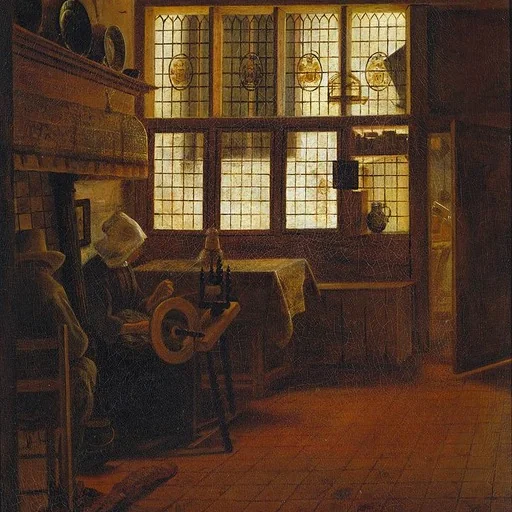
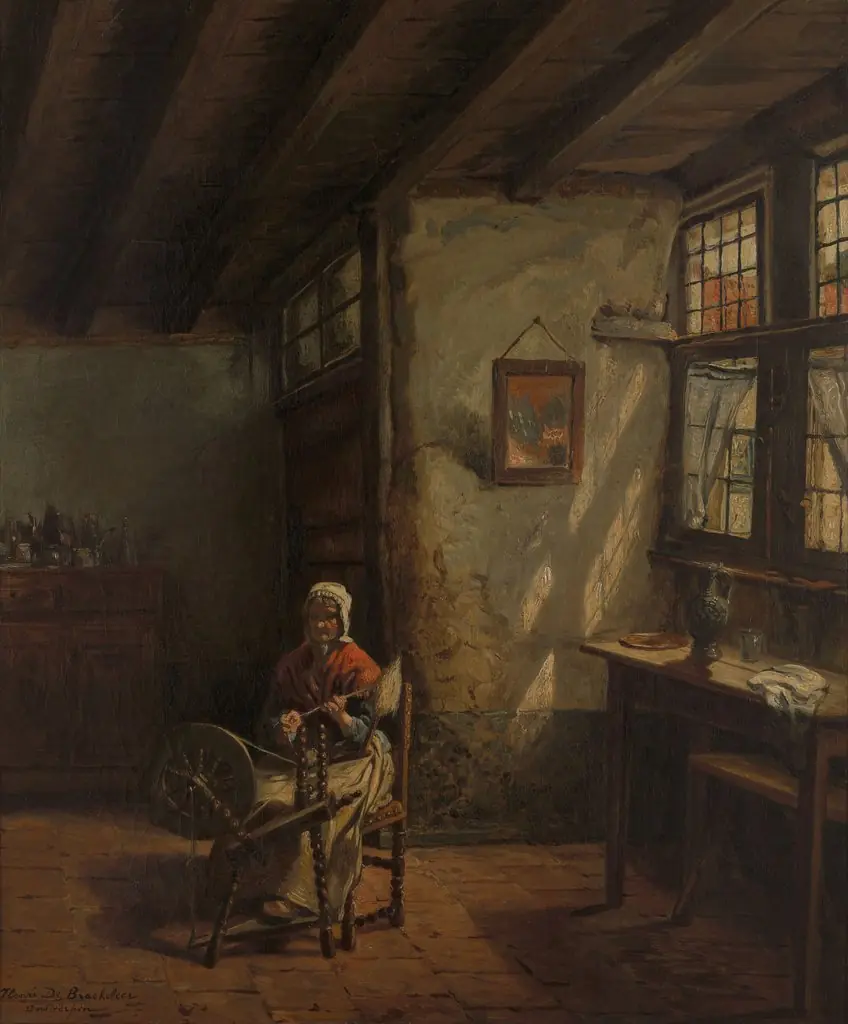
Interior with Woman at the Spinning Wheel is an unspecified painting by the Dutch Golden Age artist Esaias Boursse. It dates from 1661 and is held in the collection of the Rijksmuseum.
About this work
Subject & Meaning
The painting belongs to the tradition of Dutch genre painting, depicting a quiet domestic interior centered on a woman working at a spinning wheel.
The painting belongs to the tradition of Dutch genre painting, depicting a quiet domestic interior centered on a woman working at a spinning wheel. Such scenes of women spinning, sewing, or tending a fireplace formed the core of Esaias Boursse's oeuvre, which dealt principally with family life and household labor. The spinning wheel carried layered meaning in seventeenth-century Dutch art. It was associated with the virtue of *huiselijkheid*, domesticity, diligence, and the moral order of the home, and was frequently used to elevate ordinary women's work into a symbol of industry, chastity, and quiet virtue. By placing a solitary woman at her task within a sober interior, Boursse aligned himself with contemporaries such as Pieter de Hooch, Quiringh van Brekelenkam, and Cornelis de Man, whose restrained compositions similarly celebrated the dignity of everyday domestic routines.
Technique & Style
The painting is executed in oil on canvas, measuring 60 × 49 cm. Its composition centers on a woman at a spinning wheel within a domestic interior, rendered with a restrained palette dominated by muted grays, bluish grays, and yellowish browns. The handling emphasizes quiet, planar recession, with carefully balanced light that models forms subtly and organizes space through controlled contrasts rather than dramatic chiaroscuro. The room’s geometry, doorways, floor tiles, and furniture, supports a restrained, almost still-life-like harmony, aligning with mid-seventeenth-century Dutch interior traditions.
History & Provenance
Esaias Boursse created the painting *Interior with Woman at the Spinning Wheel* in 1661. The work is executed in oil on canvas and measures 60 × 49 cm. It is currently held in the collection of the Rijksmuseum in Amsterdam. The creation of this piece occurred during a specific period in the artist's life; in 1661, Boursse departed Amsterdam to sail with the Dutch East India Company to Ceylon, a journey that lasted until 1663. Consequently, the painting was likely produced shortly before his departure or during his initial preparations for the voyage, reflecting his focus on domestic genre scenes prior to his time abroad.
Interior with Woman at the Spinning Wheel, painted in 1661 by Esaias Boursse, is held in the Rijksmuseum Amsterdam collection. It bears the inventory number SK-A-2650. The work was exhibited in the Rijksmuseum's 1984 exhibition "Dutch Masters of the Seventeenth Century" and again in the 2015 exhibition "Dutch Golden Age: The Art of Esaias Boursse".
Context
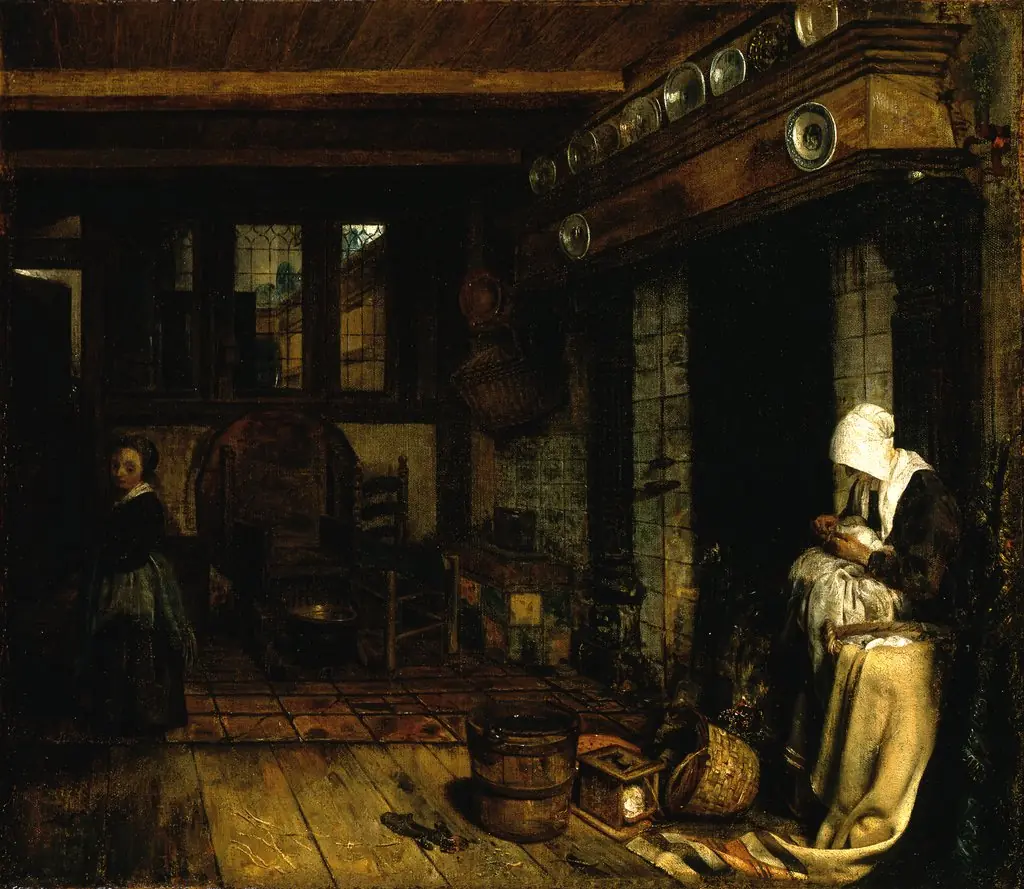
Esaias Boursse (1631-1672) was a Dutch Golden Age painter who worked primarily as a genre artist, producing intimate domestic interiors featuring women engaged in household tasks such as spinning, sewing, and cooking. His stylistic affinities lie with the Delft school painters Pieter de Hooch, Quiringh van Brekelenkam, and Cornelis de Man, and his interiors are also compared to those of Jacobus Vrel. Earlier art historians placed Boursse among Rembrandt's pupils because the two lived on the same Amsterdam street, the Sint Antoniebreestraat, but no objective evidence supports this apprenticeship. About 28 paintings survive from his oeuvre, the majority held in private collections, with examples in the Rijksmuseum Amsterdam, the Wallace Collection, the Suermondt-Ludwig-Museum in Aachen, and the Gemäldegalerie in Berlin. Boursse could not support himself through painting alone, a situation comparable to that of Jan Steen and Johannes Vermeer, and he twice sailed with the VOC, dying at sea in 1672 aboard the Rhenen. Scholarship on the artist includes entries by Wilhelm Martin in Thieme-Becker's Künstlerlexikon and by Fred G. Meijer in the Allgemeines Künstlerlexikon.
Own this work as a print
Artist & collection