Artwork
North African Landscape
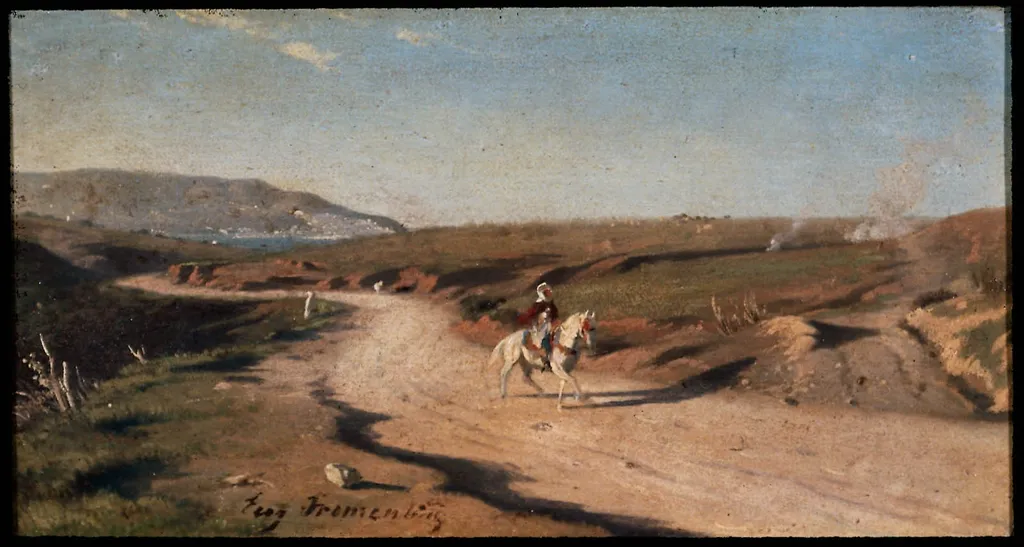
North African Landscape is an unspecified painting by the Orientalist artist Eugène Fromentin. It dates from 1847 and is held in the collection of the Museum of Fine Arts Boston.
About this work
Overview
Painted in 1847 by Eugène Fromentin, this landscape captures a solitary figure on horseback traversing a barren, undulating terrain in North Africa.
Painted in 1847 by Eugène Fromentin, this landscape captures a solitary figure on horseback traversing a barren, undulating terrain in North Africa. The work is part of the permanent collection at the Museum of Fine Arts, Boston. It reflects the artist’s early engagement with the region, informed by his travels, and presents a quiet, contemplative view of the environment rather than a dramatic or exoticized scene.
Subject & Meaning
The lone rider, cloaked in red, moves along a winding path through sparse vegetation and rolling hills. The figure is small against the vastness of the land, suggesting solitude and the quiet passage of time. The absence of narrative detail invites reflection on human presence within an indifferent landscape, emphasizing stillness over action. The red cloak serves as a subtle focal point, drawing attention without disrupting the scene’s calm.
Technique & Style
Fromentin employed soft, blended brushwork to unify the palette of muted browns, greens, and pale blues. The transitions between light and shadow are gentle, avoiding harsh contrasts, which contributes to the atmosphere of serenity. The horizon is low, allowing the sky to dominate, while the road’s curvature guides the eye into the distance. The technique favors atmospheric cohesion over precise detail, enhancing the sense of quiet immersion.
History & Provenance
Created during Fromentin’s first journey to Algeria, the painting reflects direct observation rather than studio invention. It entered the Museum of Fine Arts, Boston, in the late 19th century through a private acquisition. The work remained relatively obscure until the 20th century, when scholars began to reassess Fromentin’s role in bridging Romanticism and early Orientalist realism in French painting.
Context
In the mid-19th century, European artists increasingly turned to North Africa as a subject, drawn by its perceived exoticism and light. Fromentin’s approach, however, diverged from theatrical Orientalism; he favored understated observation, influenced by his interest in local life and landscape. His work contributed to a more nuanced, less stereotypical representation of the region within French art of the period.
Legacy
Fromentin’s North African Landscape helped shape a quieter, more introspective strand of Orientalist painting. Rather than emphasizing spectacle, it offered a meditative view of the land and its sparse inhabitants. Later artists and critics recognized its influence on the development of landscape painting that prioritized mood and atmosphere over narrative or exotic detail.
Artist & collection

- South Downs
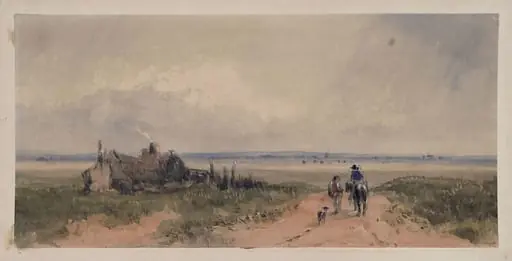 Landscape with cottage, and figures on a sandy road
 Landscape
 Arabs and their Camels surprised by Cavalry
 Landscape with Bridge, Figures and Cattle
 General Garibaldi's Residence at Caprera
 Greeting Kraków
 Jericho Plain of Gilgal, Jordan, Dead Sea, and Mountains of Moab
 The Downs, near Storrington, Sussex
 Snowy Range and Foothills from the Valley of Valmo
 Civitella Seen from the North
 False Bay from Wynberg Hill, Cape of Good Hope