Artwork
Arab Encampment
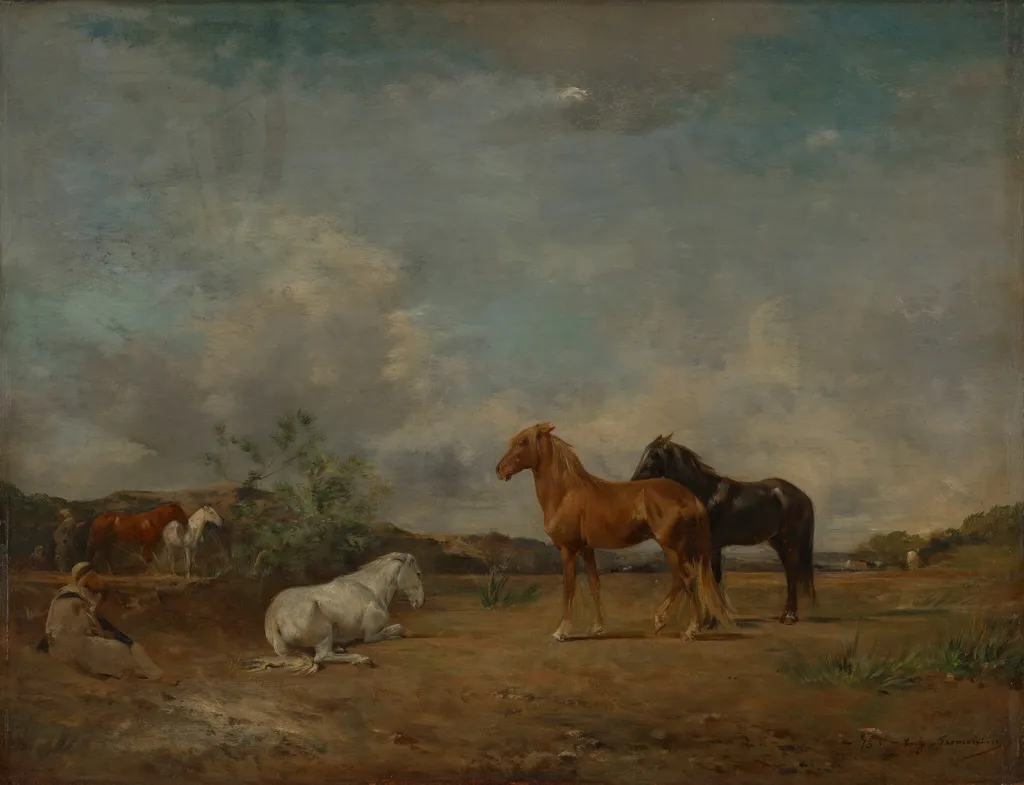
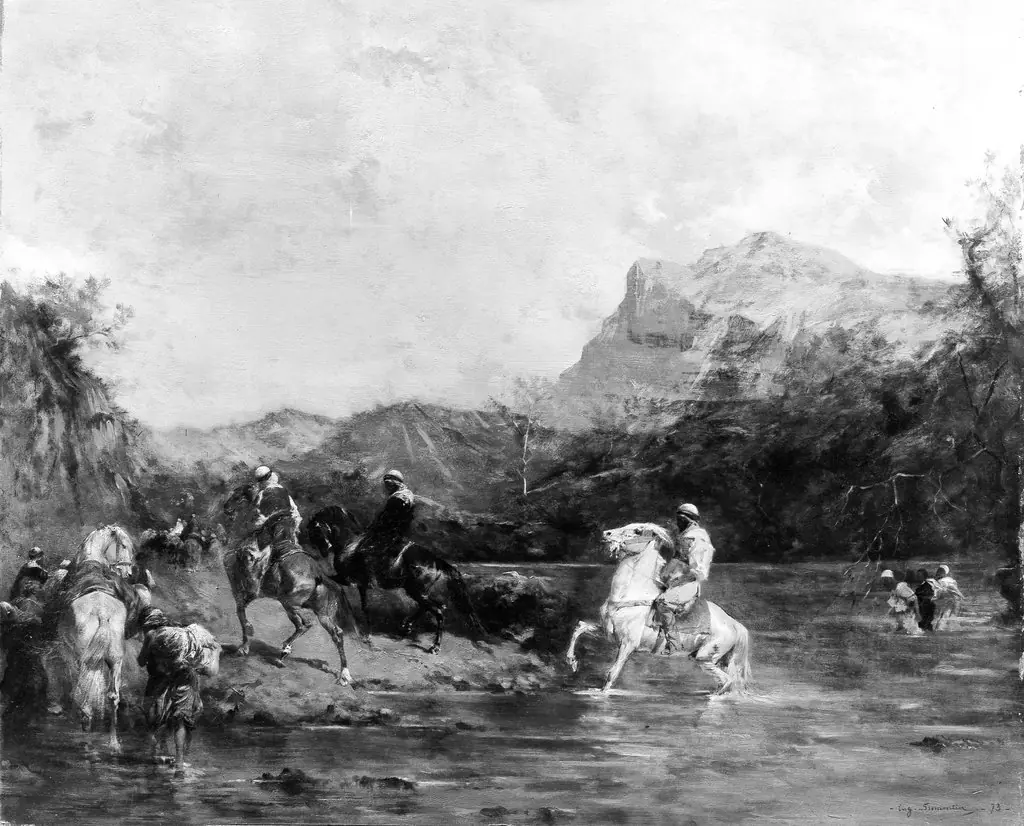
Arab Encampment is an oil painting by the Impressionist artist Eugène Fromentin. It dates from 1873 and is held in the collection of the National Gallery of Art.
- Inscription
- Inscribed:lower right: -.73. Eug - Fromentin
About this work
Technique & Style
The work demonstrates his characteristic handling of light and atmospheric perspective, rendering the desert encampment with precise yet lyrical detail.
Eugène Fromentin painted Arab Encampment in 1873 using oil on wood, creating a compact support measuring 31.75 by 41.28 centimeters. The work demonstrates his characteristic handling of light and atmospheric perspective, rendering the desert encampment with precise yet lyrical detail. Fromentin's technique emphasizes textured brushwork to suggest the rugged terrain and the subtle gradations of desert illumination.
History & Provenance
Eugène Fromentin executed Arab Encampment in 1873 as an oil painting on wood. The work entered the collection of Edward C. Walker and Mary Griffin Walker, who resided at Willistead Manor in Walkerville, Ontario, and Washington. Following Mary Griffin Walker's death, the painting was bequeathed to the Corcoran Gallery of Art in Washington on May 4, 1937.
Decades later, the institution transferred the artwork to the National Gallery of Art in 2015, where it remains part of the permanent collection.
Arab Encampment entered the collection of the Corcoran Gallery of Art in Washington through the bequest of Edward C. Walker (d. 1915) and Mary Griffin Walker (1855–1937) of Willistead Manor, Walkerville, Ontario, and Washington, transferred on 4 May 1937. The painting was subsequently acquired by the National Gallery of Art in 2015, where it is currently held. No exhibition history is recorded in the available sources. documents the provenance and current ownership, while confirms the painting's location at the National Gallery of Art in Washington, D.C., and its prior association with the Corcoran Gallery of Art collection.
Overview
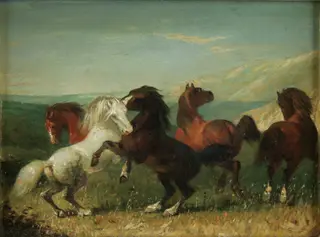
Eugène Fromentin's Arab Encampment, executed in 1873 on wood panel, depicts a serene moment in the North African desert. The composition centers on a small group of four horses, two brown, one black, and one white, standing or resting on sandy terrain alongside a solitary figure. Fromentin arranges these elements against a backdrop of soft blue and white skies with scattered clouds, while distant hills and sparse trees delineate the horizon.
The work exemplifies the artist's mature style, characterized by a restrained palette and a focus on atmospheric light rather than dramatic narrative action. Painted during a period when Fromentin had largely retired from active painting to pursue literary criticism, this piece reflects his enduring fascination with Algerian landscapes and the quiet dignity of daily life in the region. The choice of wood as a support suggests an intimate scale, emphasizing the artist's precise brushwork and attention to the textures of the animals' coats and the arid ground.
This painting stands as a representative example of French Orientalist art, prioritizing observational accuracy and mood over exoticized spectacle.
Subject & Meaning
The composition centers on the quiet coexistence of man and animal within an arid landscape, suggesting a moment of repose during a journey across the desert. The lone figure, though minimally detailed, anchors the scene, while the varied horses convey both the diversity of the caravan and the subtle rhythms of travel in a harsh environment.
Own this work as a print
Artist & collection