Artwork
Peasant on Horseback
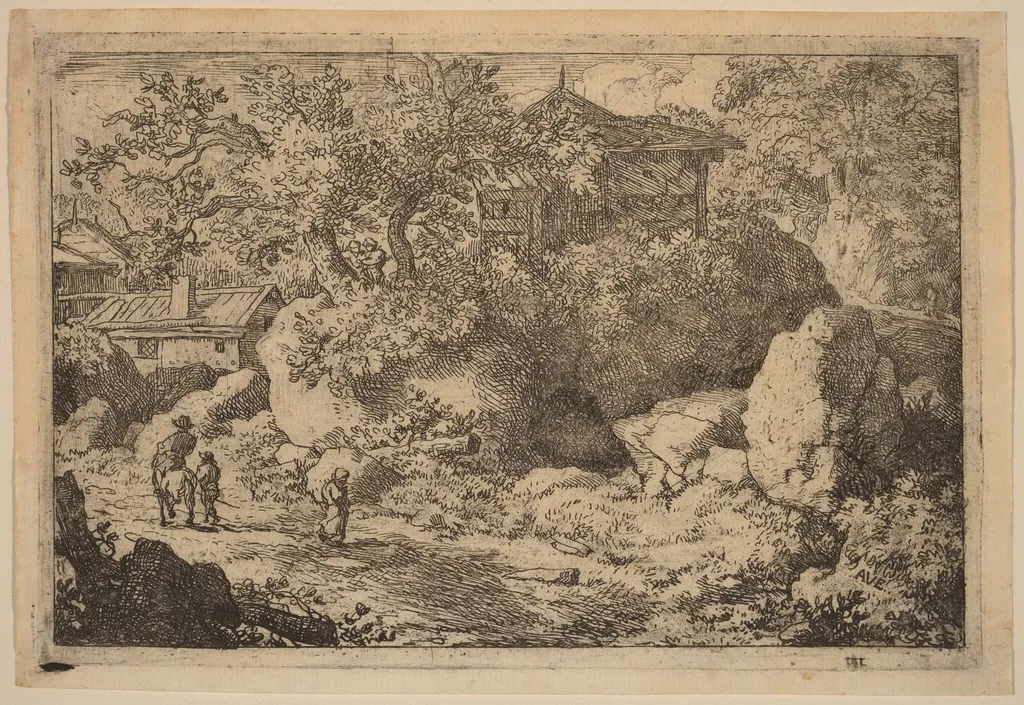
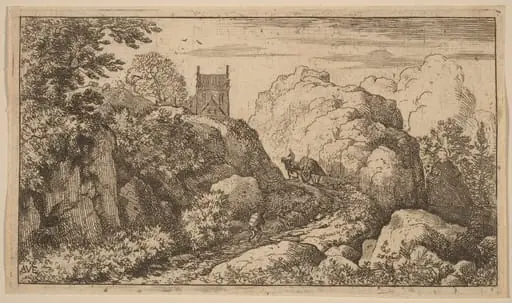
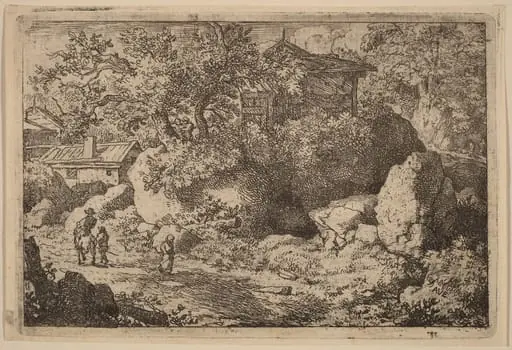
Peasant on Horseback is an ink print by the Baroque artist Allart van Everdingen. It dates from 1650 and is held in the collection of the National Gallery of Art.
About this work
Overview
The composition is framed by dense, textured trees and jagged rocky outcrops, characteristic of Everdingen's fascination with Scandinavian-inspired landscapes.
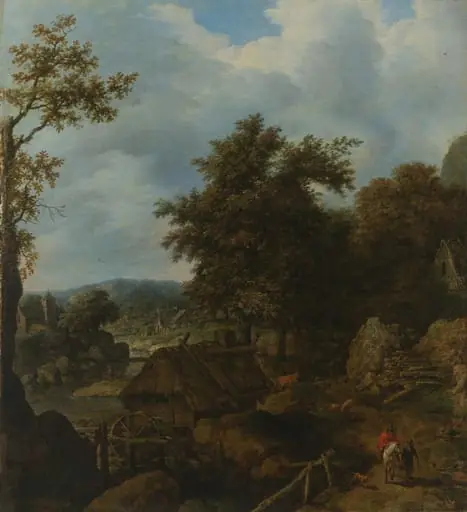
Peasant on Horseback is a 1650 etching by the Dutch Golden Age artist Allart van Everdingen. The work depicts a solitary rider mounted on a horse, guiding two additional horses along a winding, rugged path. The composition is framed by dense, textured trees and jagged rocky outcrops, characteristic of Everdingen's fascination with Scandinavian-inspired landscapes.
In the background, a small bridge and modest buildings are nestled within the terrain, adding depth to the scene. Executed in black and white, the print demonstrates the artist's mastery of etching techniques to render varied textures, from the roughness of the stone to the foliage of the forest. Created during the height of Everdingen's career, this piece reflects his significant contribution to Dutch landscape art, particularly his introduction of northern European mountainous scenery to a market accustomed to flat, pastoral views.
The work exemplifies the artist's ability to convey atmospheric density and dramatic topography through the precise control of line and cross-hatching, establishing a distinct visual identity within 17th-century printmaking.
Subject & Meaning
The central figure is a peasant, identifiable by his simple attire and practical mount, suggesting everyday rural life rather than heroic or mythic narrative. The inclusion of auxiliary horses and a modest built environment hints at a working scene, perhaps a farmer moving livestock through challenging terrain.
Technique & Style
Executed through etching, the artist incised the image onto a metal plate, allowing for delicate, precise lines that convey texture, leafy foliage, craggy stone, and rippling water. The interplay of line weight creates a sense of depth, giving the trees and hills a near‑three‑dimensional presence within the flat medium.
History & Provenance
The work originates from the Dutch Golden Age, a period when printmaking flourished alongside painting. Though the artist’s name is not inscribed on the plate, stylistic analysis links it to the oeuvre of a Dutch printmaker active in the mid‑17th century, known for both etchings and mezzotints.
Context
During the mid‑1600s, Dutch artists frequently depicted agrarian subjects, reflecting the Republic’s prosperous countryside and its cultural emphasis on modest, industrious life. This print aligns with that tradition, offering a visual record of rural mobility and landscape.
Own this work as a print
Artist & collection
Artist
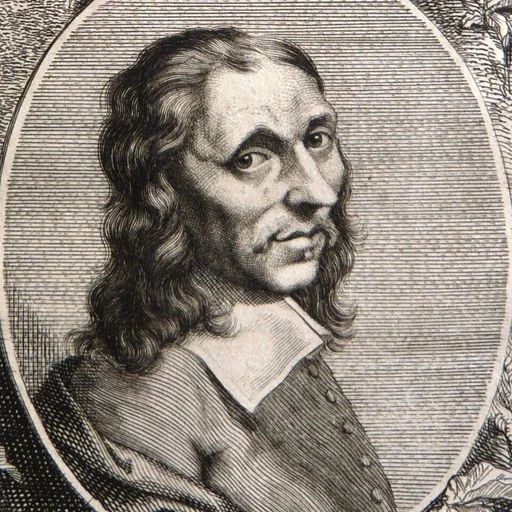
Allaert van Everdingen (Dutch pronunciation:; bapt. 18 June 1621 – 8 November 1675 (buried)), was a Dutch Golden Age painter and printmaker in etching and mezzotint.