Artwork
Bathsheba Bathing
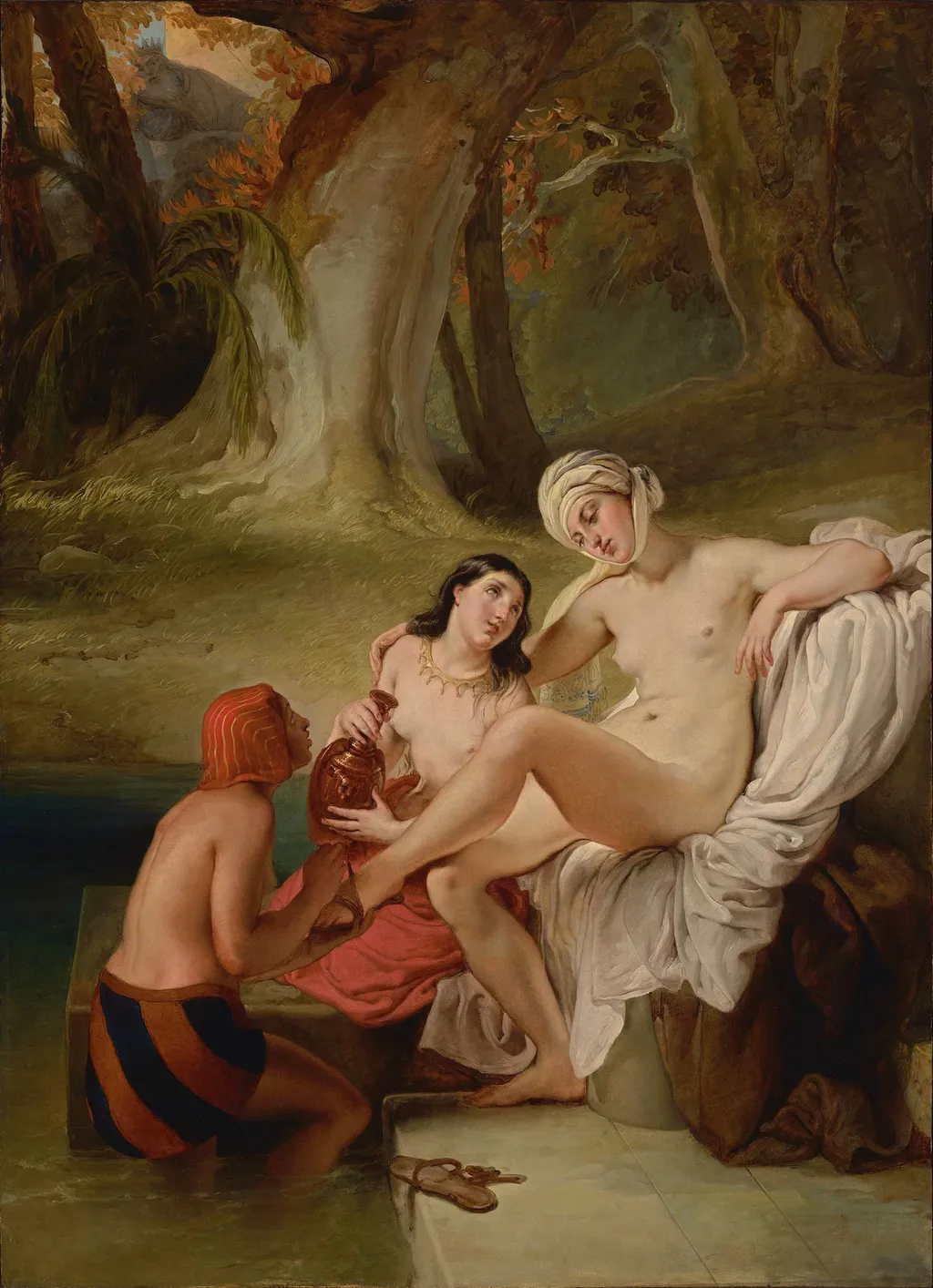
Bathsheba Bathing is an oil painting by Francesco Hayez. It dates from 1834 and is held in the collection of the Pinacoteca di Brera.
About this work
Subject & Meaning
The chromatic treatment is mostly cool, with warmth concentrated in the servants' red skirts, while light foregrounds the bodies against a shadowed background.
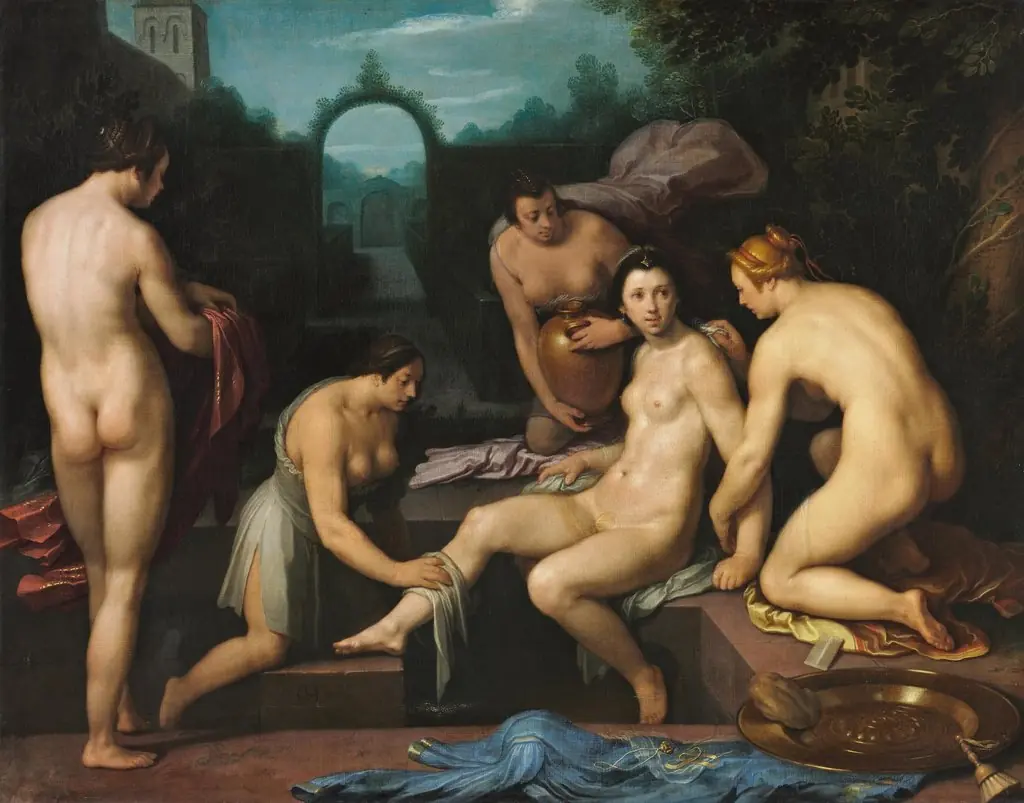
The painting depicts the biblical story of Bathsheba, wife of Uriah, bathing outdoors, a subject drawn from the Old Testament that became popular from the Renaissance onward. Hayez presents the scene within a forest setting beside a body of water, where Bathsheba sits partially nude, wearing only Israelite bandages in her hair, while two topless attendants serve her: one holds a vessel of balmy oils to cleanse her skin, while the other, immersed to her knees, removes Bathsheba's sandal.
The work merges history painting, religious narrative, and the artistic nude with an orientalist atmosphere. One attendant wears Egyptian-style skirt and headdress with darker complexion, emphasizing exoticism. King David appears barely visible among the upper left foliage, spying from above, the crucial detail that distinguishes this from a generic bathing scene.
The chromatic treatment is mostly cool, with warmth concentrated in the servants' red skirts, while light foregrounds the bodies against a shadowed background. Hayez rendered the figures naturalistically, drawing on seventeenth-century Italian models like Guido Reni and Domenichino.
Technique & Style
Francesco Hayez executed Bathsheba Bathing using oil paint on canvas, a medium choice that facilitated the naturalistic rendering of human forms and textures characteristic of the 1834 version. The work exemplifies the ascendant Romanticism of the period, blending historical-religious narrative with the artistic nude and orientalist themes. Hayez employed a predominantly cool chromatic scheme, punctuated only by the red skirts of the attendants, while utilizing shadowed backgrounds to accentuate the luminosity of the figures in the foreground.
The composition features Bathsheba with darker skin and Egyptian-style dress, contrasting with the Caucasian features of her attendants, a stylistic decision that reinforces the scene's orientalist character. The artist's handling of the bodies draws upon models from 17th-century Italian painters such as Guido Reni and Domenichino, resulting in an idealized beauty that anticipates his later purist style.
History & Provenance
Francesco Hayez created the first version of Bathsheba Bathing in 1834. This initial work was originally held in the Uboldo collection before passing to the Malinverni collection in Lugo Vicentino. Hayez had previously treated the subject in 1827 for William I of Württemberg, but the 1834 composition represents a distinct iteration.
A second version of the painting was produced around 1845 with slightly reduced dimensions. This later variant entered the Milanese Academy through a bequest from Marchese Ala Ponzoni in 1889 and subsequently became part of the Pinacoteca di Brera collection. A preparatory study in graphite, pen, and ink from 1834, which features compositional differences such as the presence of palm trees and a visible palace balcony, is preserved in the Civic Cabinet of Drawings at the Sforza Castle in Milan.
Francesco Hayez created two versions of Bathsheba Bathing with distinct holding histories. The original 1834 painting is currently held in a private collection; it previously belonged to the Uboldo collection and later passed to the Malinverni collection in Lugo Vicentino. A second version, executed around 1845, is housed in the Pinacoteca di Brera in Milan.
This later work entered the Milanese academy's holdings in 1889 following a bequest from Marchese Ala Ponzoni, eventually becoming part of the Pinacoteca's permanent collection. The 1845 version is specifically cited as being on display at the Pinacoteca di Brera.
Context
Francesco Hayez's treatment of Bathsheba reflects the ascendancy of Romanticism in the 1830s, merging religious history with the artistic nude. The subject was a established tradition since the Renaissance, yet Hayez infused the 1834 composition with Orientalist elements, distinguishing the protagonist through Egyptian-style attire and darker complexion against her attendants. Contemporary critics received the work favorably, with the 1834 issue of Ricoglitore italiano e straniero offering extensive praise for its specific details.
Art historically, the painting's naturalistic rendering of the human form draws upon seventeenth-century Italian models like Guido Reni and Domenichino, while the idealized facial features anticipate the Purist style Hayez would adopt in later years. The existence of an earlier version painted for William I of Württemberg in 1827 demonstrates the artist's recurring engagement with this biblical narrative.
Overview
Francesco Hayez’s oil painting titled Bathsheba Bathing was executed in 1834. The work portrays the biblical episode in which King David observes Bathsheba while she is bathing, a subject that has attracted artists since the Renaissance. Hayez’s version reflects the Romantic sensibilities emerging in Italy during the early 1830s.
Own this work as a print
Artist & collection

Artist
Francesco Hayez (Italian:; 10 February 1791 – 12 February 1882) was an Italian painter.