Artwork
Bathsheba
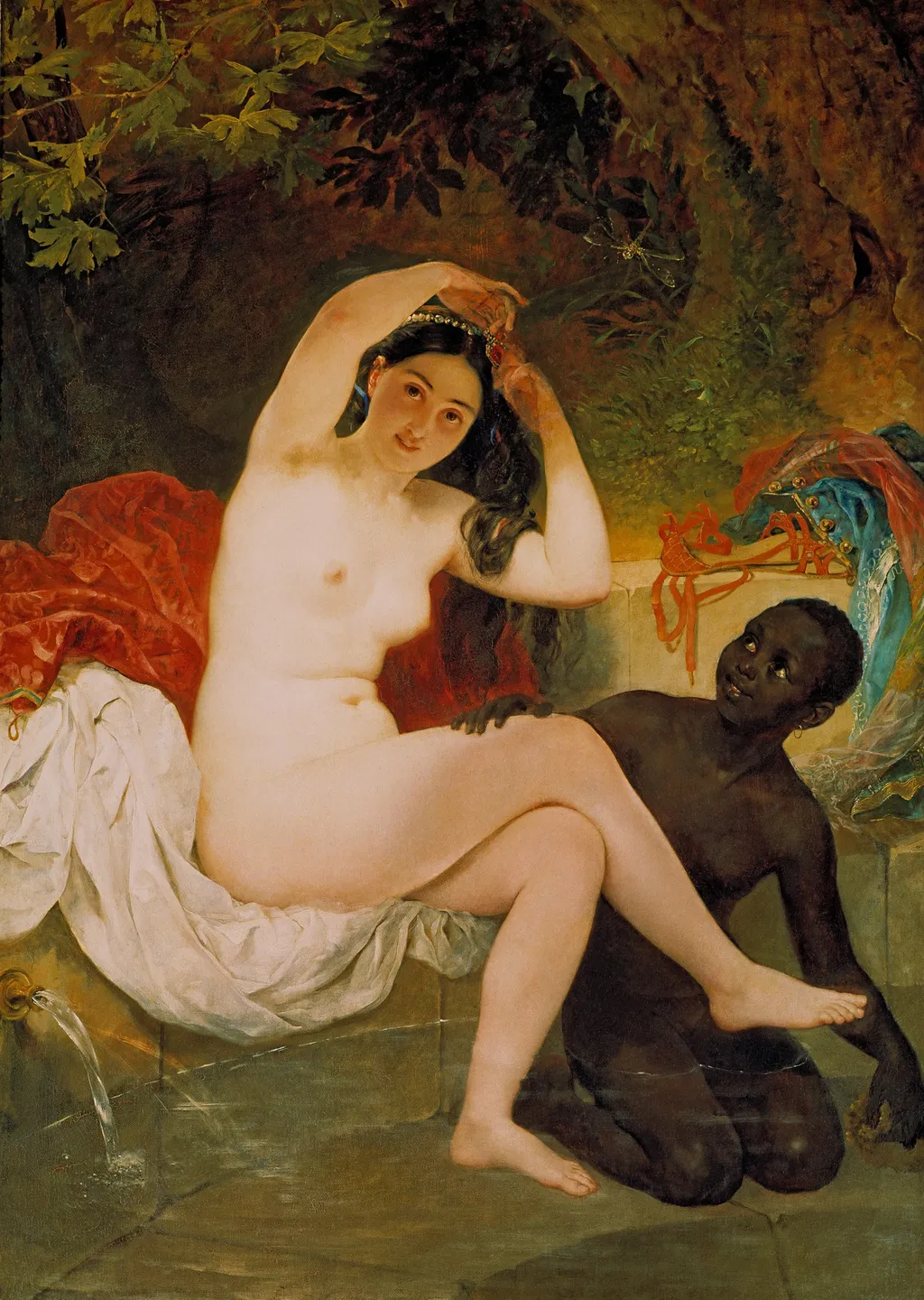
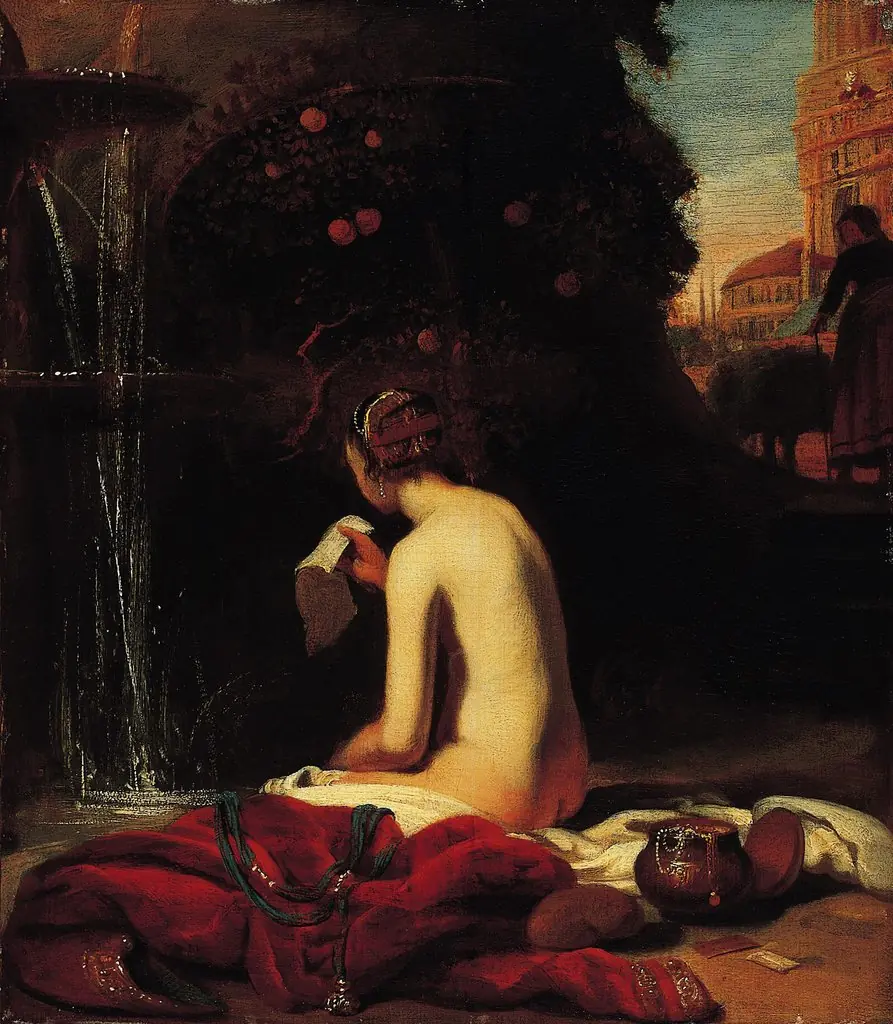
Bathsheba is an oil painting by Karl Bryullov. It dates from 1832 and is held in the collection of the Tretyakov Gallery.
About this work
Subject & Meaning
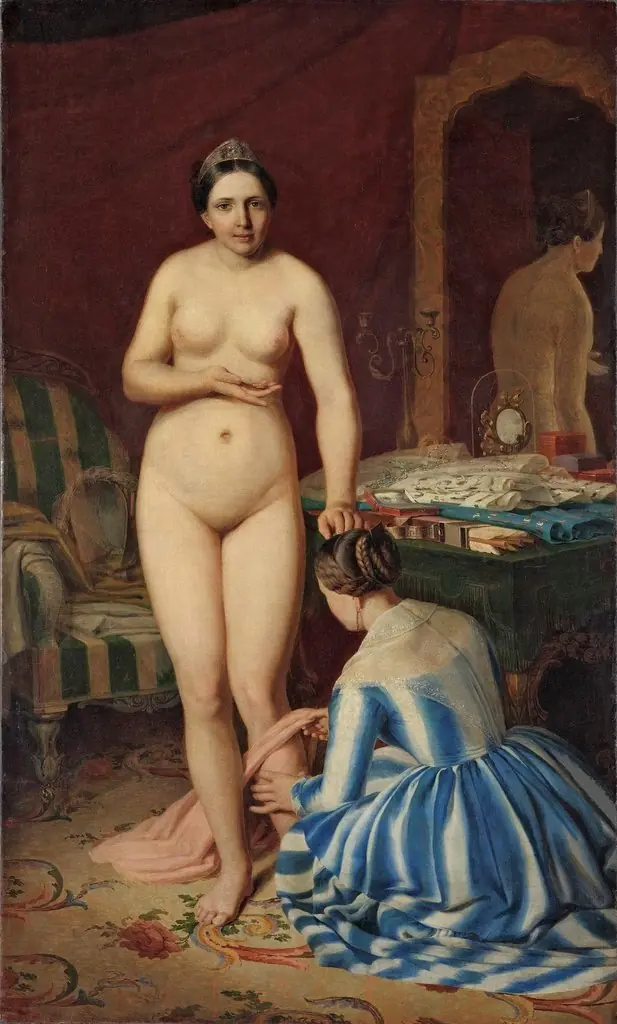
Karl Bryullov's 1832 painting depicts the biblical figure Bathsheba, wife of Uriah the Hittite, at the precise moment King David notices her bathing.
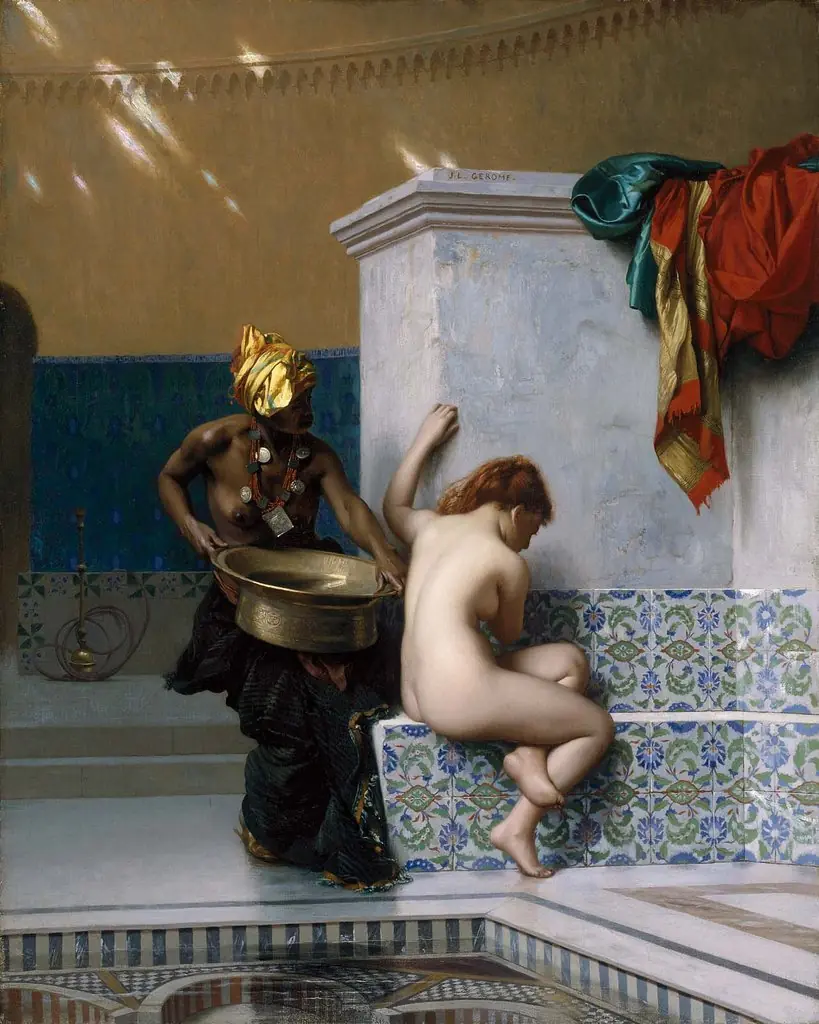
Karl Bryullov's 1832 painting depicts the biblical figure Bathsheba, wife of Uriah the Hittite, at the precise moment King David notices her bathing. The scene is set outdoors near a fountain and trees, showing the nude protagonist removing a diadem while a dark-skinned servant washes a sponge. Iconographically, the work emphasizes the narrative of seduction through specific visual cues: Bathsheba's direct gaze toward the viewer simulates the encounter with David, while the lighting strategy highlights her pale body against the shadowed face and the darker servant, creating a stark chromatic contrast.
The composition decontextualizes the historical event into an idyllic, classicizing study of the nude. Symbolically, the arrangement of discarded clothing and the intense, participatory gaze transform the religious story into a moment of voyeuristic tension, capturing the instant of desire that leads to the conception of Solomon.
Technique & Style
Bathsheba is an oil painting on canvas by Karl Bryullov, executed in 1832 and left unfinished. The canvas measures 173 cm in height by 125.5 cm in width. The composition is set outdoors beside a bathing pool near a wooded area, with the figure of Bathsheba placed in strong luminous relief against a darker, indistinct background and the figure of her dark-skinned attendant.
Bryullov applies colour in vivid, loosely connected patches characteristic of his early manner, and the chiaroscuro is pronounced: the protagonist's body is bathed in light while her face is cast in shadow, an effect that stages the gaze of the viewer as that of King David. The contrast between Bathsheba's pale skin and her attendant's darker complexion further heightens the modelling. The painting is considered the last and finest example of Bryullov's initial classicising, idyllic style before his work turned toward a more mature nineteenth-century sensibility.
History & Provenance
The painting titled Bathsheba was executed by Karl Bryullov in 1832 as an unfinished oil on canvas depicting the biblical figure at her bath. The unfinished work has been housed in the Tretyakov Gallery in Moscow, where it remains part of the museum's collection. Historical records indicate that an engraving based on this composition was later produced by the Ukrainian poet and artist Taras Shevchenko.
Context
Karl Bryullov's Bathsheba (1832) occupies a pivotal place in the transition from neoclassical idealism to Romantic sensibility in Russian art. Scholars highlight its dual focus on biblical narrative and sensual immediacy, a hallmark of Bryullov's early style. The painting's composition, particularly the stark chiaroscuro and the protagonist's direct gaze, invites viewers into King David's voyeuristic perspective.
The contrast between Bathsheba's luminous skin and the servant's darker complexion further underscores Bryullov's experimentation with light and modelling. While rooted in classical conventions, the work anticipates the artist's later shift toward more emotive, 19th-century realism, cementing its significance in the evolution of Russian historical painting.
Legacy
Karl Bryullov's Bathsheba (1832) became a touchstone for later Russian academic and realist painting, chiefly through its reinterpretation of biblical narrative as a pretext for the female nude. The work's unfinished state and bold chiaroscuro influenced Taras Shevchenko, who executed an engraving after it, extending its reach into Ukrainian graphic arts. Critics have underscored its pivotal role in Bryullov's own development: it marked the culmination of his early, classically inflected manner before he turned toward a more dramatic, nineteenth-century idiom.
The painting's provocative gaze, Bathsheba's direct address to the viewer, was later echoed in salon and Orientalist works that similarly eroticised sacred subjects.
Overview
This oil painting, titled Bathsheba, presents a reclining female figure in a natural setting, engaged in drying her hair. A young child kneels behind her, observing the scene. The composition features a blend of vibrant foliage and a decorative blue curtain, establishing a specific atmosphere for the intimate portrayal.
Own this work as a print
Artist & collection
Artist
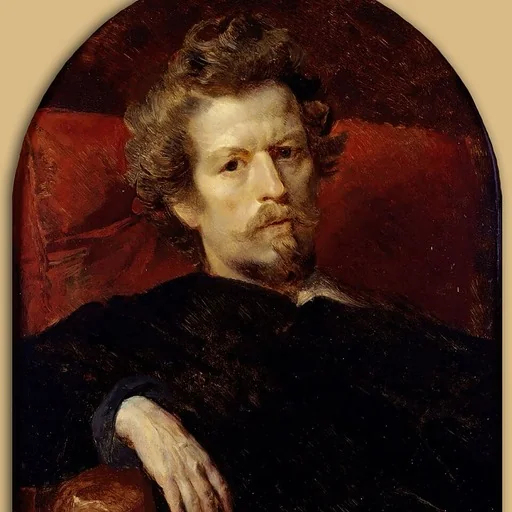
Karl Pavlovich Bryullov (né Brüllo; Russian: Карл Па́влович Брюлло́в; 23 December 1799 – 23 June 1852) was a Russian painter and draughtsman during the Romantic period, remembered among the greatest visual artists in the history of Russian…