Artwork
Bathsheba at her toilet
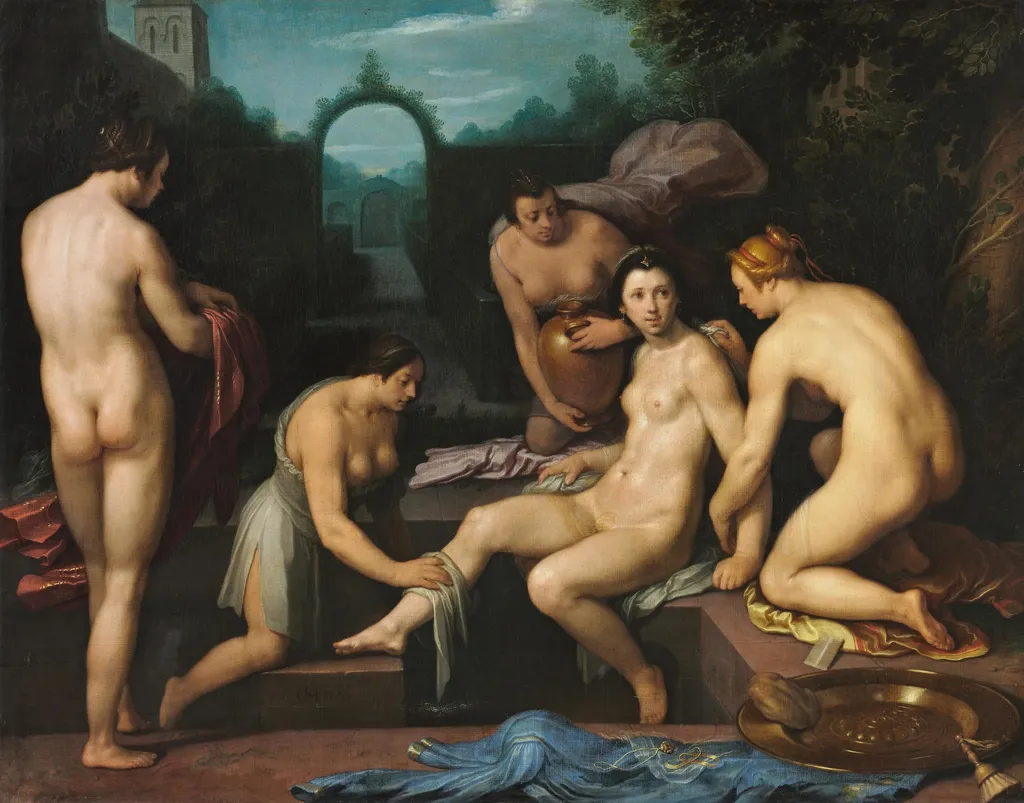
Bathsheba at her toilet is an oil painting by the Early Baroque Italian artist Cornelis van Haarlem. It dates from 1600 and is held in the collection of the Gemäldegalerie Berlin.
About this work
Subject & Meaning
The work's iconography emphasizes the female form, explicitly rendering details such as the breast, nipple, and navel.
Cornelis van Haarlem's 1600 oil painting depicts the biblical figure Bathsheba during her bath, a scene categorized within religious art that also incorporates elements of genre painting and the nude. The composition centers on Bathsheba as the main subject, shown sitting while washing, surrounded by domestic workers and set against a backdrop featuring a tree, a fountain, and a sky with clouds. The work's iconography emphasizes the female form, explicitly rendering details such as the breast, nipple, and navel.
By combining a scriptural narrative with a focus on the physical body and domestic intimacy, the painting represents the moment of Bathsheba's exposure, blending sacred history with the visual conventions of the era's genre art.
History & Provenance
Cornelis van Haarlem created the oil-on-canvas painting Bathsheba at her toilet in the year 1600. The work depicts the biblical figure Bathsheba in a religious and genre context, characterized by its dimensions of 102 cm in height and 130 cm in width. While the specific commission details and the initial ownership chain are not recorded in the available sources, the painting's provenance is currently defined by its institutional home.
The artwork is held in the collection of the Gemäldegalerie Berlin, which is located within the Bode Museum complex in Germany. This repository serves as the definitive location for the piece, preserving it as a significant example of early 17th-century Dutch religious art featuring a nude female subject.
The painting Bathsheba at her toilet by Cornelis van Haarlem, dated to 1600, is held in the collection of the Gemäldegalerie in Berlin, Germany. The work is physically located within the Bode Museum, which houses this specific branch of the state museums. While the provided records confirm its current institutional home and classify the medium as oil on canvas with dimensions of 102 by 130 centimeters, they do not list a specific inventory or accession number.
Furthermore, the available sources contain no information regarding the artwork's exhibition history, past loans, or specific display timelines outside of its permanent collection status.
Overview
Cornelis van Haarlem's painting, Bathsheba at her toilet, completed in 1600, is an oil on panel work depicting the biblical figure Bathsheba. The composition places her within a private, domestic scene, characteristic of the artist's focus on narrative subjects. It is currently housed in the collection of the Gemäldegalerie Berlin.
Technique & Style
Van Haarlem's artistic approach in this work reflects elements of Northern Mannerism, for which he was known. The artist employs strong contrasts between illuminated and shadowed areas on the figures' skin. This dramatic interplay of light and dark sculpts the bodies, creating a sense of three-dimensionality and volume, a technique that contributes to the painting's visual intensity.
Context
As a prominent figure of the Dutch Golden Age, Cornelis van Haarlem was instrumental in developing Northern Mannerism. This style often featured elongated figures, complex compositions, and a theatrical quality. While rooted in Dutch art, the painting also exhibits characteristics associated with the emerging early Baroque period, particularly in its dramatic lighting and focus on emotional intensity, reflecting broader European artistic trends.
Own this work as a print
Artist & collection
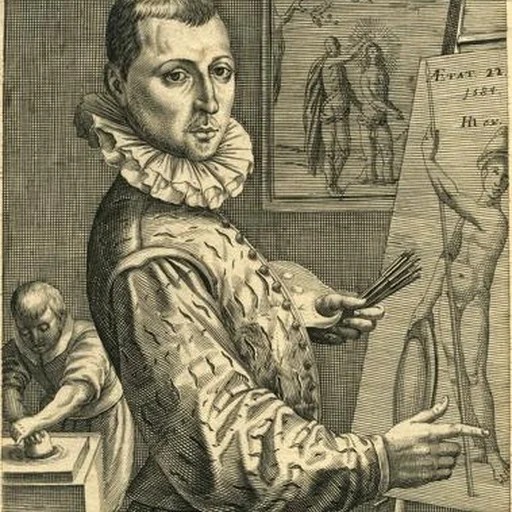
Artist
Cornelis Corneliszoon van Haarlem (Dutch:; 1562 – 11 November 1638) was a Dutch Golden Age painter and draughtsman, one of the leading Northern Mannerist artists in the Netherlands, and an important forerunner of Frans Hals as a…