Artwork
The Dog
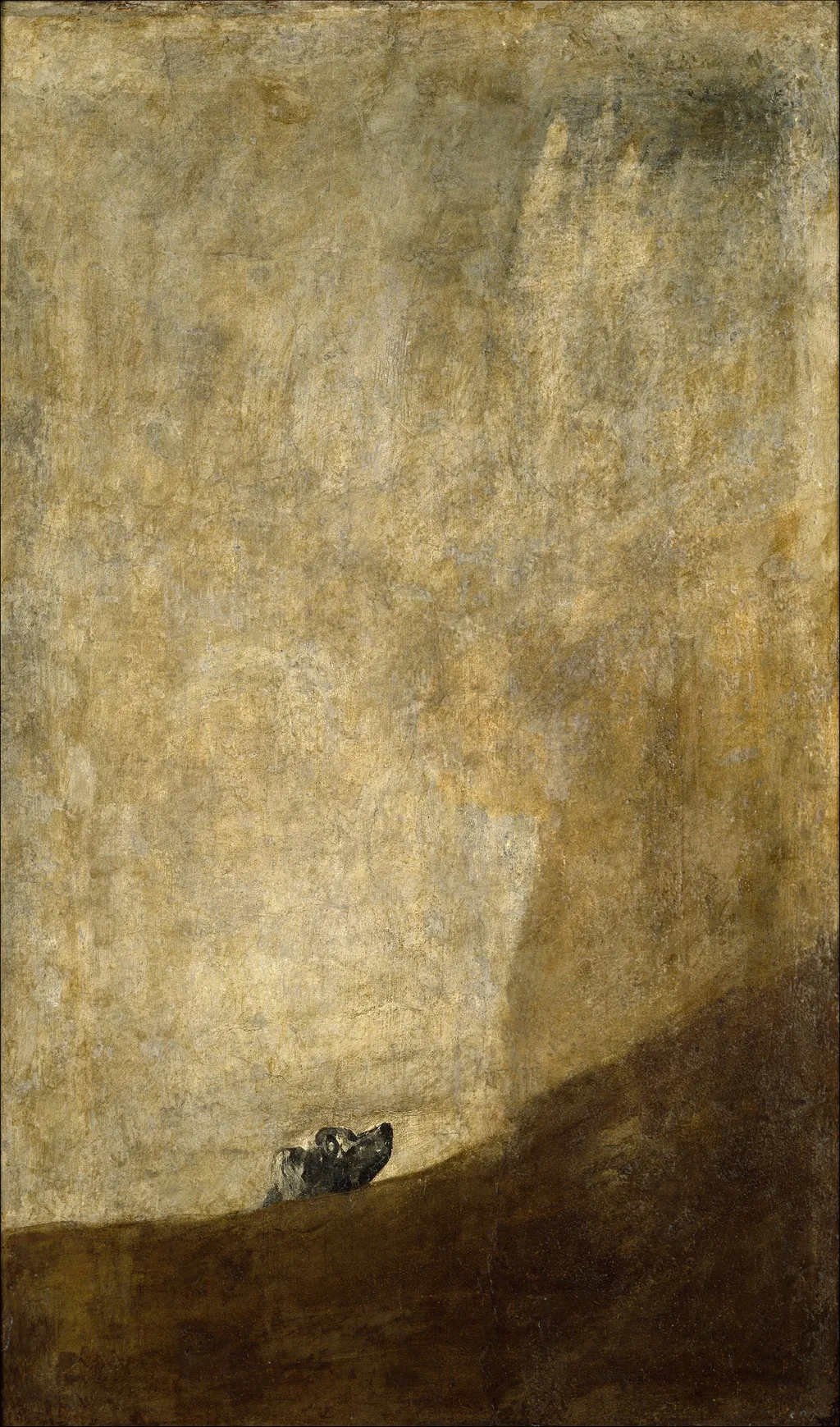
The Dog is an oil painting by Francisco de Goya. It dates from 1819 and is held in the collection of the Museo del Prado.
About this work
Subject & Meaning
By stripping the scene to its barest elements, the artist conveys a sense of existential despair and the silence of the cosmos in the face of individual agony.
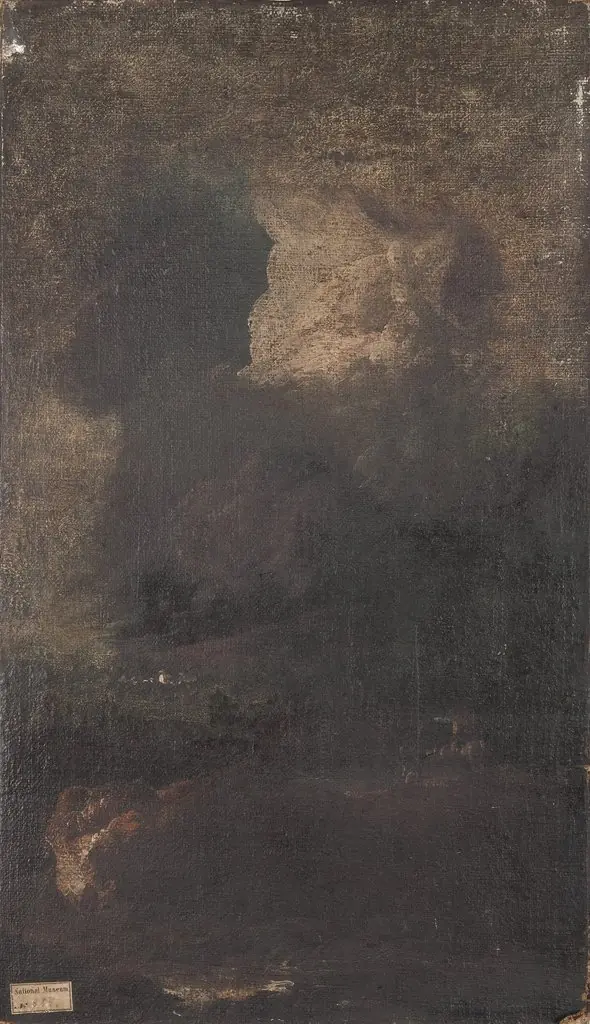
The work depicts only the head of a dog gazing upward, its body concealed by a dark, sloping mass that dominates the lower portion of the composition. The vast, empty ochre space above isolates the animal, creating an image of profound loneliness and vulnerability. Interpretations of the scene vary: the Prado suggests the dog is drowning or buried in quicksand, struggling futilely against malevolent forces while hoping for divine intervention that will not arrive. Others view the subject as a symbol of abandonment or fear of an unseen threat. The painting is often understood as a metaphor for the human condition, representing the futile struggle against indifferent natural forces or the inevitability of suffering without cause. By stripping the scene to its barest elements, the artist conveys a sense of existential despair and the silence of the cosmos in the face of individual agony.
Technique & Style
The work is an oil painting executed directly onto the plaster wall of Goya's house, the Quinta del Sordo, between 1819 and 1823. It is classified as one of the Black Paintings, a series of fourteen privately made murals that Goya created in his later years while living in seclusion and poor health. The canvas measures 131 cm in height by 79 cm in width and depicts only the head of a dog, rendered in dark earth tones against an expansive ochre sky. The animal appears partially obscured by a sloping brown mass that may represent quicksand or earth, contributing to the painting's enigmatic and unsettling atmosphere. Interpretations often link the image to themes of isolation, despair, and the futility of resistance against unseen forces, with scholars describing it as a visual poem of Symbolist significance. The work was transferred from the house to canvas in the 1870s and eventually entered the collection of the Museo del Prado, where it remains on public view.
History & Provenance
Francisco Goya created The Dog between 1819 and 1823 as part of his Black Paintings series, applying oil paint directly onto the plaster walls of his residence, the Quinta del Sordo, which he purchased in February 1819. The uncommissioned work, never intended for public exhibition, was located on the house's second floor. When Goya departed for France in 1823, he left the murals behind; the property eventually passed to his grandson, Mariano, before changing ownership. By 1874, after 70 years on the walls, the deteriorating murals were removed from the crumbling plaster and transferred to canvas under Salvador Martínez Cubells. The new owner, Baron Émile d'Erlanger, exhibited the works at the 1878 Exposition Universelle in Paris before donating them to the Spanish state in 1881, after which they entered the Museo del Prado. The Dog is held in the Museo del Prado, Madrid. Its inventory number at the museum is P00770. The work was transferred from the walls of Goya’s house, the Quinta del Sordo, in 1874-1878. It was exhibited at the Exposition Universelle, Paris, in 1878 before being donated to the Spanish state by Baron Émile d’Erlanger in 1881 and subsequently installed in the Prado.
Context
The Dog belongs to the cycle of fourteen Black Paintings that Goya executed directly onto the plaster walls of his country house, the Quinta del Sordo, between 1819 and 1823, while he was in his seventies, deaf, and in declining physical and mental health. These murals were never intended for public display; after roughly fifty years they were transferred to canvas under the direction of Salvador Martínez Cubells and eventually donated to the Spanish state by Baron Émile d'Erlanger, entering the Museo del Prado.
The work has been treated as a landmark of modern sensibility. The Spanish painter Antonio Saura called it "the world's most beautiful picture," while Rafael Canogar described it as a "visual poem" and cited it as the first Symbolist painting of the Western world. Robert Hughes wrote that "we do not know what it means, but its pathos moves us on a level below narrative." The painting's compositional boldness has been linked to later abstraction, and its imagery has been taken up by artists such as Antonio Saura and Herman Braun-Vega, as well as echoed in Pierre Bonnard's 1910 The Red-Checkered Tablecloth.
Legacy
Although originally intended as private murals, *The Dog* is now regarded as one of Francisco de Goya's most significant works. Its enigmatic composition and emotional depth have influenced later artists, including Pierre Bonnard, whose 1910 painting references the dog motif with a contrasting cheerful tone. The work has been hailed by contemporaries such as Antonio Saura, who called it "the world's most beautiful picture," and Rafael Canogar, who described it as a "visual poem" and the first Symbolist painting in Western art. It also inspired Herman Braun-Vega, who incorporated the image into his triptych *La familia informal*. The painting appears in literature, notably in Arno Geiger's novel *Das glückliche Geheimnis*, and in film, including Laurie Anderson's *Heart of a Dog*, where it symbolizes a passage into the afterlife. A 2024 Netflix film, *La Plateforme 2*, also references the painting.
Artist & collection
Artist
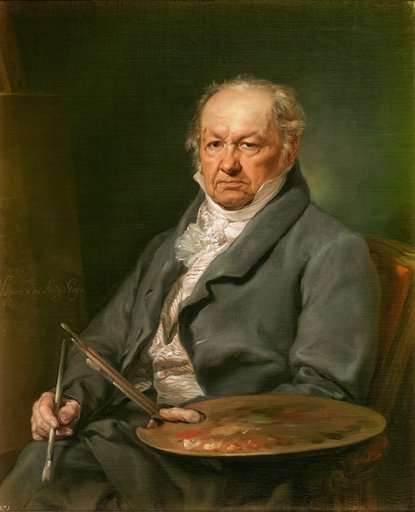
Francisco José de Goya y Lucientes was a Spanish romantic painter and printmaker.