Artwork
Witches' Sabbath
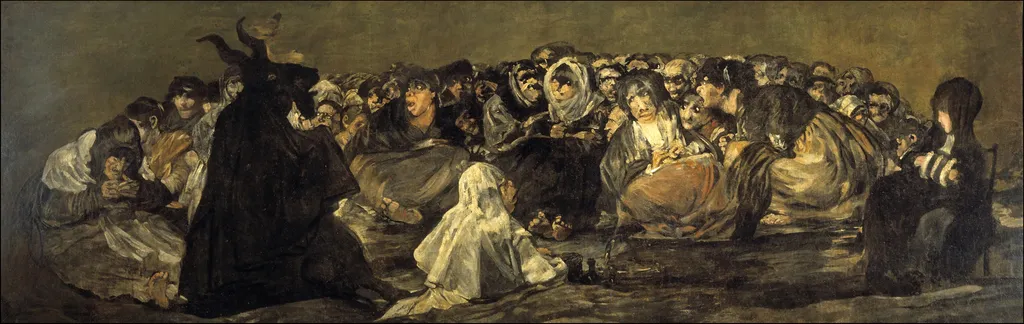
Witches' Sabbath is an oil painting by the Romanticist artist Francisco de Goya. It dates from 1820 and is held in the collection of the Museo del Prado.
About this work
Technique & Style
The color scheme relies heavily on black, accented by subtle white highlights, yellows, red earth tones, ochres, and occasional blue touches.
Originally executed as an oil mural directly onto the plaster walls of the Quinta del Sordo between 1820 and 1823, the work was transferred to canvas support in 1874 by restorer Salvador Martínez Cubells. This physical intervention significantly altered the composition; approximately 140 cm were cut from the right side, reducing the original width and disrupting the symmetrical balance between the central figures. The painting measures 140 cm in height and 438 cm in width following these modifications.
Goya applied the oil paint with a loose, thick, and rapid technique intended for distant viewing, utilizing fine lines to define silhouettes against a predominantly dark palette. The color scheme relies heavily on black, accented by subtle white highlights, yellows, red earth tones, ochres, and occasional blue touches. This handling creates a nightmarish atmosphere, while the grotesque, caricatured figures display animalistic features rendered through violent brushstrokes that leave parts of the underlying texture exposed.
History & Provenance
Witches' Sabbath is one of the fourteen Black Paintings that Francisco de Goya applied in oil directly onto the plaster walls of his house, the Quinta del Sordo, outside Madrid, between 1820 and 1823. The work occupied a full wall between two windows on the first floor, opposite A Pilgrimage to San Isidro. Goya did not title the piece; the name El Gran Cabrón (The Great He-Goat) was later assigned by the painter Antonio Brugada in an inventory he compiled after Goya's death.
Ownership of the Quinta del Sordo passed to Goya's grandson Mariano, and the house changed hands several times before March 1873, when the Belgian banker Frédéric Émile d'Erlanger acquired it. Around 1874, d'Erlanger commissioned Salvador Martínez Cubells, restorer of the Museo del Prado, to transfer the deteriorating murals from plaster to canvas. During the transfer, approximately 140 cm were trimmed from the right-hand side, reducing the work to its present dimensions of 140 × 438 cm. After a poorly received showing at the 1878 Paris Exposition Universelle, d'Erlanger donated the Black Paintings to the Spanish state in 1881, and the work entered the collection of the Museo del Prado, where it remains.
The work is held by the Museo del Prado, Madrid, where it is inventoried under the title El aquelarre (or El gran cabrón).
Its current dimensions are 140 cm in height by 438 cm in width, the result of a transfer from plaster to canvas and subsequent trimming. Between 1874 and 1875 the murals from Goya’s Quinta del Sordo were detached and relined onto canvas by Salvador Martínez Cubells under the patronage of the Baron Frédéric Émile d’Erlanger. After the Paris Exposition Universelle of 1878, the series was donated to the Spanish state in 1881 and entered the Prado’s collection.
Context
Created between 1820 and 1823 as part of the fourteen Black Paintings, Witches' Sabbath was executed in oil directly onto the plaster walls of Goya's Quinta del Sordo. The artist, then in his mid-seventies and living in isolation, left the works untitled and undocumented, leading to later attributions such as El Gran Cabrón by Antonio Brugada. Scholars interpret the mural as a satirical condemnation of superstition and the Spanish Inquisition, reflecting Goya's disillusionment with the restored Bourbon monarchy and his personal fears of madness and aging.
The work thematically connects to his earlier print series, including The Sleep of Reason Produces Monsters and the posthumously published Disasters of War.
The murals were transferred to canvas between 1874 and 1875 under the direction of Salvador Martínez Cubells for the Belgian owner Frédéric Émile d'Erlanger. This process involved cutting approximately 140 cm from the right side to fit exhibition spaces, altering the original composition. Although the paintings were exhibited at the 1878 Paris Exposition Universelle with little immediate commercial success, they were donated to the Spanish state in 1881 and are now held by the Museo del Prado.
Overview
Created between 1820 and 1823, this oil mural by Francisco de Goya forms part of his late series known as the Black Paintings. Executed directly on the plaster walls of his home, the Quinta del Sordo, the work portrays a nocturnal gathering dominated by a goat‑headed figure. The composition is stark, its palette limited to deep blacks and muted tones, conveying a somber, unsettling atmosphere.
Subject & Meaning
The central figure, a hulking goat with horns, presides over a circle of aged, frightened women, suggesting a witches’ sabbat. The scene evokes themes of superstition, fear, and mortality, with the goat often interpreted as a demonic embodiment of Satan. Scholars view the image as a critique of the credulity and cruelty associated with the Spanish Inquisition’s witch trials, reflecting Goya’s own disillusionment.
Artist & collection
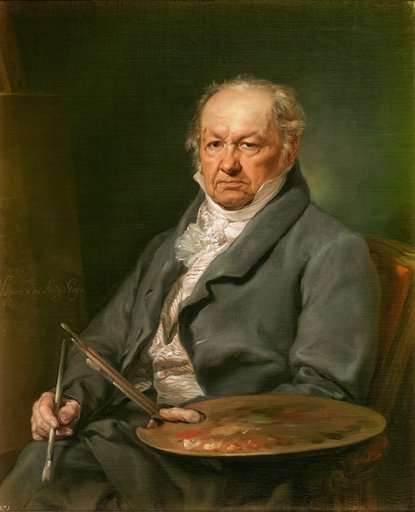
Artist
Francisco José de Goya y Lucientes was a Spanish romantic painter and printmaker.

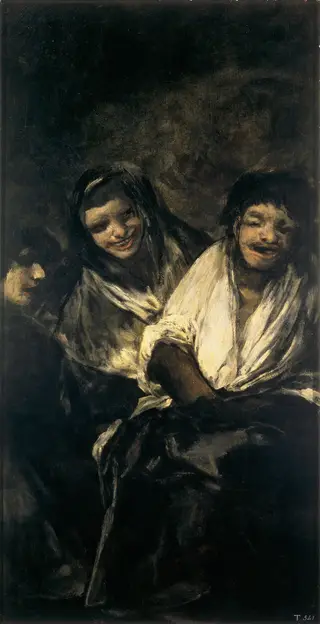
- Man Mocked by Two Women
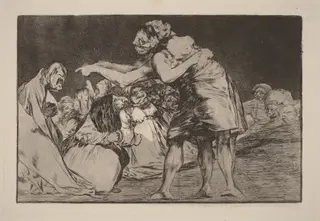 Disparate desordenado (Disorderly Folly)
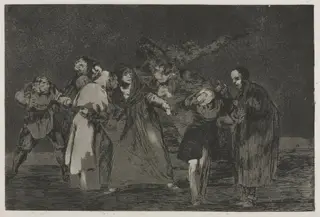 The Proverbs: Wounds Heal Quicker Than Hasty Words
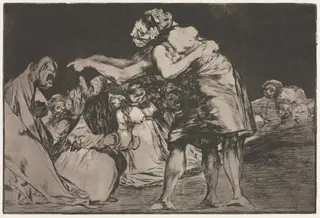 The Proverbs: Matrimonial Folly
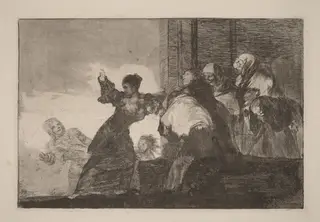 Disparate pobre (Poor Folly)
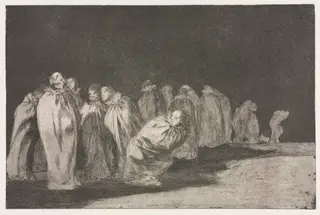 The Proverbs: The Men in Sacks
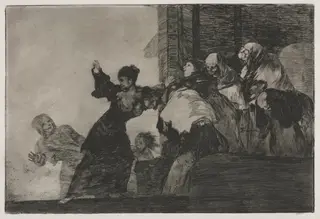 The Proverbs: Poor Folly
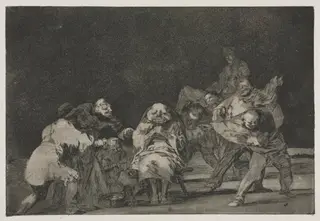 The Proverbs: Loyalty
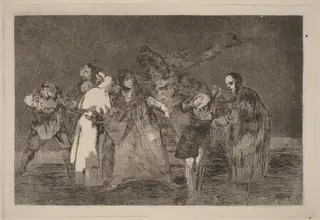 Sanan cuchilladas mas no malas palabras (Wounds Heal Quicker than Hasty Words)
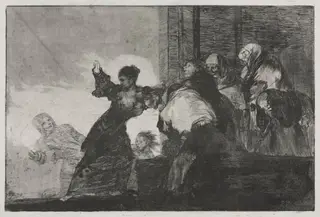 The Proverbs: Two Heads are Better than One or Poor Folly
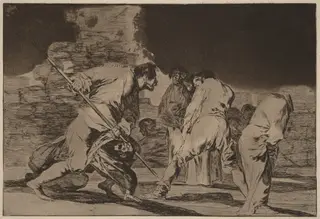 Disparate furioso (Furious Folly)
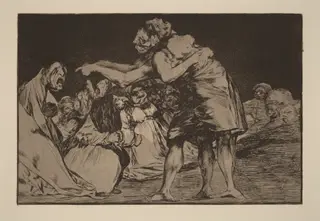 Disparate desordenado (Disorderly Folly)