Artwork
God the Father
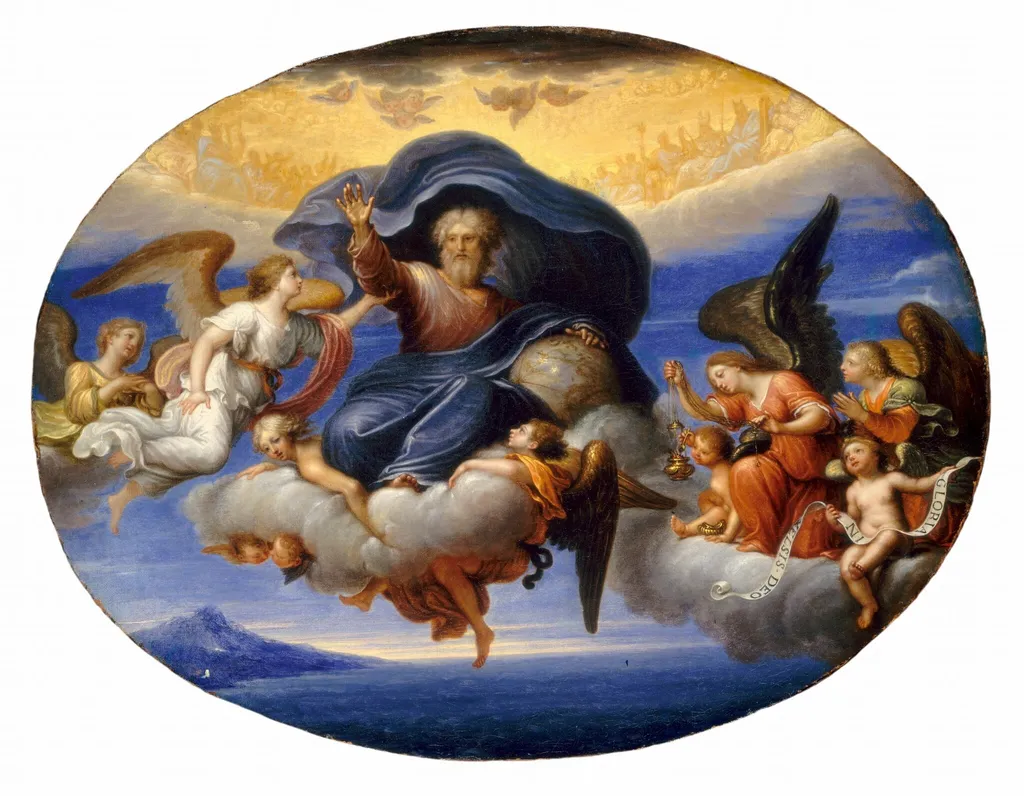
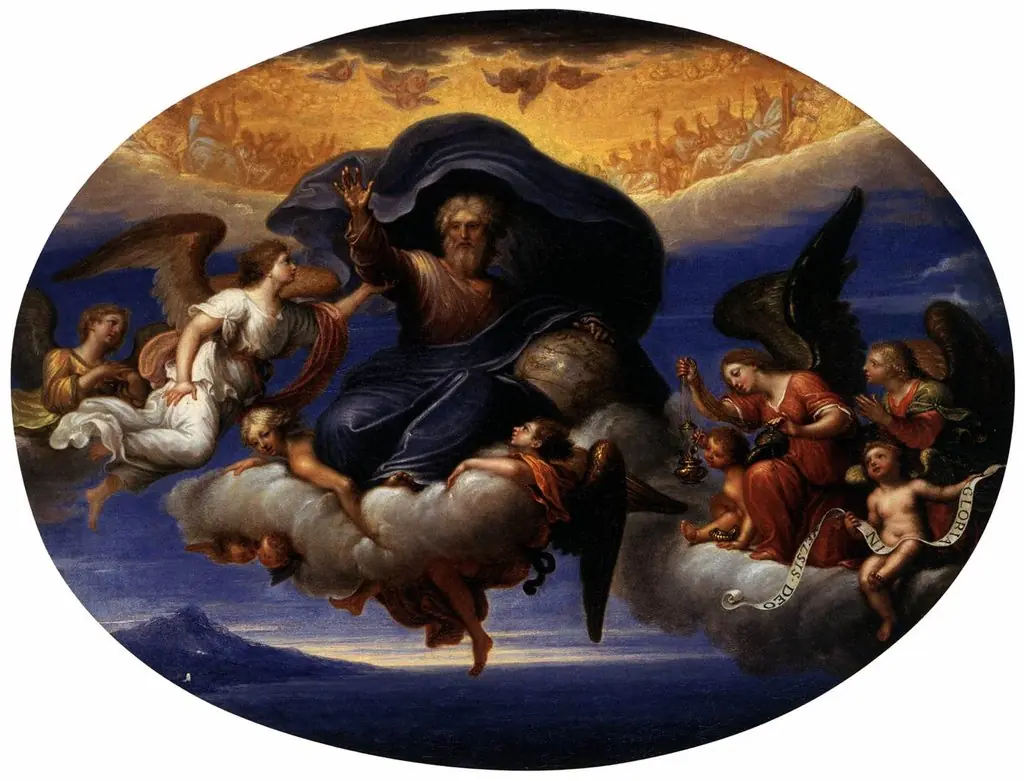
God the Father is an oil painting. It dates from 1664 and is held in the collection of the National Gallery of Art.
- Inscription
- Inscribed:lower right: on banner held by angel, letters upside down: GLORIA IN XELSIS DEO; center reverse, first two letters in monogram: J:B.[or] H:B. N:66. / Albano.
About this work
Subject & Meaning
The celestial setting, rendered with soft, luminous light, underscores the work’s sacred context, aligning with 17th-century French religious art conventions.
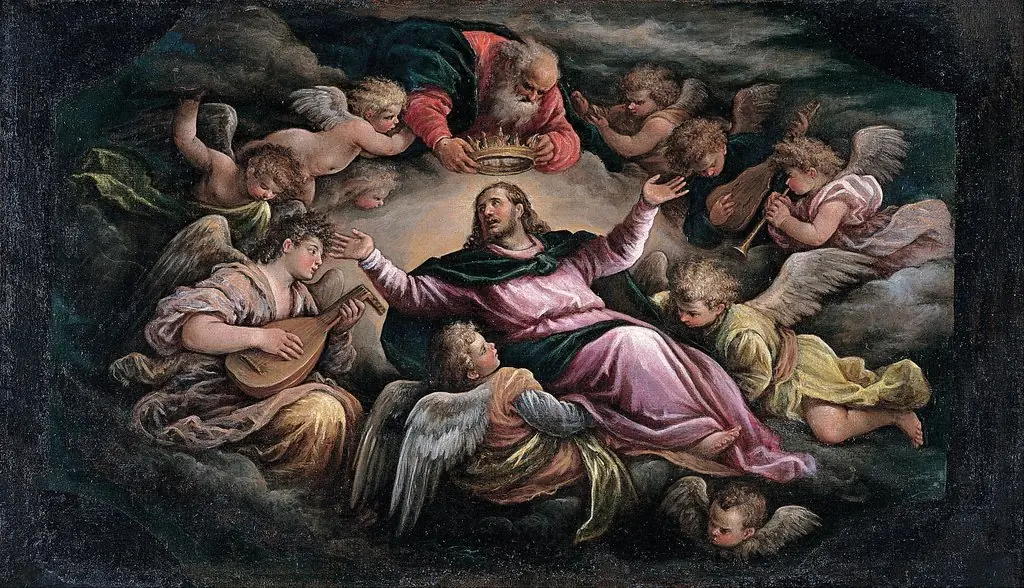
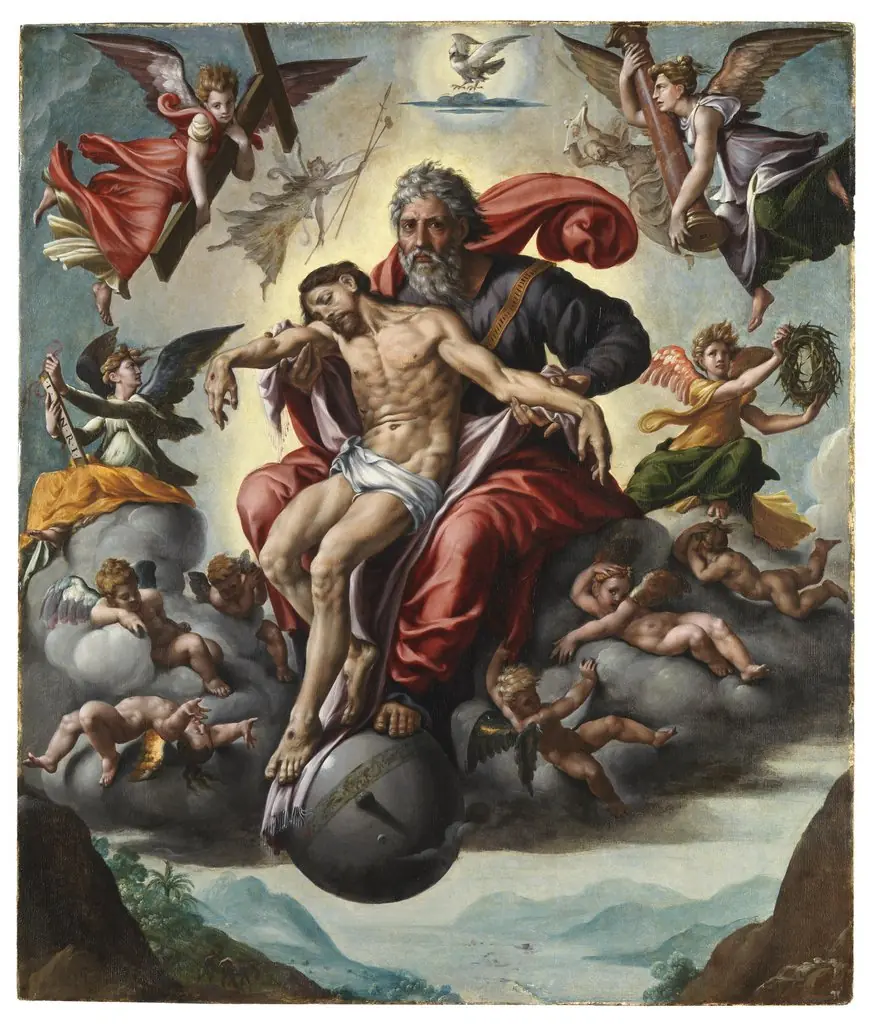
The painting depicts God the Father as an elderly, bearded figure seated on clouds, embodying patriarchal authority and divine omnipotence. The figure is shown in a frontal pose, draped in classical drapery, and holds a globe or orb, symbolizing Christ’s dominion over the earth. The celestial setting, rendered with soft, luminous light, underscores the work’s sacred context, aligning with 17th-century French religious art conventions.
The inscription on the reverse, referencing ‘Albano,’ suggests a possible attribution to the circle of François Perrier or another follower of Albani, reflecting the era’s conflation of divine iconography with classical aesthetics. The subject’s representation as an ancient, benevolent ruler conveys themes of eternal sovereignty and paternal care, central to Counter-Reformation devotional imagery.
Technique & Style
Executed in 1664, this religious painting is an oil on canvas work measuring 46.5 by 60.3 centimeters. The support is a standard woven canvas, typical for French 17th-century religious compositions of this scale. While the reverse bears the inscription "J:B, N:66 / Albano," suggesting a potential attribution to the Albani workshop or a connection to John Barnard, the work is stylistically categorized within the French 17th-century tradition, with some attributions linking it to Pierre Mignard I. The painting depicts God the Father as the central subject within a celestial hierarchy.
Its formal qualities reflect the rich color and composition noted in historical sale descriptions of similar oval-format works from the era, though this specific piece retains its rectangular dimensions. The condition of the canvas and oil paint layers has allowed the work to survive several centuries of ownership and multiple public auctions.
History & Provenance
Dated to 1664, this oil on canvas was possibly identified as lot 35 in the 1767 Paris estate sale of Jean de Julienne, where it was attributed to Francesco Albani and purchased by engraver Pierre François Basan. The work subsequently entered the collection of John Barnard in London, bearing a reverse inscription linking him to the piece. Upon Barnard's death in 1784, inheritance passed the painting to his nephew, Thomas Hankey.
Following Hankey's demise, it was sold at Christie's in June 1799 to James Akers. Akers consigned the work to a Stanley auction in April 1814, where it was acquired by George Spencer-Churchill, the 5th Duke of Marlborough. The Duke sold the painting at his White Knights residence in October 1819.
After appearing at a Phillips auction in 1985 attributed to the Workshop of Albani, the piece was handled by Havari and Johns before being sold to the National Gallery of Art in 1986.
God the Father is held by the National Gallery of Art in Washington, D.C., having been acquired in 1986 from the London dealers Havari and Johns. The painting's provenance traces through several English private collections, beginning with John Barnard (d. 1784) of London, who is identified by the inscription "J:B, N:66 / Albano" on the reverse. It passed by inheritance to his nephew Thomas Hankey (d. 1799) of Bedford Park, London, and was offered at Hankey's estate sale at Christie's, London, on 7–8 June 1799 (lot 36).
Subsequent owners included James Akers of London (sale at Stanley's, 28–29 April 1814, lot 127) and George Spencer-Churchill, 5th Duke of Marlborough, at White Knights, Berkshire (sale at his residence, 26–28 October 1819, third day, lot 13). The work resurfaced at Phillips, London, on 12 October 1985, attributed to the workshop of Albani, before its 1986 purchase by the NGA.
Legacy
After passing through the hands of several prominent British collectors, John Barnard, Thomas Hankey, James Akers, and George Spencer‑Churchill, 5th Duke of Marlborough, the painting appeared in auctions at Christie’s (1799), Stanley (1814), and Hawkes (1819). In 1985 it was offered at Phillips in London as a work of the Workshop of Albani and was acquired the following year by the National Gallery of Art in Washington, D.C., where it remains part of the museum’s permanent collection.
Overview
This oil on canvas painting, titled "God the Father," depicts a celestial scene centered on a venerable, bearded male figure clad in a flowing white robe. He appears suspended amidst a sky filled with clouds, surrounded by numerous angels. Some of these angelic figures possess wings, while others hold symbolic objects such as a globe or a scroll. The composition conveys a sense of dramatic grandeur through its arrangement of figures and atmospheric elements.
Artist & collection