Artwork
Pulpit in Saint Mark's, Venice
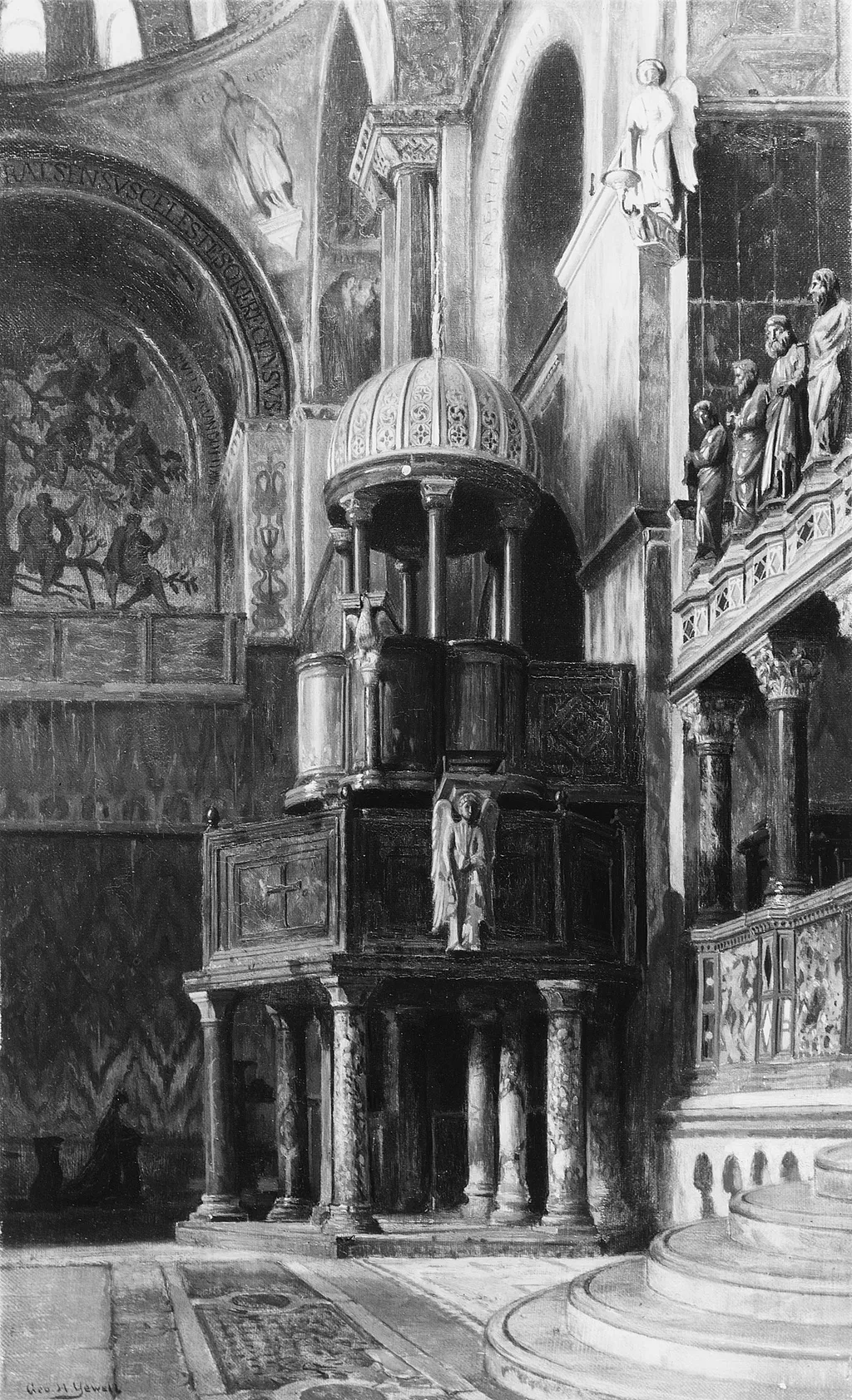
Pulpit in Saint Mark's, Venice is an oil painting by the American Impressionist artist George Henry Yewell. It dates from 1870 and is held in the collection of the Metropolitan Museum of Art.
About this work
Technique & Style
According to the catalog entry, the support is canvas and the medium is oil paint, indicating a traditional easel technique typical of the period.
The work titled Pulpit in Saint Mark's, Venice is an oil painting executed on canvas in 1870. According to the catalog entry, the support is canvas and the medium is oil paint, indicating a traditional easel technique typical of the period. The composition captures an interior church space, centering on the architectural detail of the pulpit while surrounding walls and vaults provide context, reflecting a realist interest in ecclesiastical interiority.
Measured at 54.6 cm in height and 32 cm in width, the piece belongs to the Metropolitan Museum of Art collection, where it is preserved and displayed as part of the European painting holdings.
History & Provenance
George Henry Yewell created the painting Pulpit in Saint Mark's, Venice in 1870. Executed in oil paint on canvas, the work was started and completed during that year. While the specific details of its original commission and early ownership chain are not documented in the provided sources, the painting's subsequent provenance places it in the collection of the Metropolitan Museum of Art.
Pulpit in Saint Mark's, Venice is held in the collection of the Metropolitan Museum of Art in New York, where it is catalogued as an oil-on-canvas painting measuring 54.6 by 32 centimeters. Created in 1870 by George Henry Yewell, the work is recorded in the Metropolitan Museum of Art's holdings through its Wikidata entry, which lists the museum as both collection and location. The sources do not provide a specific accession number or details of any prior or subsequent exhibition history.
Overview
Painted in 1870 by American artist George Henry Yewell, this oil on canvas depicts the interior of the pulpit within Saint Mark's Basilica in Venice. The composition centers on the stone pulpit, characterized by its tall, rounded canopy adorned with intricate carvings and a small figure positioned within the enclosure. Yewell captures the architectural grandeur of the surrounding space, featuring arched colonnades and walls decorated with faded frescoes that attest to the basilica's historic layers.
To the right, a balcony populated by figures provides a sense of scale and human presence within the sacred environment. The artist focuses on the play of light and shadow across the textured stone surfaces, emphasizing the atmospheric depth of the Venetian interior. Created during a period when American artists frequently traveled to Italy to study Old Master techniques and architectural subjects, this work reflects Yewell's engagement with European religious art and his interest in documenting the specific spatial qualities of historic monuments.
The painting serves as a record of the basilica's interior as it appeared in the late nineteenth century, blending architectural precision with a painterly sensitivity to the ambient light of the space.
Subject & Meaning
The composition focuses on a prominent stone pulpit, characterized by its tall, rounded top, elaborate carvings, and a small figure within. The surrounding walls feature decorative arches, columns, and faded mural paintings, hinting at the building's long history. A balcony to the right, populated by several figures, adds a human element to the sacred space.
Artist & collection


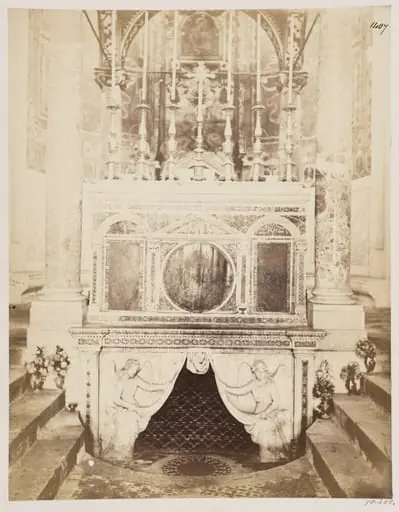 Church and Altar Decoration, S. Cesareo - Altar with Confessio under it, shewing Cosmati Mosaic-work and Sculpture
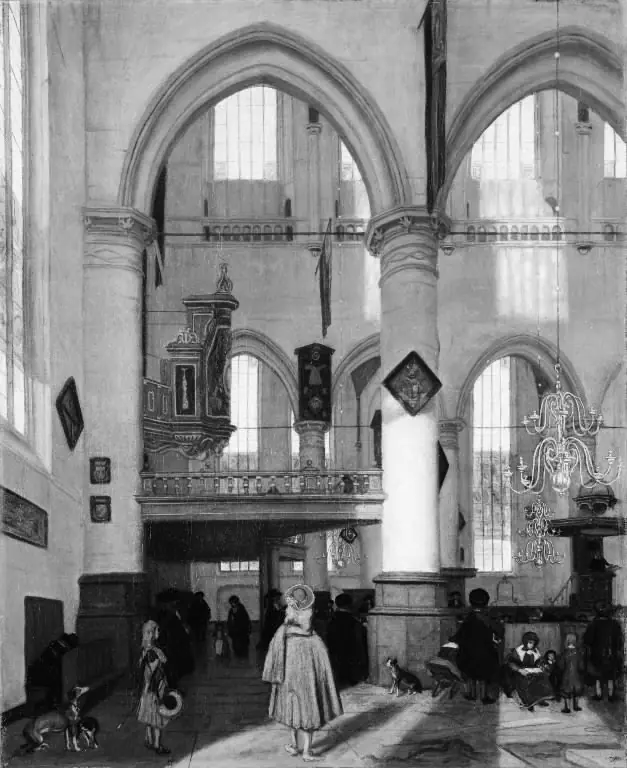 Interior of the Oude Kerk, Amsterdam, during a Sermon
 Interior of S Lorenzo fuori le mura
 Interior of a Church
 Interior of S Lorenzo fuori le mura
 Interior of a Church
 Koret i Århus Domkirke
 Christ Healing at the Pool of Bethesda
 Church Interior
 L'Inconestase de la Cathedrale de l'Assomption