Artwork
Self-Portrait
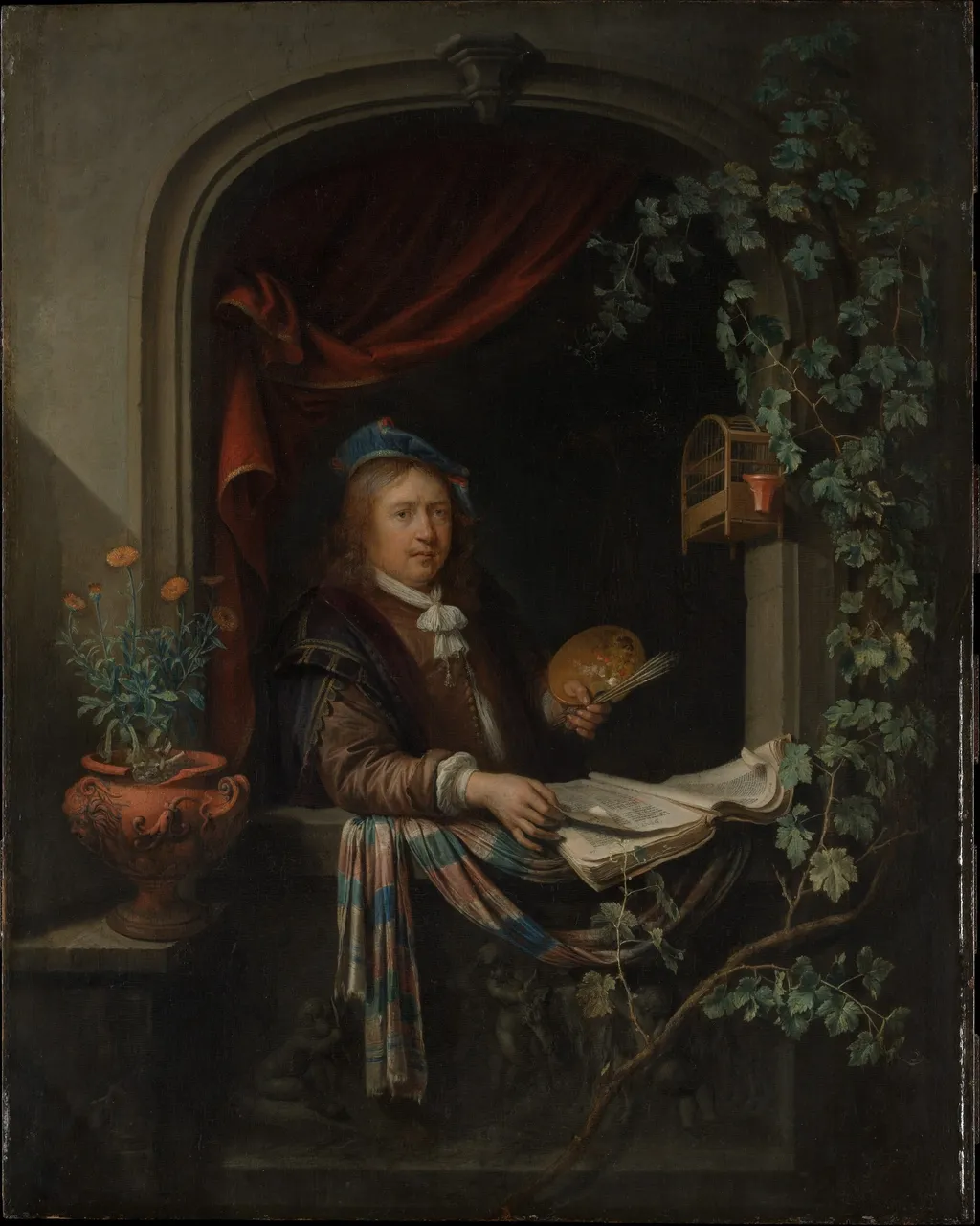
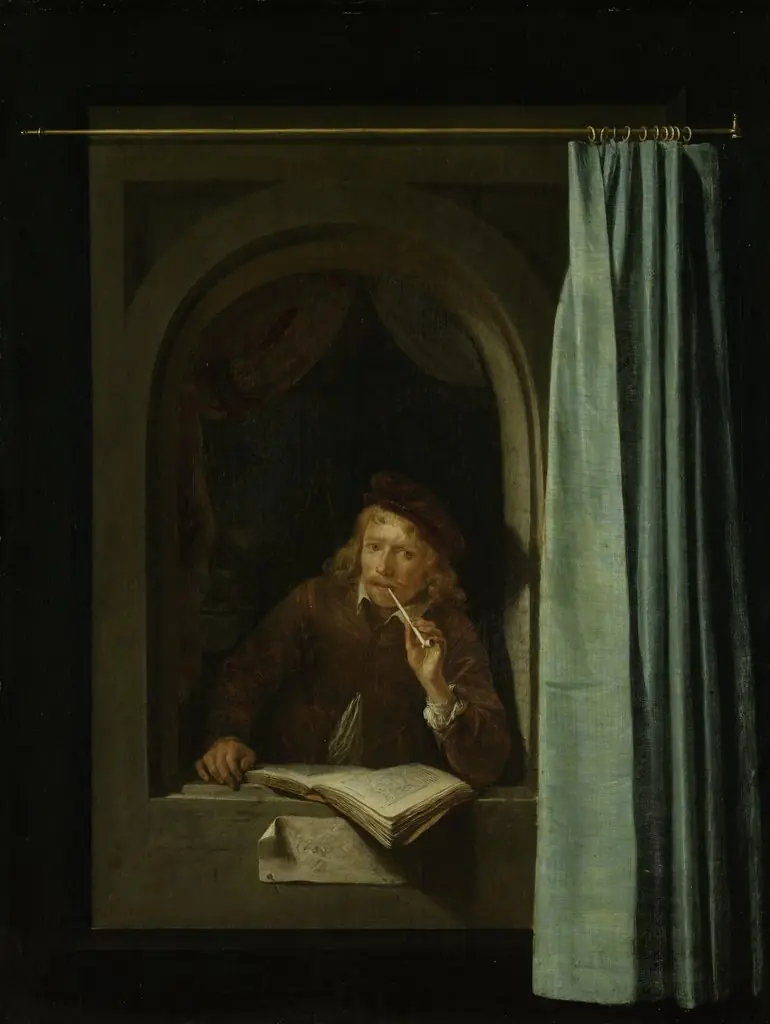
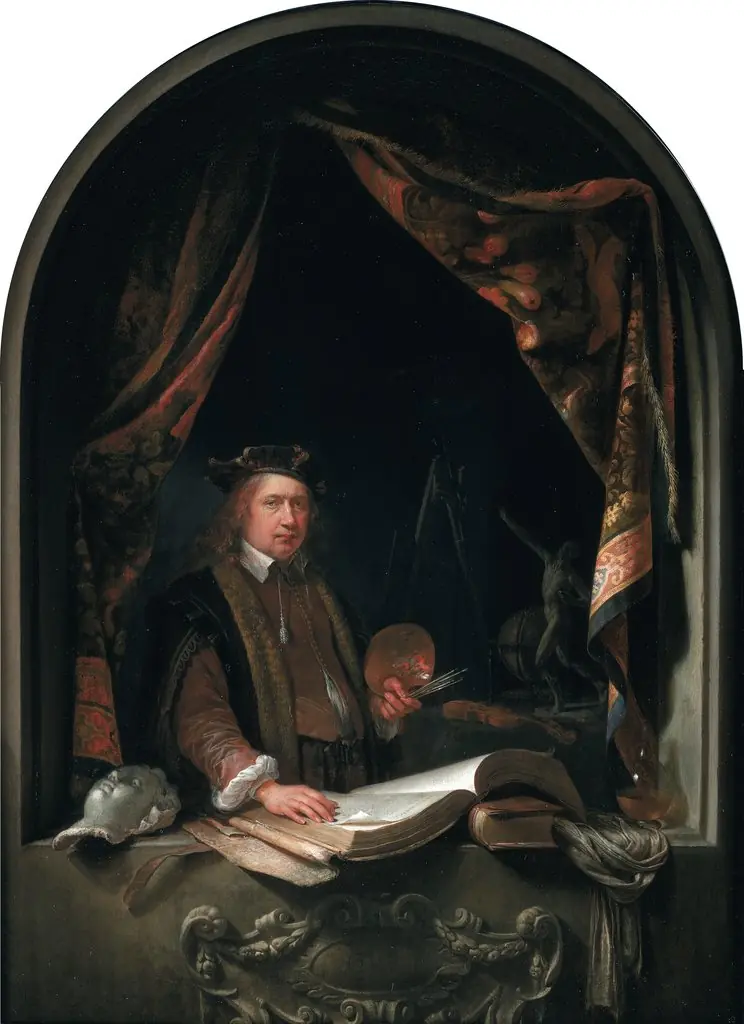
Self-Portrait is an oil painting by the Dutch Golden Age artist Gerrit Dou. It dates from 1665 and is held in the collection of the Metropolitan Museum of Art.
About this work
Subject & Meaning
Gerrit Dou’s Self-Portrait (1665) depicts the artist as a master of his craft, surrounded by studio attributes that underscore his skill and status.
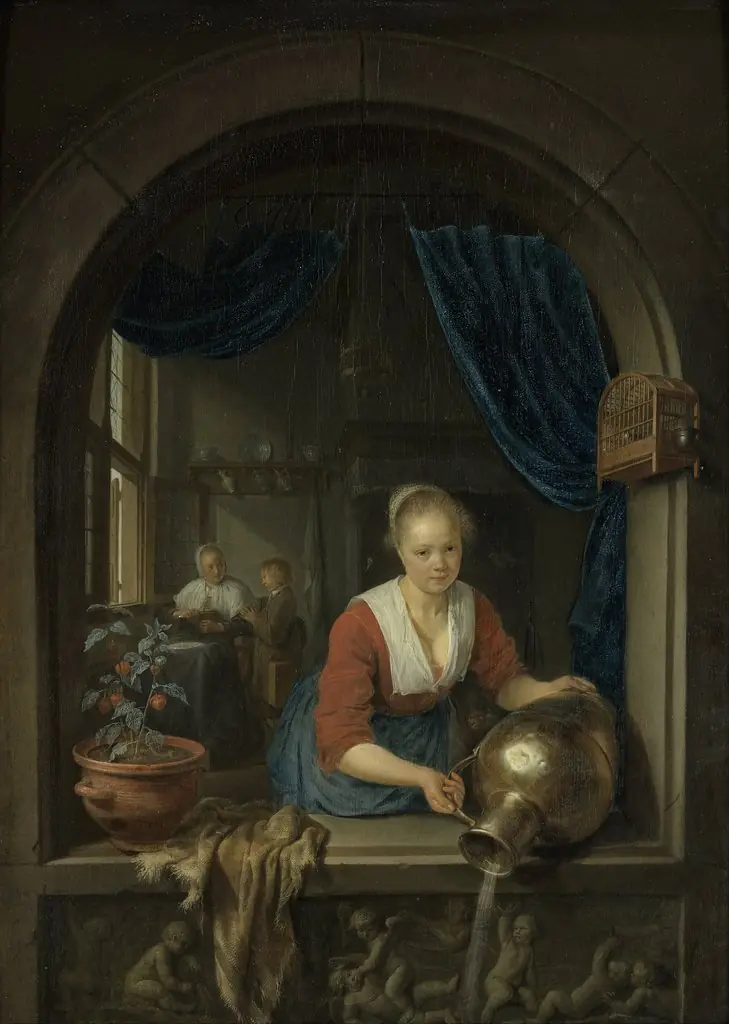
Gerrit Dou’s Self-Portrait (1665) depicts the artist as a master of his craft, surrounded by studio attributes that underscore his skill and status. He holds a palette and brushes, symbols of his profession, while turning the pages of a large book, a nod to knowledge and artistic tradition. The inclusion of François Duquesnoy’s relief Infants Playing with a He-Goat beneath the window, a motif Dou reused in other works, suggests classical inspiration and technical virtuosity.
A birdcage, marigolds, and an easel with an open umbrella further enrich the scene, evoking themes of transience, domesticity, and protection. The meticulous arrangement of objects, characteristic of Dou’s fijnschilderei (fine painting), reinforces the work’s meaning: a celebration of artistic identity, precision, and the elevated role of the painter in seventeenth-century Dutch society.
Technique & Style
Executed in 1665, this self-portrait by Gerrit Dou is an oil painting on panel, exemplifying the precise technique of the Dutch Fijnschilderei (fine painting) tradition. The work measures 48.9 by 39.1 centimeters and depicts the artist within a niche composition, standing at a window. Dou renders minute details with high finish, including a dark blue cloak embroidered with gold lace, a light blue cap, and a brownish vest.
The formal arrangement includes a palette and brushes held in the left hand, while the right hand turns the pages of a large book resting on the sill. Surrounding elements such as a pot of marigolds, a birdcage, a vine, and a relief of children playing with a he-goat are depicted with meticulous attention to texture and light. A curtain partially obscures the window, and an easel topped with an open umbrella appears in the background, showcasing Dou's mastery of illusionistic space and surface detail.
History & Provenance
Executed in 1665, this oil-on-panel self-portrait by Gerrit Dou depicts the artist at the height of his fame. While the exact commissioning patron remains unrecorded, scholars suggest Dou likely produced his approximately dozen known self-portraits for specific clients who owned multiple works by his hand. The painting was documented by Hofstede de Groot in 1908, who provided a detailed description of its iconography and condition.
The work entered the collection of the Metropolitan Museum of Art in New York through the bequest of Benjamin Altman in 1913. Its historical significance is further evidenced by a copy made by Etienne Compardel, which may have served as a reference for Jacobus Houbraken's engravings in his father's biographical dictionary of painters.
Gerrit Dou's 1665 Self-Portrait is held in the collection of the Metropolitan Museum of Art in New York. The painting entered the museum's collection through the Benjamin Altman bequest in 1913. It was documented by Hofstede de Groot in 1908 and is cataloged as number 37 in the museum's Dutch Paintings in the Metropolitan Museum of Art Volume I, authored by Walter Liedtke in 2007. The provided sources do not detail a broader exhibition history for the work.
Context
Gerrit Dou’s Self-Portrait (1665) occupies a pivotal place in 17th-century Dutch art as a paradigm of fijnschilderei (fine painting) and as a self-conscious assertion of artistic identity. Scholars such as Hofstede de Groot (1908) and Walter Liedtke (2007) underscore its meticulous execution and iconographic richness, linking it to Dou’s broader niche-painting practice []. Contemporaries like Arnold Houbraken elevated Dou’s reputation, positioning him alongside Bartholomeus van der Helst as a “guiding light” in Dutch art and cementing his influence on later biographers and engravers, including Jacob Houbraken [].
The work’s inclusion in the Benjamin Altman bequest (1913) further attests to its enduring critical esteem, while its studio motifs, such as the François Duquesnoy relief, became a recurring trope in Dou’s oeuvre, reinforcing his status as a master of illusionistic detail [].
Legacy
The Self‑Portrait (1665) by Gerrit Dou continued to be referenced long after its creation. It was copied by the etcher Etienne Compardel, and this copy likely served as the model for Jacob Houbraken’s engravings in his father’s dictionary of painters. Arnold Houbraken, who admired Dou greatly, opened the second volume of his Schouburgh with the artist’s biography, pairing Dou with his contemporary Bartholomeus van der Helst as “two guiding lights in the arts” and illustrating their portraits with two burning wicks.
These references cemented Dou’s reputation as a exemplar of fine‑painting tradition and kept his self‑portrait visible in art‑historical discourse.
Overview
Gerrit Dou's Self-Portrait, an oil painting from 1665, depicts the artist within a window frame, a compositional device frequently used in his work. This piece captures Dou at a prominent stage in his career, surrounded by objects that signify his artistic profession. The painting is part of the collection at the Metropolitan Museum of Art in New York.
Own this work as a print
Artist & collection
Artist
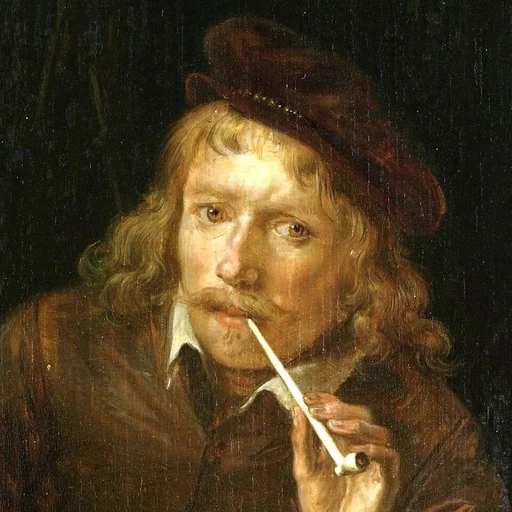
Gerrit Dou (pronounced; 7 April 1613 – 9 February 1675), also known as Gerard Douw or Dow, was a Dutch Golden Age painter, whose small, highly polished paintings are typical of the Leiden fijnschilders.