Artwork
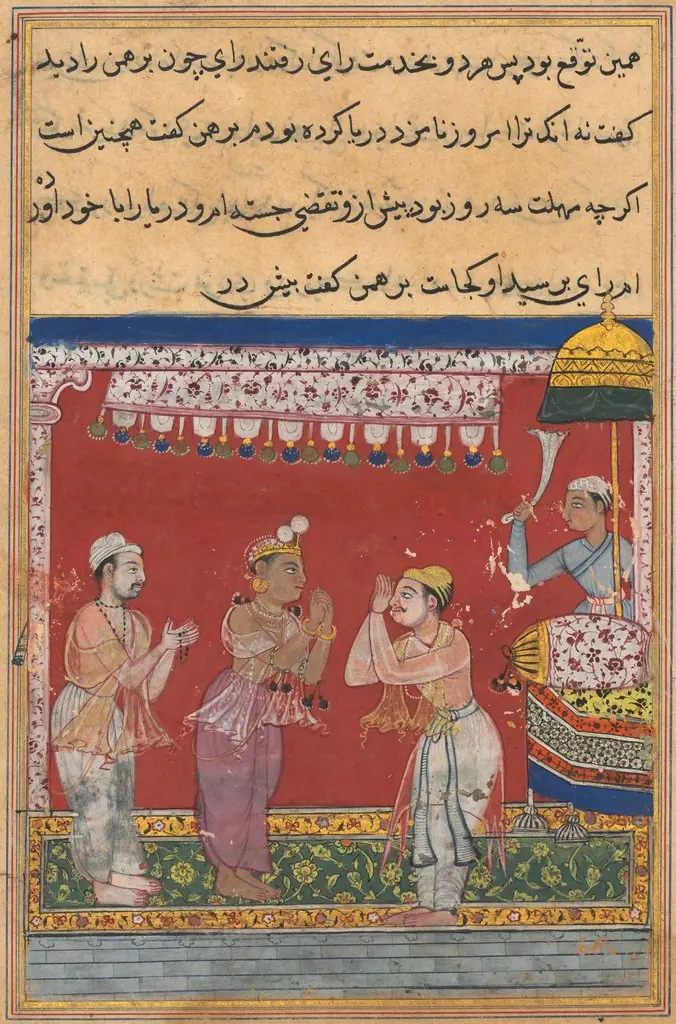
The king of the Ocean, having assumed human form, arrives at the court of the Raja, from a Tuti-nama (Tales of a Parrot): Eleventh Night
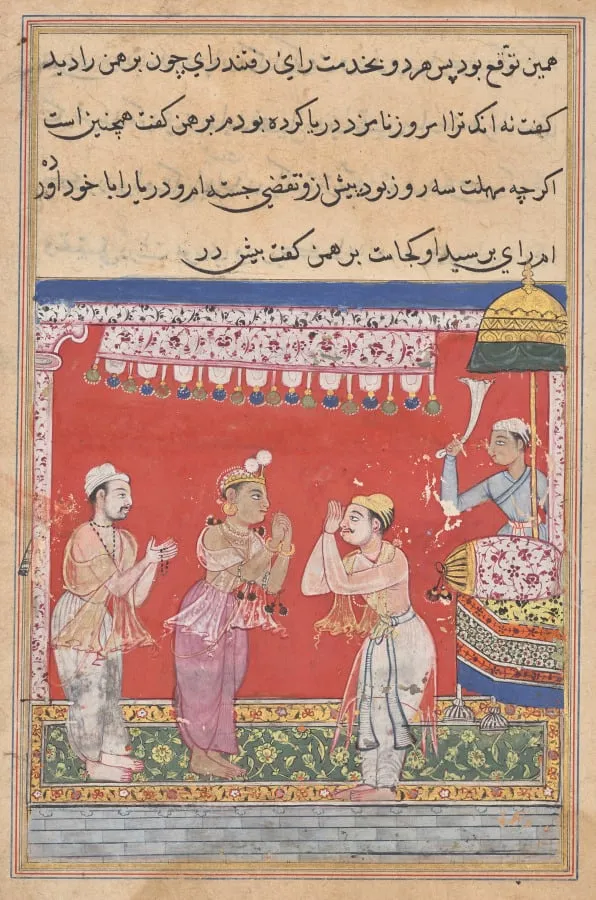
The king of the Ocean, having assumed human form, arrives at the court of the Raja, from a Tuti-nama (Tales of a Parrot): Eleventh Night is an unspecified painting by the Mughal Painting artist Ghulam 'Ali. It dates from 1560 and is held in the collection of the Cleveland Museum of Art. The painting depicts a blue‑skinned monarch of the sea kneeling before a regal figure seated on a gilded throne.
- Accession no.
- 1962.279.92.a
- Credit line
- Gift of Mrs. A. Dean Perry
About this work
The artist painted it for Emperor Akbar’s royal workshop, where Hindu tales were illustrated in a style that mixed Persian and Indian traditions.
A blue-skinned king kneels before a ruler on a golden throne, while a priest in white watches. The king wears a simple white cloth and a sacred thread; the ruler is dressed in fine muslin and a flat turban.
This scene comes from a story told by a parrot to keep a queen from sneaking out at night. The artist painted it for Emperor Akbar’s royal workshop, where Hindu tales were illustrated in a style that mixed Persian and Indian traditions.
To see more paintings like this, look up Mughal India, court of Akbar (reigned 1556–1605).
Overview
The painting depicts a blue‑skinned monarch of the sea kneeling before a regal figure seated on a gilded throne. A Brahman priest stands to the left, holding a rosary, while the ruler, dressed in fine white muslin and a flat turban, rises from his seat to receive the ocean king’s respectful greeting.
Subject & Meaning
The scene illustrates a tale from the Tuti‑nama, a collection of parrot‑narrated stories, in which the ocean king assumes human form and presents himself at the court of a Raja. The inclusion of Hindu symbols such as the sacred thread and the Brahman priest underscores the narrative’s religious and cultural context.
Technique & Style
Executed for Emperor Akbar’s royal atelier, the work blends Persian miniature conventions with Indian iconography. Delicate brushwork renders the luminous white muslin and the intricate floral crown, while the vibrant blue skin of the sea king reflects a stylized, symbolic palette characteristic of Mughal court painting.
History & Provenance
Created during the reign of Akbar (1556–1605), the piece was part of a series illustrating Hindu legends for the emperor’s workshop. It remains associated with the Mughal court’s patronage of cross‑cultural artistic projects, though its later ownership record is limited.
Context
Mughal artists of Akbar’s era frequently incorporated stories from Indian epics and folklore, adapting them to a courtly aesthetic that merged Persian courtly elegance with indigenous motifs. This painting exemplifies that syncretic approach, reflecting the emperor’s policy of religious tolerance and cultural synthesis.
Artist & collection

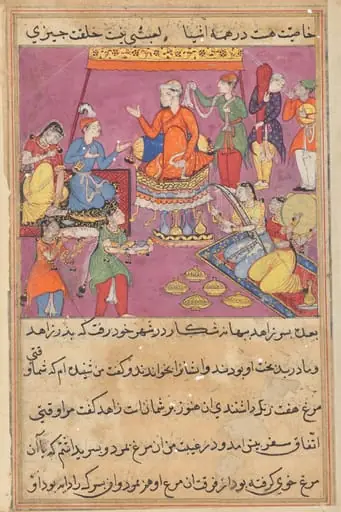
 The king of Bahilistan offers his daughter to the King of Kings, from a Tuti-nama (Tales of a Parrot): Seventh Night
 The king of the Ocean, having assumed human form, arrives at the court of the Raja, from a Tuti-nama (Tales of a Parrot): Eleventh Night
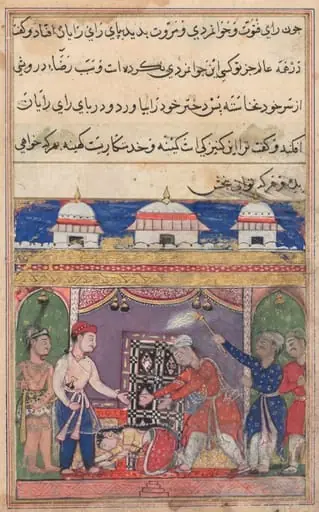
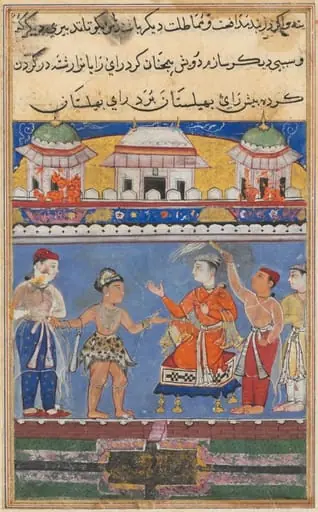 The dervish brings the King of Kings before the king of Bahilistan, from a Tuti-nama (Tales of a Parrot): Seventh Night
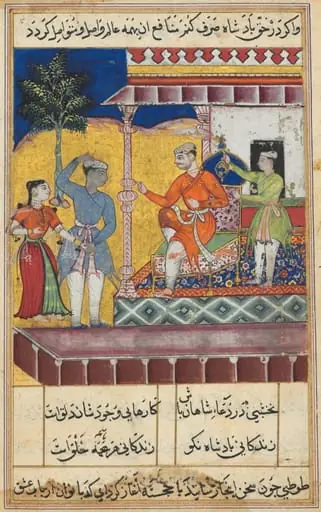 The rejuvenated old man and the daughter of the king of the jinns take leave of the King of Kings, from a Tuti-nama (Tales of a Parrot): Seventh Night
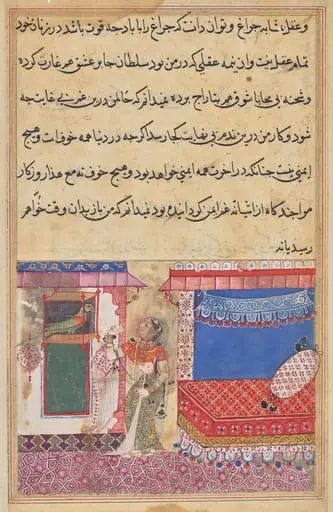 The Parrot Addresses Khujasta at the Beginning of the Eighteenth Night, from a Tuti-nama (Tales of a Parrot)
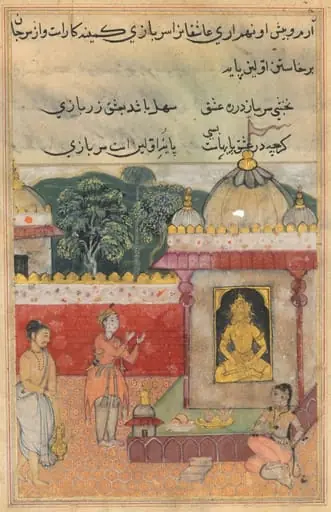 The Raja’s son vows to sever his head and offer it to the image if he is united with the princess he has seen in the temple, from a Tuti-nama (Tales of a Parrot): Thirty-fourth Night
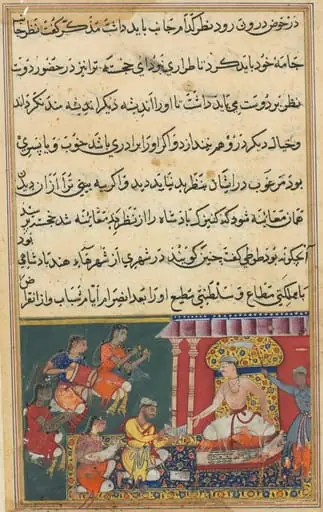 The astrologer predicts a calamity for the newly born prince in his thirteenth year, but one which he would be able to overcome, from a Tuti-nama (Tales of a Parrot): Eighth Night
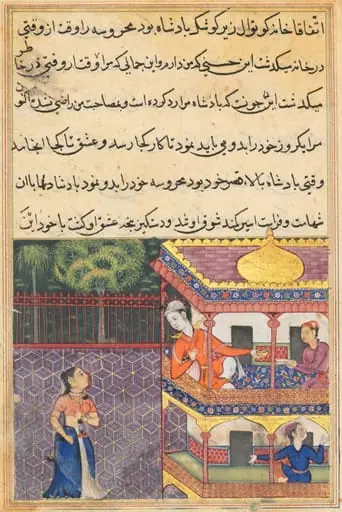 The king of Zabul sees Mahrusa from his palace balcony, from a Tuti-nama (Tales of a Parrot): Thirty-sixth Night
- The king gives his daughter in marriage to the pious man’s son, from a Tuti-nama (Tales of a Parrot): Fifty-second Night
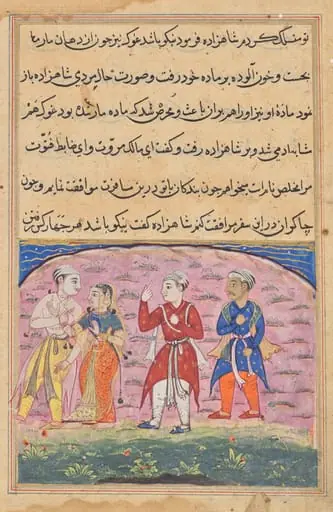 The prince and Nikfal are joined by Khalis and the Mukhlis who are the grateful snake and frog in human form, from a Tuti-nama (Tales of a Parrot): Eighteenth Night
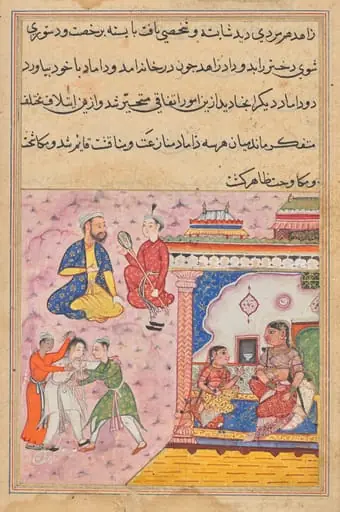 Three suitors fight amongst themselves for the hand of the devotee’s daughter, from a Tuti-nama (Tales of a Parrot): Twentieth Night