Artwork
The dervish brings the King of Kings before the king of Bahilistan, from a Tuti-nama (Tales of a Parrot): Seventh Night
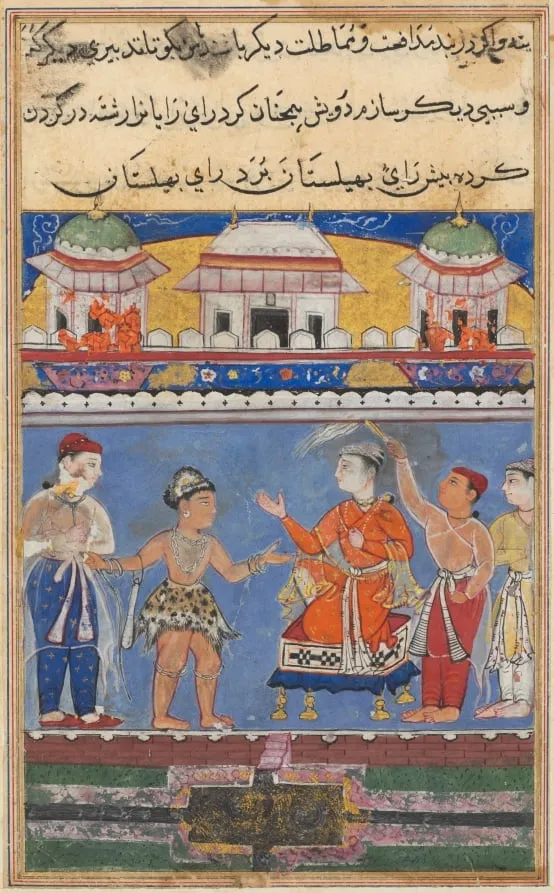
The dervish brings the King of Kings before the king of Bahilistan, from a Tuti-nama (Tales of a Parrot): Seventh Night is an unspecified painting by the Mughal Painting artist Unknown. It dates from 1560 and is held in the collection of the Cleveland Museum of Art.
- Accession no.
- 1962.279.46.a
- Credit line
- Gift of Mrs. A. Dean Perry
About this work
Bright colors fill the scene, red, blue, and green robes, a garden with water channels, and tiny flowers underfoot.
You see a king sitting on a throne under a gold canopy while a holy man leads another king toward him. Bright colors fill the scene, red, blue, and green robes, a garden with water channels, and tiny flowers underfoot.
This painting comes from a book of parrot tales made for Emperor Akbar’s court. The story is wild: a king demands another king’s head as a wedding gift, but the second king just shows up alive. The gold leaf under the throne was later painted over, hiding part of the original design.
If you like these bold colors and royal stories, look up Mughal India, court of Akbar (reigned 1556–1605).
Overview
The painting illustrates a scene from a seventh‑night episode of the Tuti‑nama, a collection of parrot tales compiled for Emperor Akbar’s court. A holy dervish escorts a local monarch toward a seated ruler beneath a gilded canopy, while a formal garden with water channels and low foliage frames the encounter. The composition is dominated by vivid reds, blues and greens, characteristic of Mughal court art.
Subject & Meaning
According to the story, a vizier urges his sovereign to demand the head of the supreme King of Kings as a condition for marrying his daughter. The dervish presents this demand to the higher king, who replies that he will present the requested head still attached to the body, thereby subverting the brutal request and highlighting themes of mercy and cleverness within the tale.
Technique & Style
Executed in the Mughal miniature tradition, the work combines delicate brushwork with a rich palette of primary colors. Original gilded elements, an oval of gold beneath the central pool and orange tiles on the pavilion roofs, were later overpainted, and a blue strip with intricate floral arabesques was added to align the piece with evolving Persian aesthetic preferences. The garden’s canals and foliage are rendered with fine linear detail.
History & Provenance
The painting originates from a manuscript of the Tuti‑nama created for the imperial workshop of Akbar (reigned 1556–1605). Subsequent restorations altered the original gilding, concealing parts of the initial design. The work remains a valuable example of the cross‑cultural exchange between Persian narrative art and the Mughal court, illustrating the literary and visual tastes of the period.
Artist & collection









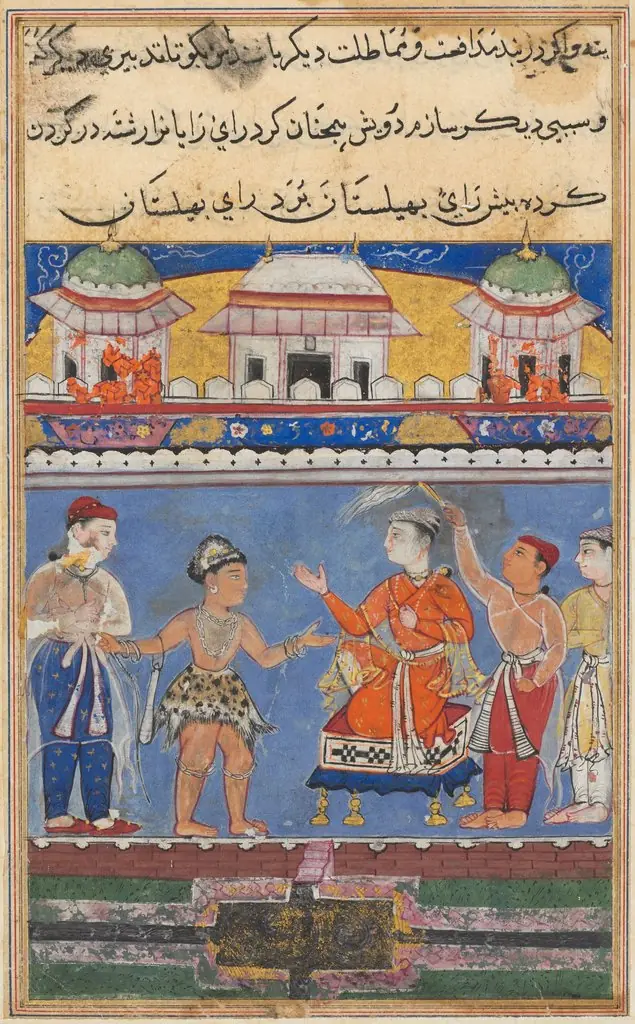
- The dervish brings the King of Kings before the king of Bahilistan, from a Tuti-nama (Tales of a Parrot): Seventh Night
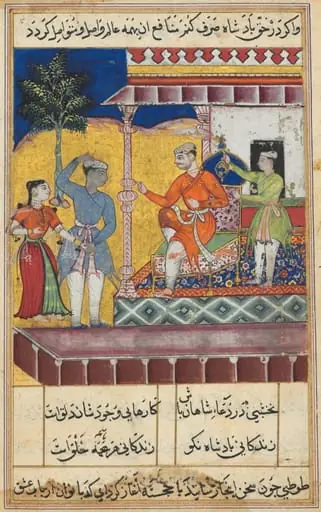 The rejuvenated old man and the daughter of the king of the jinns take leave of the King of Kings, from a Tuti-nama (Tales of a Parrot): Seventh Night
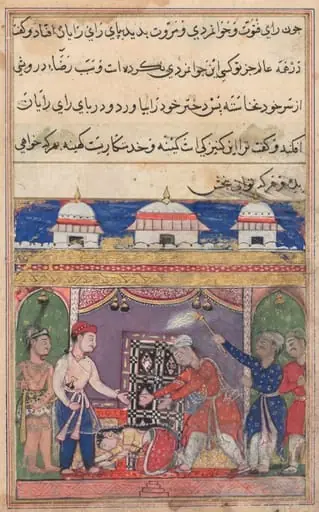 The king of Bahilistan offers his daughter to the King of Kings, from a Tuti-nama (Tales of a Parrot): Seventh Night
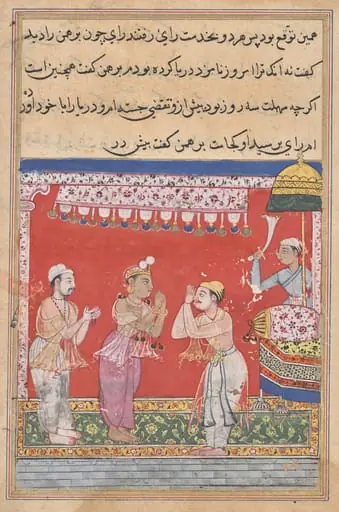 The king of the Ocean, having assumed human form, arrives at the court of the Raja, from a Tuti-nama (Tales of a Parrot): Eleventh Night
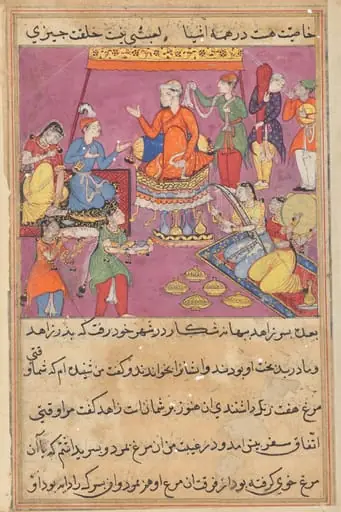 The king gives his daughter in marriage to the pious man’s son, from a Tuti-nama (Tales of a Parrot): Fifty-second Night
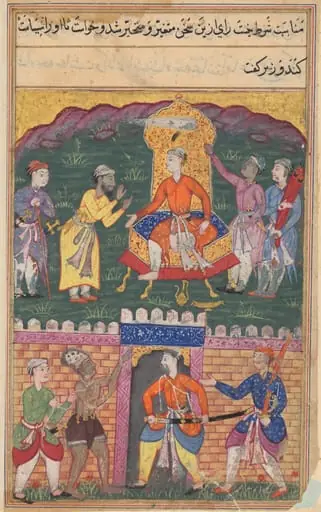 The vizier dissuades the king of Bahilistan from executing the dervish who asks for his daughter’s hand in marriage, from a Tuti-nama (Tales of a Parrot): Seventh Night
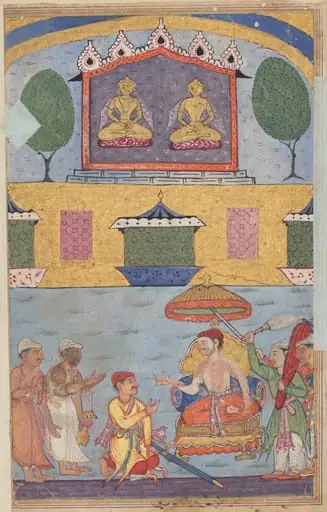 The goldsmith and the carpenter inform the king of a dream in which the golden images plan to desert the city for lack of worshippers, from a Tuti-nama (Tales of a Parrot): Third Night
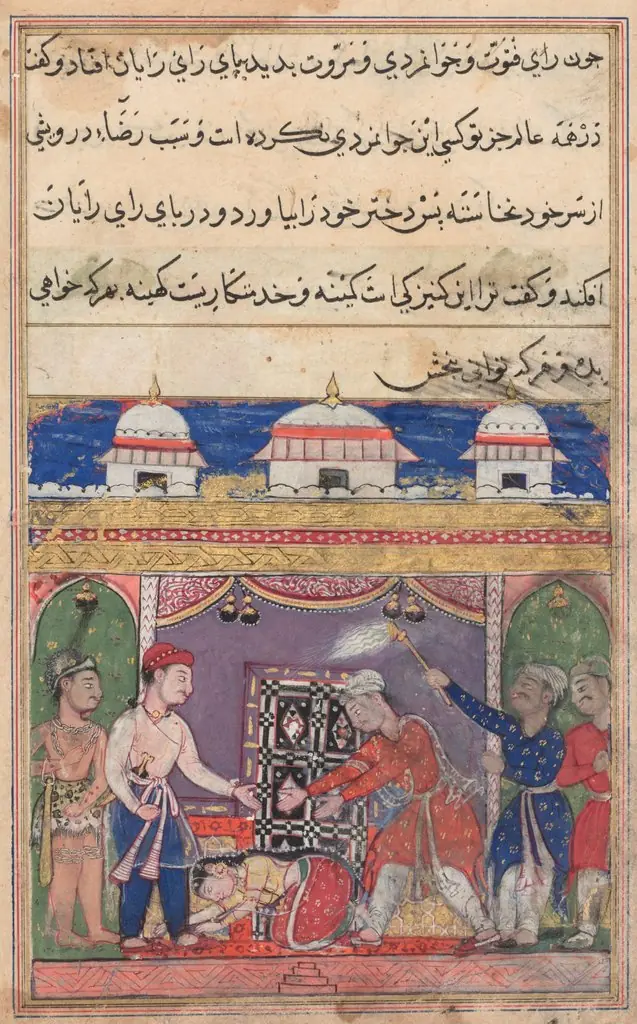 The king of Bahilistan offers his daughter to the King of Kings, from a Tuti-nama (Tales of a Parrot): Seventh Night
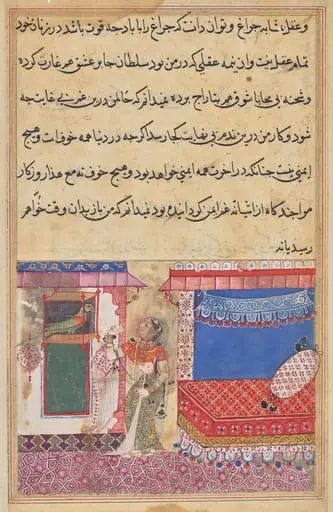 The Parrot Addresses Khujasta at the Beginning of the Eighteenth Night, from a Tuti-nama (Tales of a Parrot)
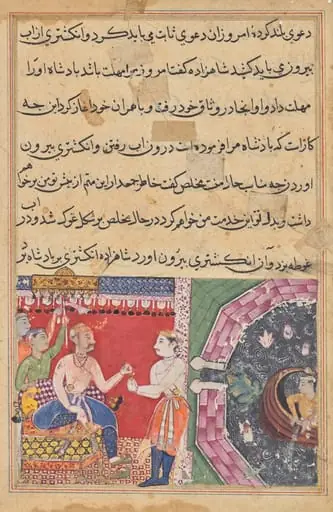 The prince, with the help of Mukhlis who changes into a frog, recovers the ring lost in the sea, and returns it to the king, from a Tuti-nama (Tales of a Parrot): Eighteenth Night