Artwork
Saints Roch, Anthony Abbot and Lucy
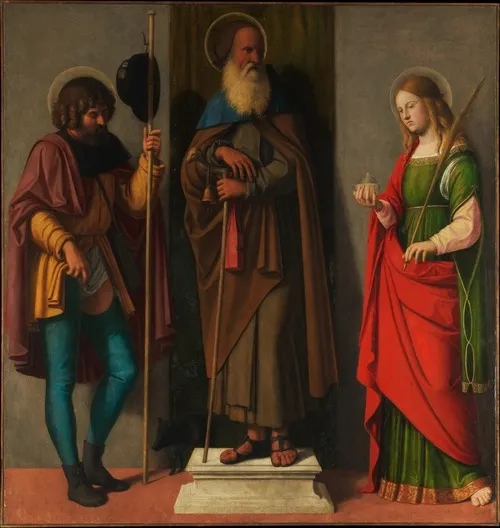
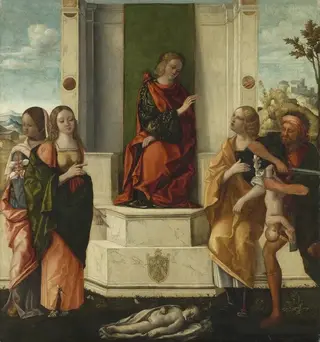
Saints Roch, Anthony Abbot and Lucy is an oil painting by the Venetian Renaissance artist Giovanni Battista Cima da Conegliano. It dates from 1513 and is held in the collection of the Metropolitan Museum of Art. This devotional painting by Cima da Conegliano, completed in 1513, depicts three prominent saints.
About this work
Subject & Meaning
Contemporary records suggest the painting was originally attributed to Giovanni Bellini before being correctly linked to Giovanni Battista Cima da Conegliano.
The work depicts the three titular saints, Saint Roch, Saint Anthony Abbot and Saint Lucy, arranged with Saint Anthony Abbot centrally elevated, Saint Roch displaying the sore on his thigh to emphasize his role as a plague protector, and Saint Lucy holding an oil lamp and a martyr’s palm. Their attributes correspond to established iconography: Roch’s alms bell on a crutch, Lucy’s lamp and palm. The composition likely served a devotional function for the Hospital Brothers of St Anthony, a charitable order caring for plague victims, explaining the patron saint emphasis.
Contemporary records suggest the painting was originally attributed to Giovanni Bellini before being correctly linked to Giovanni Battista Cima da Conegliano.
Technique & Style
Executed in 1513, this religious work is an oil painting originally created on a wood panel before being transferred to canvas, a process that reportedly caused physical damage and potentially reduced the composition's dimensions. The extant support measures 128.3 by 121.9 centimeters. Stylistically, the arrangement features Saint Anthony Abbot elevated centrally, flanked by Saint Roch, who gestures toward a thigh ulcer, and Saint Lucy, identified by an oil lamp and martyr's palm.
Detailed iconography includes a small alms bell suspended from Anthony's crutch. The handling of these figures suggests the work may have served as an inspiration for Correggio's subsequent compositions in Parma. Although once misattributed to Giovanni Bellini, the piece is recognized as a mature example of Cima da Conegliano's output.
History & Provenance
The work, an oil on canvas (originally panel) painted in 1513 in Parma, depicts Saints Roch, Anthony Abbot and Lucy and is attributed to Giovanni Battista Cima da Conegliano. Its creation may have been commissioned by the Hospital Brothers of St. Anthony, a charitable order serving plague victims. The painting entered the collection of Empress Josephine at Malmaison, was later owned by her son Eugène de Beauharnais, and from 1843 to 1904 belonged to the Duke of Leuchtenberg, who kept it in Munich and St. Petersburg.
The Metropolitan Museum of Art acquired it in 1907; the work suffered panel‑to‑canvas transfer and possible size reduction.
The painting is held in the collection of the Metropolitan Museum of Art, New York, as a gift of J. Pierpont Morgan in 1907 (inv. 07.122). It was previously housed in the Duke of Leuchtenberg’s collection from 1843 to 1904, having earlier belonged to Eugène de Beauharnais, Viceroy of Italy, and before that to Empress Joséphine at Malmaison. The work has not been on public view since at least 2018.
Context
Painted in 1513, Saints Roch, Anthony Abbot and Lucy represents a significant late work by Giovanni Battista Cima da Conegliano, created during his time in Parma. Art historical scholarship suggests the composition may have directly inspired Correggio's Four Saints, also held by the Metropolitan Museum of Art, highlighting Cima's influence on the development of Parmese Renaissance art. The painting's iconography, featuring Saint Anthony elevated centrally alongside plague patrons Roch and Lucy, has led to theories that it was commissioned by the Hospital Brothers of St. Anthony for plague relief contexts.
Historically, the work suffered from misattribution; it was long cataloged as a creation of Cima's probable teacher, Giovanni Bellini, a confusion that persisted through its ownership by Empress Josephine at Malmaison. This attributional shift underscores the evolving critical understanding of Cima's distinct style within the Venetian school.
Legacy
The 1513 altarpiece by Giovanni Battista Cima da Conegliano exerted a documented influence on later Renaissance art, particularly through its presumed role as a model for Correggio’s "Four Saints", a connection noted in both English and Italian Wikipedia entries. Contemporary scholarship traces its reputation through a series of attributional shifts, including an early misattribution to Giovanni Bellini that was later corrected. Provenance records from the Empress Josephine, the Beauharnais family, and the Duke of Leuchtenberg underscore its historic significance, while its absence from public display since 2018 has kept scholarly attention on its stylistic impact.
The work remains a reference point for studies of Venetian devotional painting and the transmission of iconographic motifs.
Overview
This devotional painting by Cima da Conegliano, completed in 1513, depicts three prominent saints. Originally executed on a wood panel using oil paint, the artwork is now part of the Metropolitan Museum of Art's collection in New York, having been transferred to canvas. The work is also known by the title Three Saints.
Artist & collection
Artist
Giovanni Battista Cima da Conegliano
Giovanni Battista Cima, also called Cima da Conegliano (c. 1459 – c. 1517), was an Italian Renaissance painter, who mostly worked in Venice. He can be considered part of the Venetian school, though he was also…



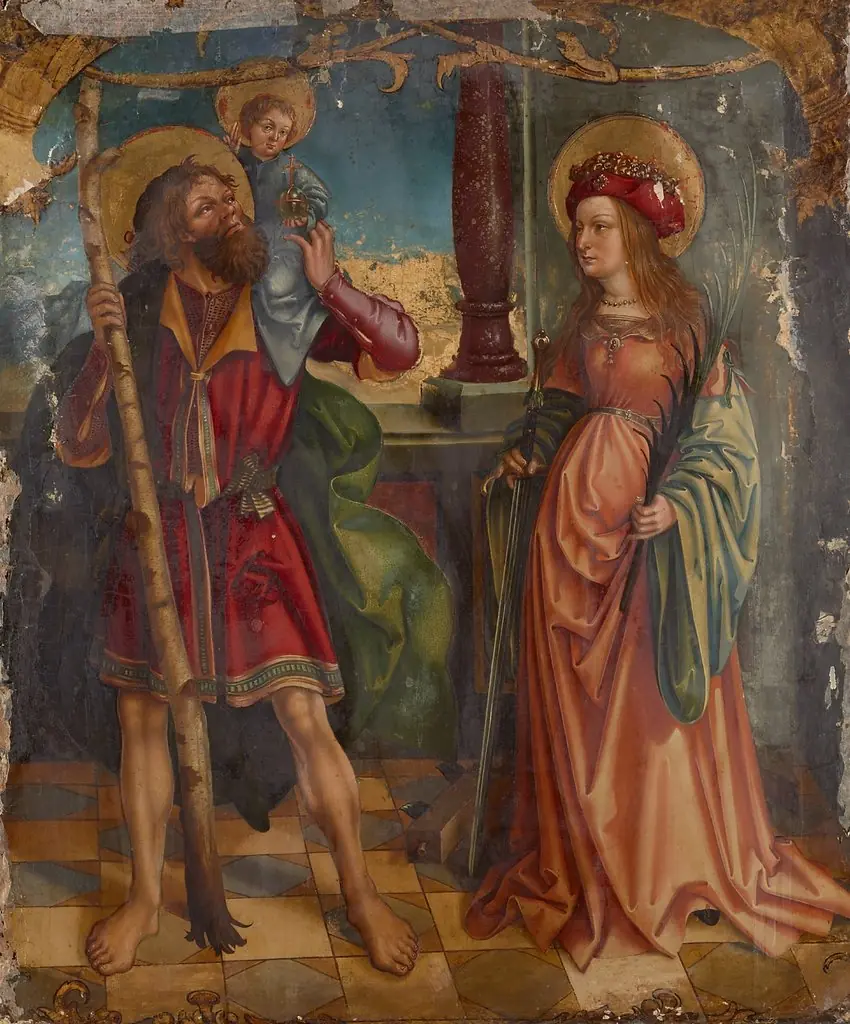 Hll. Christophorus und Katharina
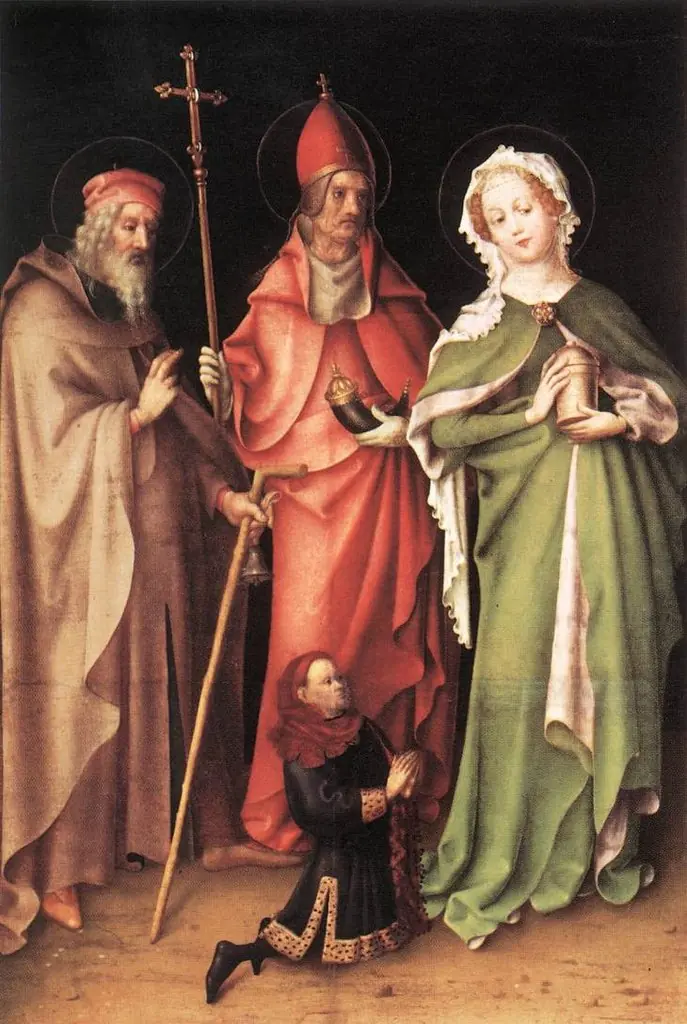 Sts Anthony the Hermit, Cornelius and Mary Magdalen with a Donor
 Saint Catherine of Alexandria Preaching to the Emperor
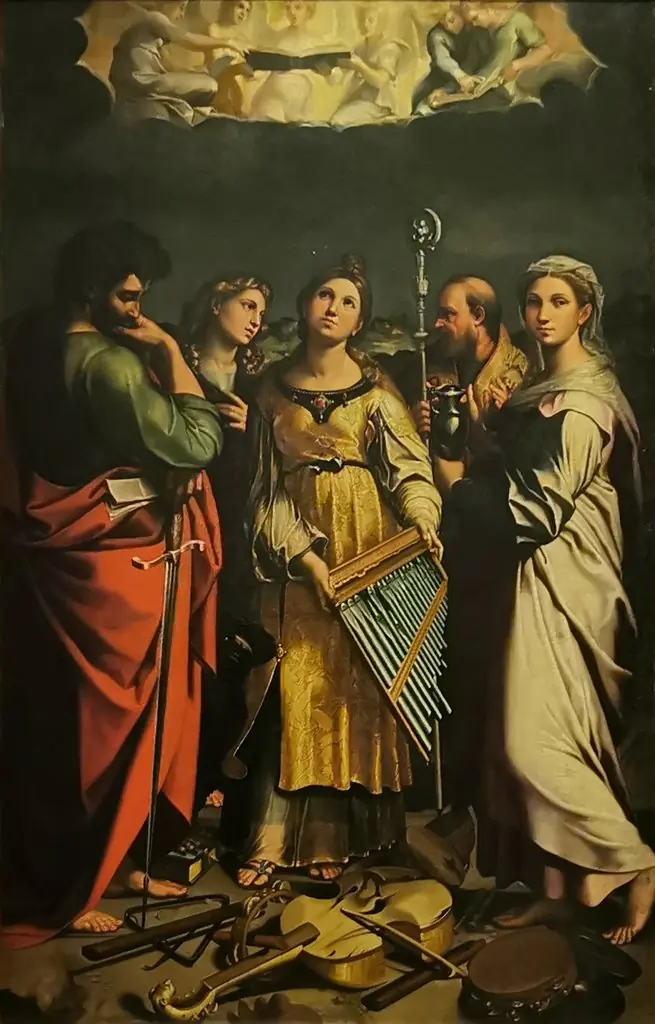 Saint Cecilia
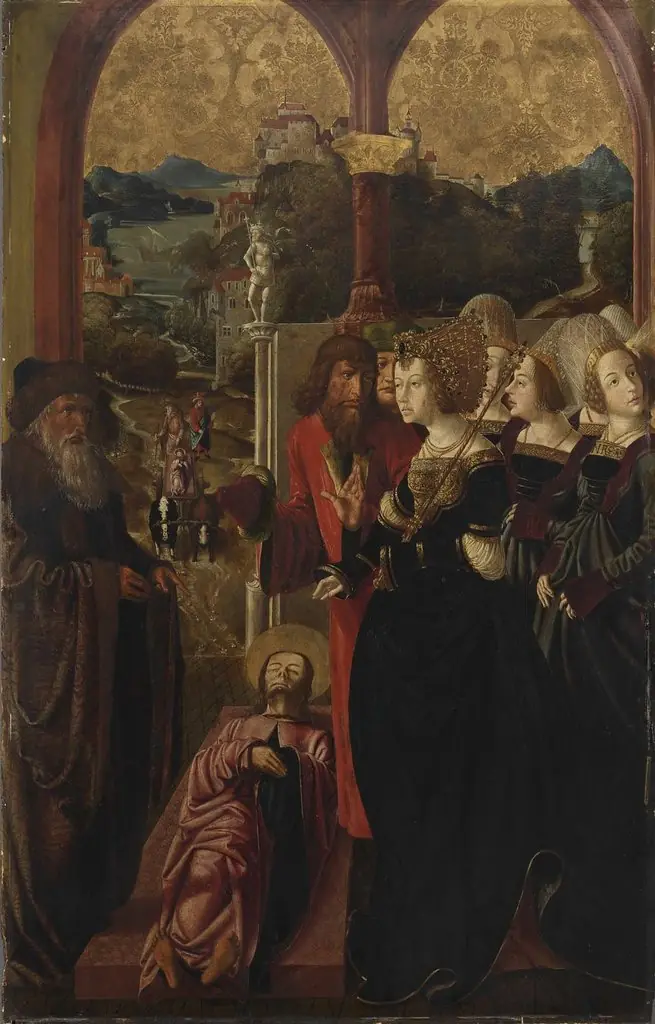 Jakobus-Stephanus-Altar: Der Leichnam des Jakobus wird vor Königin Lupa gebracht
 Das Urteil Salomonis
 The Holy Family with an Angel
 The Ecstasy of Saint Cecilia