Artwork
The Sacrifice of Isaac
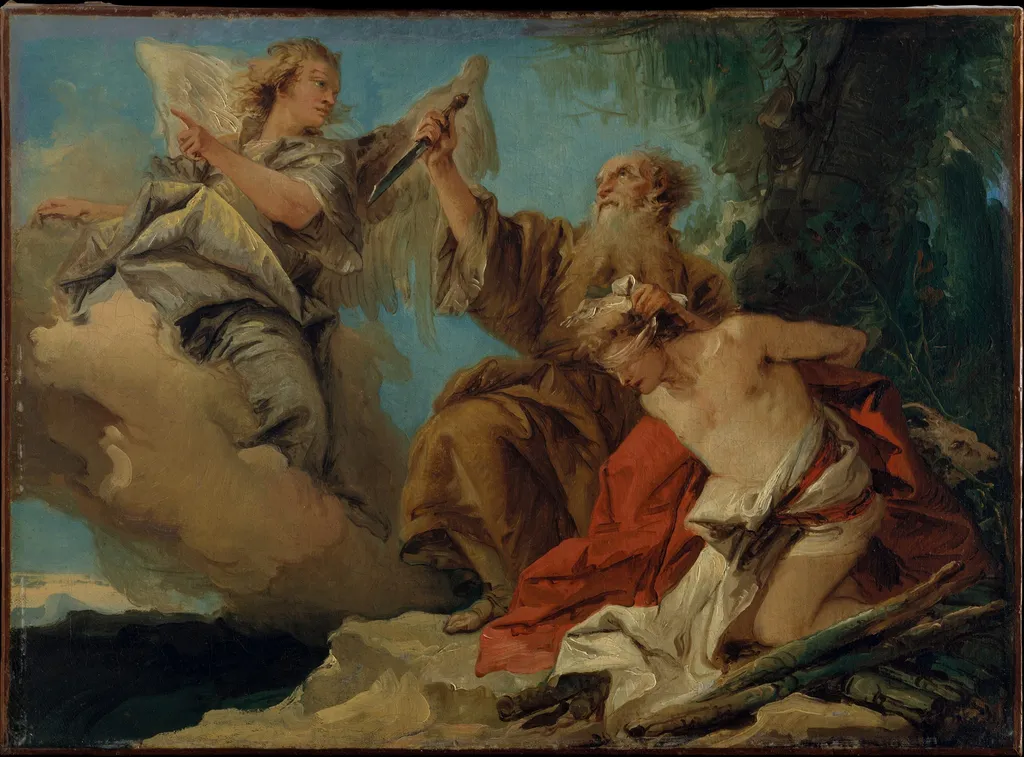
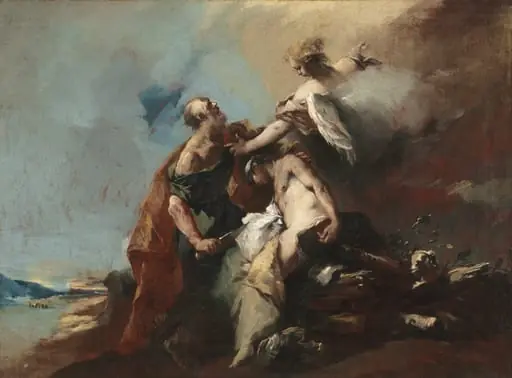
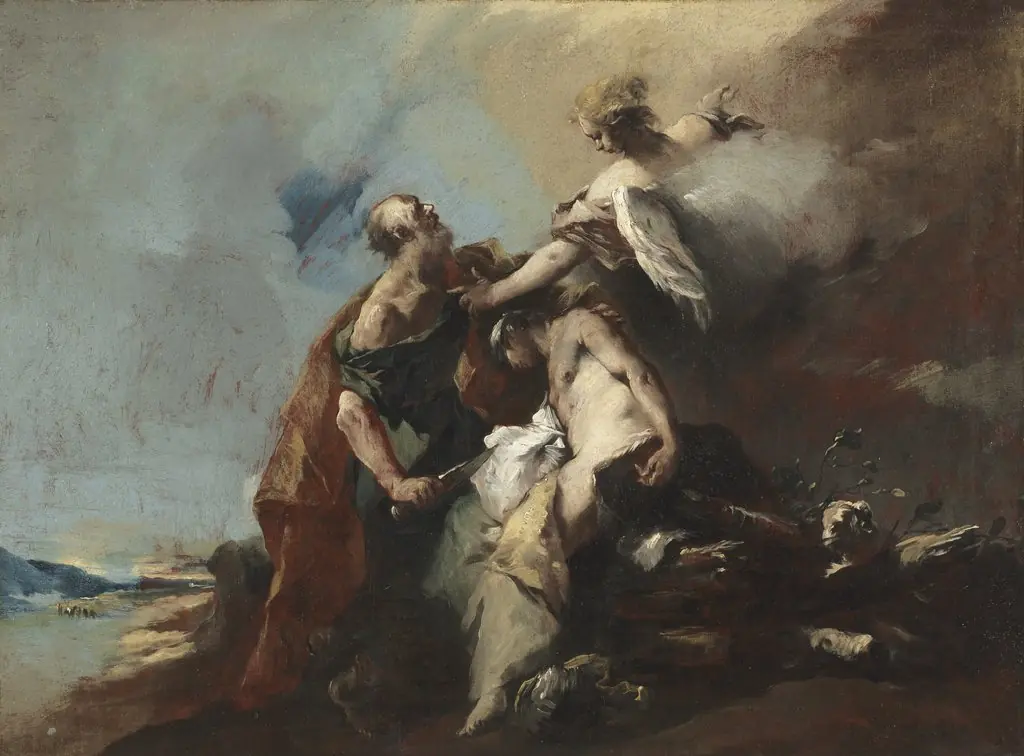
The Sacrifice of Isaac is an oil painting by the Rococo painting artist Giovanni Domenico Tiepolo. It dates from 1750 and is held in the collection of the Metropolitan Museum of Art.
About this work
Three figures fill a dramatic scene. An angel in flowing robes reaches out to stop an older man gripping a knife, while a younger figure lies on the ground, half-covered by a red cloth. The sky swirls with blues and greens, its clouds almost like smoke. Giovanni Domenico Tiepolo painted it in oil around 1750.
Subject & Meaning
The inclusion of the angel and the ram reinforces the narrative’s resolution, symbolizing God’s provision and the substitution of Isaac’s life with the ram’s.
Giovanni Domenico Tiepolo’s The Sacrifice of Isaac (1750) depicts the biblical narrative of Abraham’s near-sacrifice of his son Isaac, as recounted in Genesis 22. In the composition, Abraham, knife in hand, is poised to obey God’s command, while an angel intervenes to halt the act, directing attention to a nearby ram as a substitute offering. The scene emphasizes divine mercy and obedience, underscoring the theological theme of substitutionary sacrifice.
The inclusion of the angel and the ram reinforces the narrative’s resolution, symbolizing God’s provision and the substitution of Isaac’s life with the ram’s. The painting’s religious genre aligns with Counter-Reformation traditions, which emphasized dramatic biblical episodes to convey moral and theological truths.
Technique & Style
Executed in 1750, this religious painting by Giovanni Domenico Tiepolo utilizes oil paint applied to a canvas support. The work measures 39.1 cm in height and 53.3 cm in width. While specific details regarding the artist's brushwork, surface condition, or handling techniques are not explicitly detailed in the available records, the piece is formally categorized as a painting depicting the biblical Binding of Isaac.
The composition features key figures including Abraham, Isaac, and an angel, along with symbolic elements such as a knife. The medium and support combination of oil on canvas was a standard practice for the artist during this period, allowing for the fluid application characteristic of the era's religious genre works.
History & Provenance
The Sacrifice of Isaac was created by Giovanni Domenico Tiepolo in 1750, executed in oil as a religious work depicting the Binding of Isaac, and measures 39.1 by 53.3 centimeters. The painting was once owned by William T. Blodgett before entering the collection of the Metropolitan Museum of Art, where it is currently held. Beyond this documented ownership link, the sources do not provide further details regarding the original commission, intermediate owners, or specific creation circumstances, nor do they contain a specific accession number or a detailed chronology of past exhibitions.
Overview
Giovanni Domenico Tiepolo, a prominent figure in the Rococo period and son of the renowned Giovanni Battista Tiepolo, completed The Sacrifice of Isaac around 1750. This oil on canvas composition captures a pivotal moment from the Old Testament, illustrating the dramatic intervention of an angel to prevent Abraham's sacrifice of his son. The work is now part of The Metropolitan Museum of Art's collection.
Own this work as a print
Artist & collection
Artist
Giovanni Domenico Tiepolo (August 30, 1727 – March 3, 1804) was an Italian painter and printmaker in etching. He was the son of artist Giovanni Battista Tiepolo and elder brother of Lorenzo Baldissera Tiepolo.