Artwork
January
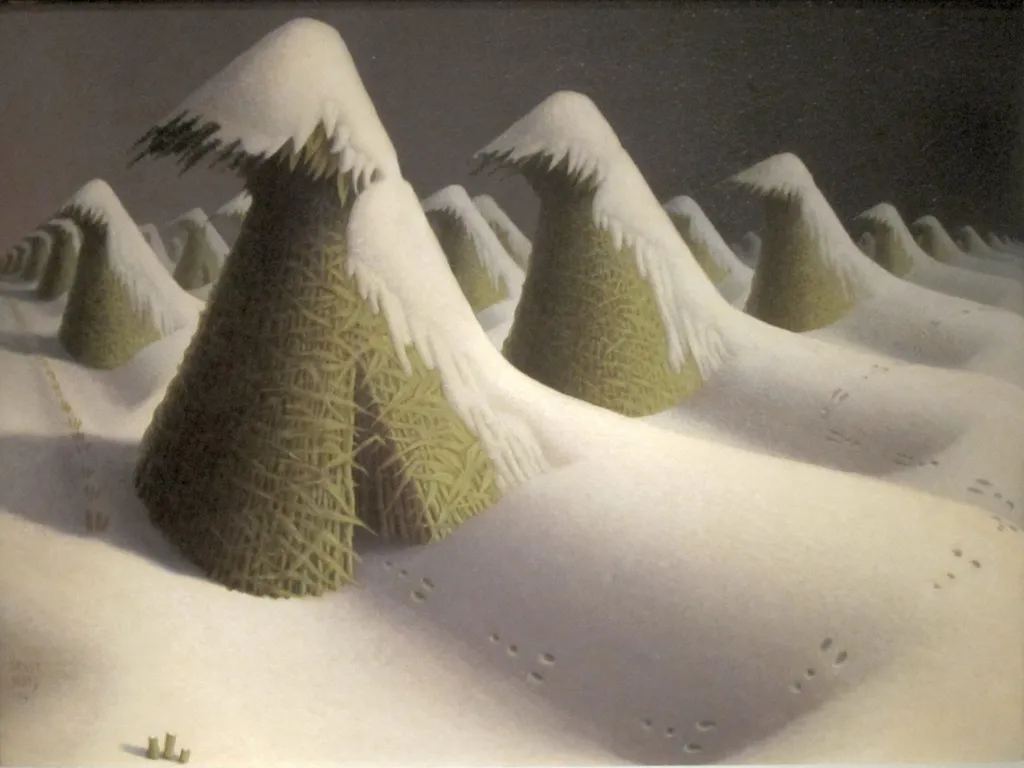
January is an unspecified painting by the Regionalist artist Grant Wood. It dates from 1940 and is held in the collection of the Cleveland Museum of Art.
About this work
Technique & Style
No further details regarding specific paint handling, surface condition, or stylistic elaboration are documented in the available sources.
January is a painting executed on masonite, a hardboard support favored by Grant Wood during this period of his career. The work measures 67 cm in height by 82.5 cm in width, giving it a horizontal orientation. Stylistically, it is classified within the Regionalist genre, a movement associated with Wood's depictions of the American Midwest.
The painting is held in the collection of the Cleveland Museum of Art, where it was accessioned as object number 2002.2.
No further details regarding specific paint handling, surface condition, or stylistic elaboration are documented in the available sources.
History & Provenance
Grant Wood created the painting January in 1940. Executed on masonite, the work was produced in the United States during the final years of the artist's life. The piece entered the collection of the Cleveland Museum of Art, where it remains held under the accession number 2002.2.
While the specific circumstances of its commission or its ownership history between Wood's studio and the museum are not detailed in the available records, the work is firmly dated to 1940 and identified as a product of the Regionalist genre.
January is held by the Cleveland Museum of Art, where it is catalogued under inventory number 2002.2. The painting entered the museum's collection as part of its holdings of American Regionalist works by Grant Wood.
No exhibition history beyond its inclusion in the Cleveland Museum of Art's permanent collection is documented in the available sources.
Overview
January, painted by Grant Wood in 1940, depicts a stark Iowa winter landscape characterized by rolling, cone-shaped hills dusted with snow. The composition features a high horizon line under a heavy, dark sky that contrasts sharply with the white ground, emphasizing the severity of the season. Wood executed the work on Masonite, utilizing short, distinct brushstrokes to render the texture of the snow and the sparse vegetation clinging to the slopes.
This piece aligns with Wood's Regionalist style, which sought to celebrate and document the American Midwest, yet it diverges from his more famous narrative works like American Gothic by focusing on pure atmospheric mood rather than human figures. Created during the final years of the artist's life, January reflects his continued engagement with the rural landscape of his native state, capturing the quiet isolation and geometric forms of the terrain. The painting stands as a significant example of Wood's ability to stylize the natural environment into a rhythmic, almost abstract arrangement of forms and colors, solidifying his legacy as a defining voice of 20th-century American art.
Subject & Meaning
The painting depicts a quiet, snow-covered terrain characterized by unusual, conical hills. A fresh layer of white snow blankets the ground, contrasting with the dark, almost black sky above, which intensifies the brightness of the winter scene. Sparse patches of green vegetation cling to the hillsides, suggesting a stark, cold atmosphere devoid of human or animal presence.
Context
January aligns with Grant Wood's broader artistic practice, which often explored regional American themes and landscapes with a distinctive, sometimes surreal, sensibility. While many of his well-known works feature figures or architectural elements from small-town life, this painting demonstrates his capacity to imbue a natural scene with the same peculiar, stylized quality that defines his broader body of work.
Own this work as a print
Artist & collection

Artist
Grant DeVolson Wood was an American artist and representative of Regionalism, best known for his paintings depicting the rural American Midwest.

- The Ricks Barn, Woodstock
 Nest of Winter
 Winter Scene in Moonlight
 En egn ved Töplitz. Vinter
 En egn ved Töplitz. Vinter
 Memoria zidului
 The Connecticut Valley
 Near Fortunen, Jægersborg Deer Park, North of Copenhagen
 A Winter Landscape Within a Jugendstil Border
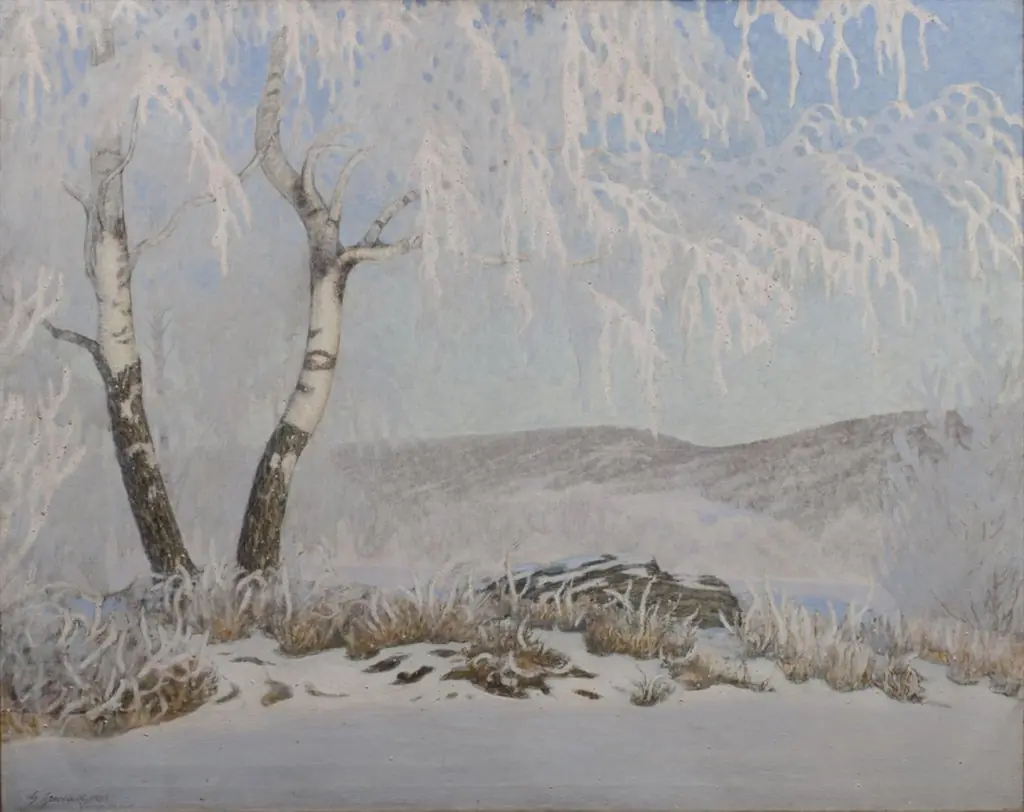 White Frost in Sunshine
 White Frost in Sunshine