Artwork
American Gothic
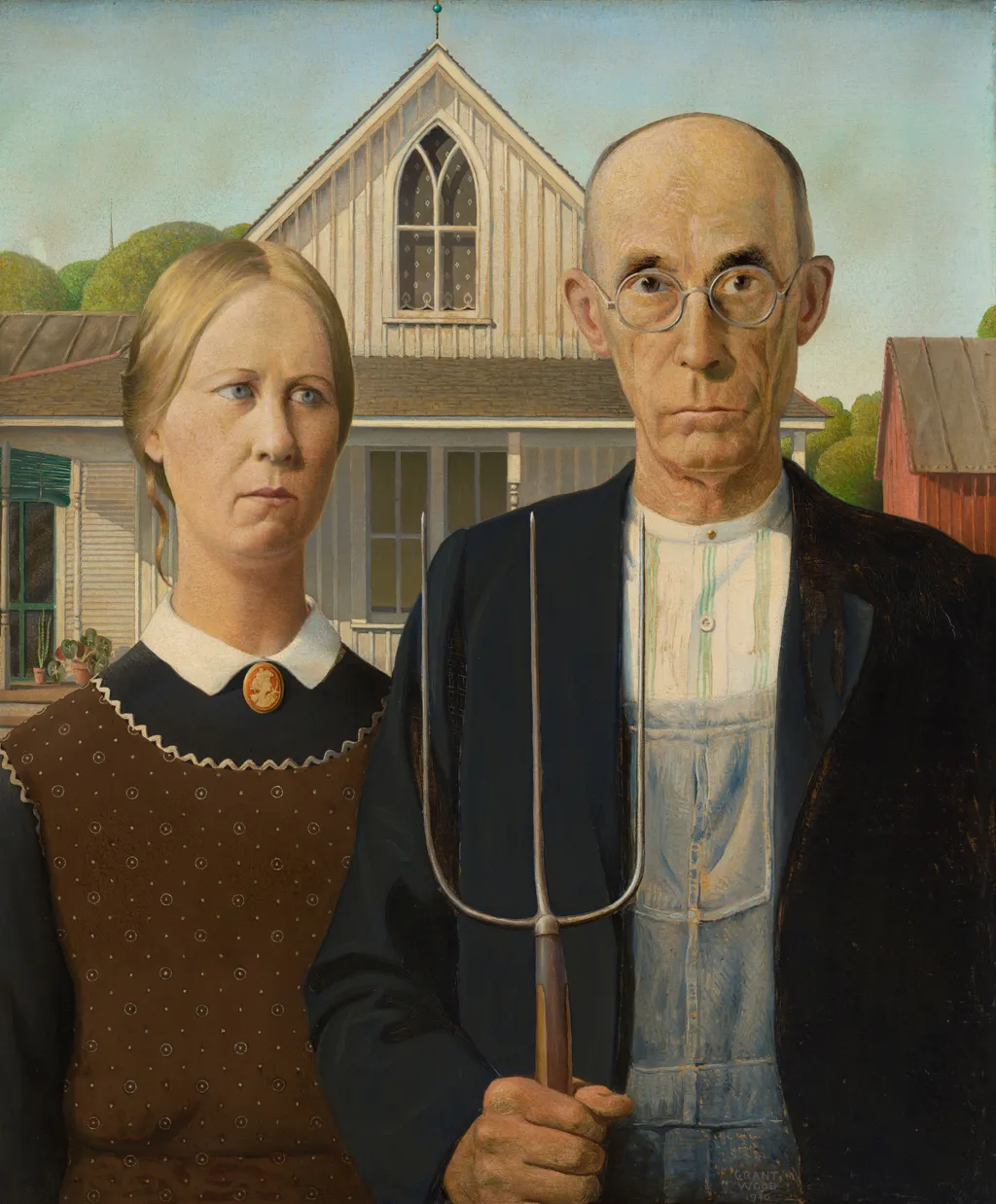
American Gothic is an oil painting by the Regionalist artist Grant Wood. It dates from 1930 and is held in the collection of the Art Institute of Chicago.
About this work
Grant Wood's American Gothic, an oil from 1930, shows a farmer and his daughter before their house. The style is Regionalism, art rooted in the everyday life of specific parts of America. The pointed window behind them gives the picture its name.
Wood modeled the man's face on his dentist, and the stern expressions have kept the scene memorable ever since.
Subject & Meaning
Contemporary observers have read the work variously as satire of Midwestern conservatism, as a tribute to rural resilience, and as an ambiguous blend of both.
The painting shows a farmer standing beside a woman in a colonial-print apron before a Carpenter Gothic house; the man grips a three-pronged pitchfork. The house, identified as the Dibble House in Eldon, Iowa, features a pointed-arch window that recalls Gothic architecture. Symbolic details include the pitchfork, the apron's rickrack trim, and the potted plants on the porch.
Contemporary observers have read the work variously as satire of Midwestern conservatism, as a tribute to rural resilience, and as an ambiguous blend of both. The figures were modeled on Grant Wood's sister Nan Wood Graham and the dentist Byron McKeeby, and their portrayal has sparked debate about whether the pair represents a wife, daughter, or symbolic archetype. Together these elements convey a complex meditation on American identity and pioneer spirit.
Technique & Style
American Gothic is executed in oil paint on a beaverboard support. Wood painted each figure and architectural element separately, with the models posing independently and never together before the house; he later used a photograph of the Dibble House to complete the composition. The work displays a meticulous realist style indebted to the exactitude of Flemish Renaissance painters such as Jan van Eyck, while also reflecting German Renaissance influences.
Its composition emphasizes vertical echoes of Gothic architecture, the pitchfork, the window tracery, and the man's facial structure, and presents the subjects in a frontal, photographic pose reminiscent of nineteenth-century American portraiture.
History & Provenance
American Gothic was painted in 1930 by Grant Wood, an Iowa-born artist with prior European training, in oil on beaverboard. While visiting Eldon, Iowa, in August 1930, Wood spotted a small white Carpenter Gothic-style farmhouse, the Dibble House, and made an initial sketch from the front yard, exaggerating the steepness of the roof and the pointed upper window. Back in his Cedar Rapids studio, he added two figures, posing them separately: his sister Nan Wood Graham modeled for the woman, in a colonial-print apron, while the family dentist, Dr. Byron McKeeby, posed for the man.
Wood entered the finished painting in the Art Institute of Chicago's Forty-Third Annual Exhibition of Painting and Sculpture, where it won a bronze medal and a $300 prize; the institution then purchased it, and it remains in the Art Institute's collection. The painting has rarely left the United States, traveling abroad for the first time in 2016–2017 to Paris and London.
Context
American Gothic (1930) stands as a defining work of the Regionalist movement, marking a shift away from European modernism toward a distinct American visual identity. Grant Wood employed a veristic style influenced by the Flemish Primitives, particularly Jan van Eyck, to depict a Midwestern farmer and a woman. While initially interpreted by critics such as Gertrude Stein as a satire of rural small-town life akin to the contemporary fiction of Sinclair Lewis, the work's meaning evolved with the Great Depression.
Wood later positioned the piece as a tribute to the steadfast pioneer spirit, aligning himself with populist peers Thomas Hart Benton and John Steuart Curry. Its reception remains complex: it sparked local backlash in Iowa for perceived caricature yet became a national icon, one of the most frequently referenced images in American popular culture.
Legacy
Since its 1930 debut, American Gothic has become an enduring emblem of Midwestern identity, displayed internationally at Paris's Musée de l'Orangerie and London's Royal Academy in 2016–2017. Critics initially labeled it a satire, while later reinterpretations framed it as a homage to pioneer resilience during the Depression. Scholarly discourse continues to emphasize its ambiguous tone, debating parody versus celebration. The image's pervasiveness in popular culture, from The Simpsons to commercial advertising, underscores its lasting symbolic power.
Overview
Grant Wood's 1930 oil painting, "American Gothic," is rendered on beaverboard and depicts a Midwestern farmer with a woman identified as his daughter. They stand before a house featuring distinctive Carpenter Gothic architecture. This work is a seminal example of American Regionalism, an art movement focused on portraying everyday life and specific cultural landscapes across the United States. It stands as one of the most recognized American artworks from the 20th century.
Own this work as a print
Artist & collection

Artist
Grant DeVolson Wood was an American artist and representative of Regionalism, best known for his paintings depicting the rural American Midwest.