Artwork
The Midnight Ride of Paul Revere
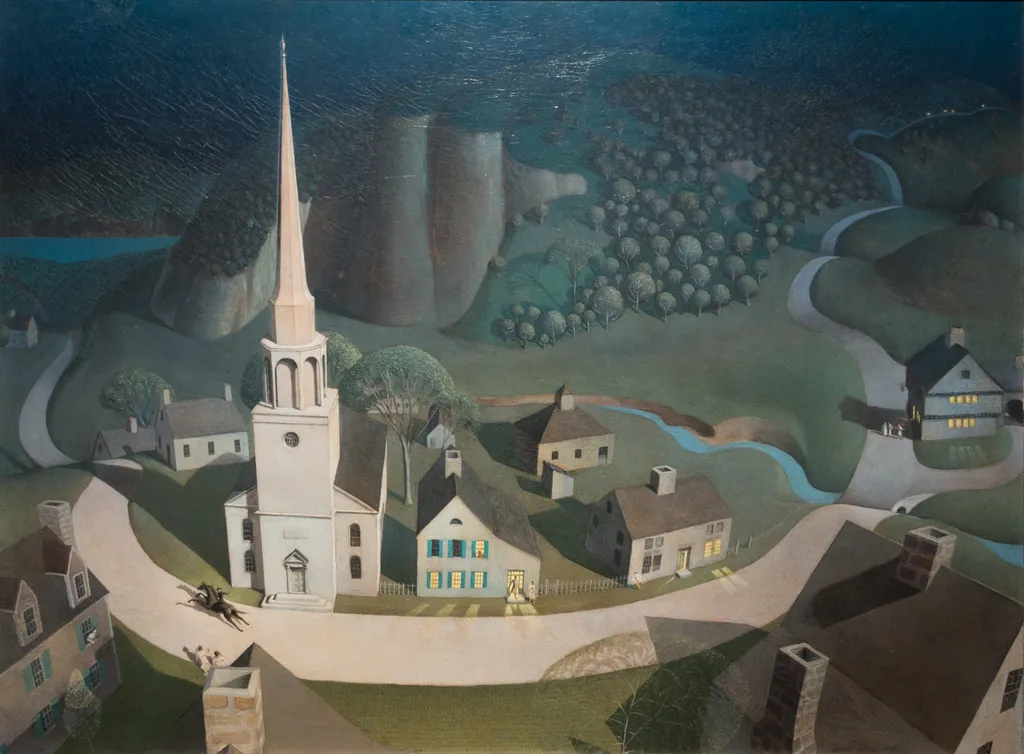
The Midnight Ride of Paul Revere is an oil painting by the Regionalist artist Grant Wood. It dates from 1931 and is held in the collection of the Metropolitan Museum of Art.
About this work
From a bird's-eye view, Grant Wood sends Paul Revere galloping through a toy-like Lexington, Massachusetts, under a bright moon.
From a bird's-eye view, Grant Wood sends Paul Revere galloping through a toy-like Lexington, Massachusetts, under a bright moon. Painted in 1931, the horse is modeled on a child's hobby horse and the houses glow as if wired for light. Wood took the scene from Longfellow's poem rather than the record, a deliberately stylized image of the 1775 ride. The Met acquired it in 1950, a defining work of American Regionalism.
Subject & Meaning
The work portrays the American patriot Paul Revere astride a horse as he rides through a nocturnal Lexington, Massachusetts. A high-altitude view shows the moon-lit town, a prominent church steeple, and the road he traverses, linking the scene to the 1775 midnight ride. The composition includes a road, a church building, and surrounding countryside, all rendered in an equestrian, revolutionary context.
Wood's stylized forms, dramatic lighting, and use of a child's hobby horse as a model create a dream-like, symbolic representation of national courage and the impending conflict of the American Revolution.
Technique & Style
The Midnight Ride of Paul Revere is executed in oil paint on a masonite panel. Grant Wood applied the oil medium with careful, linear precision to render the scene's forms. The painting adopts a markedly elevated, bird's-eye perspective that bathes Lexington in intense, almost theatrical light, producing unrealistic shadows and a dreamlike atmosphere.
Buildings and foliage are stylized into geometric, almost decorative shapes, while the horse was modeled after a child's hobby horse, a detail Wood used to achieve a distinctive, illustrative quality. These formal choices align the work with Wood's broader tendency toward stylized, narrative Americana.
History & Provenance
Grant Wood executed The Midnight Ride of Paul Revere in 1931 as an oil painting on masonite. Inspired by Henry Wadsworth Longfellow's 1860 poem, the artist utilized a child's hobby horse as the model for the equestrian figure. Upon completion, the work entered the collection of Mr. and Mrs. Cecil M. Gooch in Memphis, Tennessee, where it remained from 1931 until 1950.
That year, the Gooches donated the painting to the Memphis YWCA. Shortly thereafter, the organization sold the piece to the Metropolitan Museum of Art in New York City for $15,000, where it has been held in the permanent collection since.
The painting was removed from public view in 2017 and is currently stored in the museum's study rooms.
Legacy
The Midnight Ride of Paul Revere (1931) by Grant Wood is classified as a history painting and is part of the Metropolitan Museum of Art's collection. Its stylized nocturnal composition and regionalist approach have been highlighted in art-historical surveys, contributing to Grant Wood's lasting reputation as a chronicler of American heritage. The work's provenance, from the Gooch family to a 1950 donation to the Met, illustrates its institutional acceptance, and its frequent citation in encyclopedic entries reflects its recognized legacy in shaping visual narratives of the American Revolution.
Overview
Grant Wood's 1931 oil painting, "The Midnight Ride of Paul Revere," reimagines the historic event of April 1775. It presents a distinctive, elevated perspective of Paul Revere galloping through a stylized Lexington, Massachusetts. This work is notable for its dream-like quality and its connection to American Regionalism, offering a unique visual interpretation of a national legend.
Own this work as a print
Artist & collection

Artist
Grant DeVolson Wood was an American artist and representative of Regionalism, best known for his paintings depicting the rural American Midwest.