Artwork
Man at His Bath
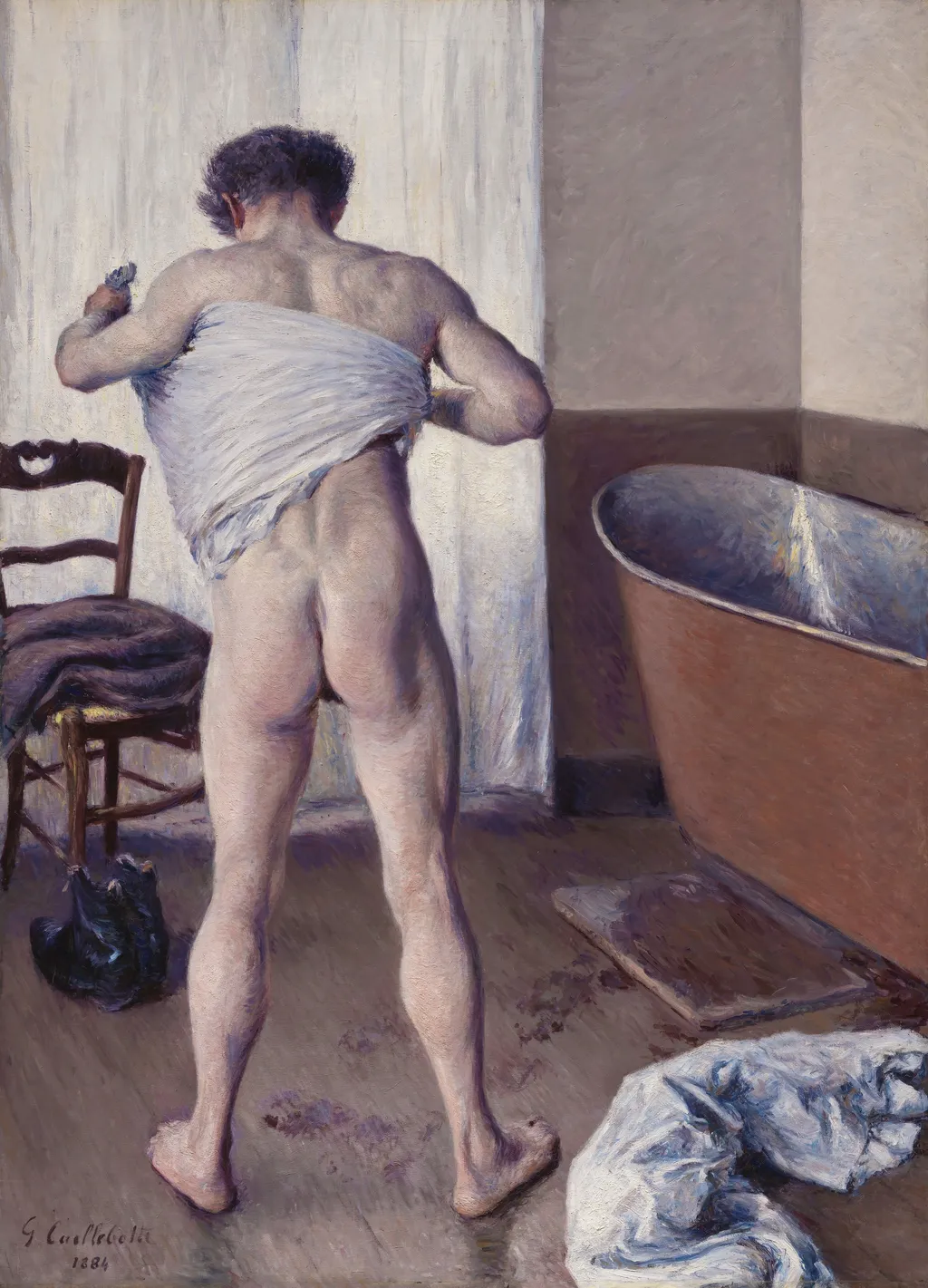
Man at His Bath is an oil painting by the Impressionist artist Gustave Caillebotte. It dates from 1892 and is held in the collection of the Museum of Fine Arts Boston.
About this work
This painting is called Man at His Bath. It's an oil painting by a French artist.
The artist, Gustave Caillebotte, created this work in 1884. It's described as an oil painting, which gives us a sense of the medium used.
To learn more about the style and techniques that might be used in this painting, look up the technique of glazing.
Subject & Meaning
This tension between public expectation and private reality aligns with Caillebotte’s broader practice of portraying modern life with unsentimental fidelity.
The painting depicts a man drying himself after a bath, viewed from behind in a modest interior. The composition centers on an unidealized male nude, emphasizing quotidian realism rather than classical or heroic ideals. The subject’s posture and partial concealment by a towel underscore a rare vulnerability in Impressionist art, where male nudity was uncommon and domestic bathing scenes typically associated with women, often coded as prostitution.
Critics have framed the work as a challenge to contemporary gender norms, contrasting traditional masculinity with the figure’s exposed, unheroic body. This tension between public expectation and private reality aligns with Caillebotte’s broader practice of portraying modern life with unsentimental fidelity.
Technique & Style
Executed in 1884, this work is an oil painting on canvas measuring approximately 145 by 114 centimeters. Caillebotte employs a realist approach to depict a male figure drying himself after emerging from a metal bathtub, rejecting the idealized masculinity common in academic art of the period. The composition focuses on the subject's back, with wet footprints trailing across the wooden floor toward a chair holding folded clothes and boots.
This unvarnished portrayal of a domestic toilette, typically associated with female subjects in Impressionism, emphasizes vulnerability over heroic form. The handling of the scene captures specific physical details, such as the texture of the towel and the dampness of the floor, grounding the image in a tangible, everyday reality.
History & Provenance
Man at His Bath was painted by Gustave Caillebotte in 1884, the same year as its pendant, Man Wiping His Leg.
The work remained with the artist until his death in 1894, then passed to his heirs and later to family descendants. In 1967 it was sold to the Parisian gallery Lorenceau and immediately resold to Swiss collector Samuel Josefowitz. The Museum of Fine Arts, Boston acquired the painting in June 2011 for approximately $17 million, funding the purchase by deaccessioning eight works, including pieces by Monet, Renoir, Gauguin, Sisley, Pissarro and others, at Sotheby’s in November 2011.
Gustave Caillebotte's Man at His Bath is held by the Museum of Fine Arts, Boston, where it has been part of the permanent collection since June 2011. The work was exhibited at the Les XX show in Brussels in 1888, but due to its controversial realistic depiction of a male nude, it was removed from the main gallery and placed in a restricted room accessible only to experts. Following the artist's death in 1894, the painting remained with his heirs until 1967, when it was sold to a private collector in Switzerland.
The Museum of Fine Arts acquired the piece for approximately $17 million, a purchase funded by the controversial deaccession and sale of eight other works. While the museum does not list a specific accession number in the provided sources, the acquisition marked the institution's first Impressionist nude.
Context
Exhibited at Les XX in Brussels in 1888, the painting provoked such controversy due to its unidealized realism that organizers relegated it to a private room inaccessible to the general public. Scholars note that while female nudes were common in Impressionism, often linked to prostitution, Caillebotte's depiction of a vulnerable male figure challenged contemporary gender norms and the academic tradition of heroic masculinity.
The work's difficult subject matter complicated its modern acquisition; in 2011, the Museum of Fine Arts, Boston, found donors unwilling to fund the purchase of a male nude. Consequently, the museum controversially deaccessioned eight works by more famous artists, including Monet and Renoir, to raise the necessary $17 million. Critics and defenders alike recognized the acquisition as a bold move that secured the museum's first Impressionist nude.
Legacy
Upon its 1888 exhibition at Les XX in Brussels, Man at His Bath faced immediate controversy due to its unidealized depiction of a male nude, resulting in its removal from the main gallery to a restricted room accessible only to experts. This initial reception highlighted the work's challenge to 19th-century gender norms, where domestic bathing scenes were traditionally associated with female subjects. The painting's legacy was further cemented by the Museum of Fine Arts, Boston's 2011 acquisition, which sparked significant debate over the deaccessioning of eight works by renowned artists like Monet and Renoir to fund the purchase.
Critics and defenders alike noted the difficulty in securing donations for a painting depicting male nudity, yet the acquisition was hailed as a bold, adventurous move for a world-class institution. The work now stands as the museum's first Impressionist nude, marking a pivotal moment in the public acceptance of Caillebotte's realistic approach to masculinity.
Overview
Gustave Caillebotte's "Man at His Bath," completed in 1884, is an oil painting that exemplifies the French artist's engagement with Impressionist principles. The artwork, also known by its French title "Homme au bain," is rendered on a canvas measuring 145 by 114 centimeters, indicating a substantial scale. This piece reflects Caillebotte's distinct approach within the broader Impressionist movement.
Own this work as a print
Artist & collection

Artist
Gustave Caillebotte (French: ; 19 August 1848 – 21 February 1894) was a French painter who was a member and patron of the Impressionists, although he painted in a more realistic manner than many others in the group.