Artwork
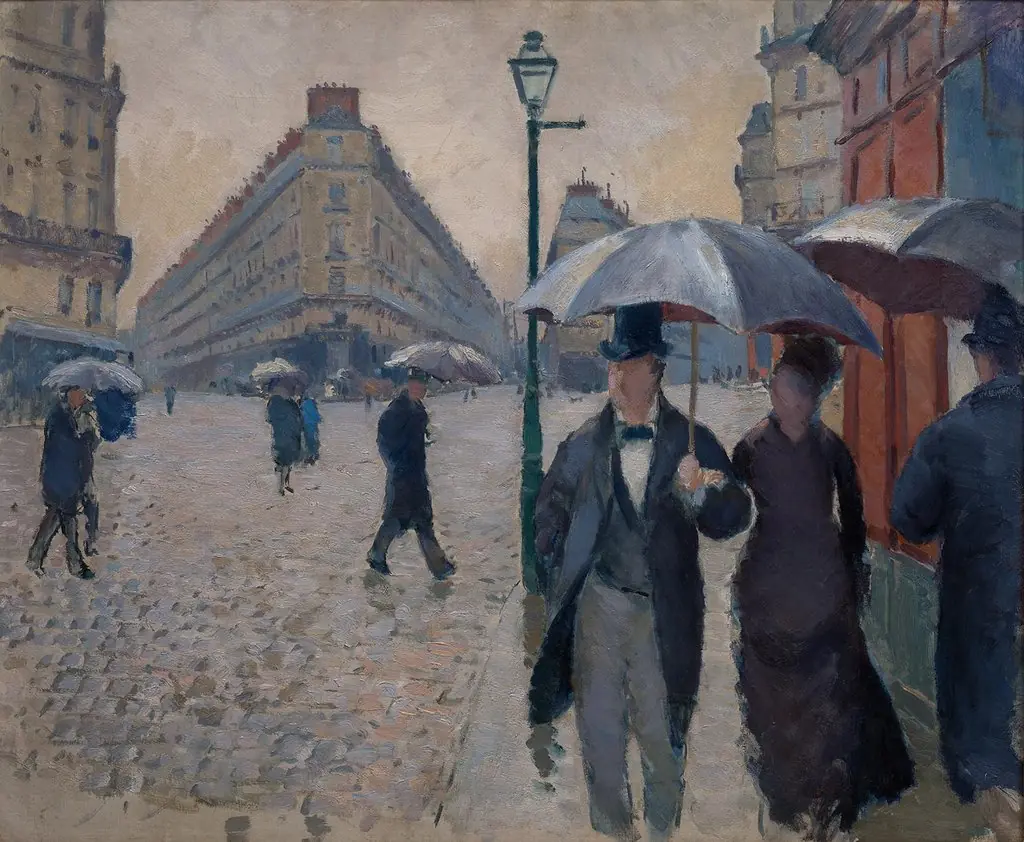
Paris Street; Rainy Day
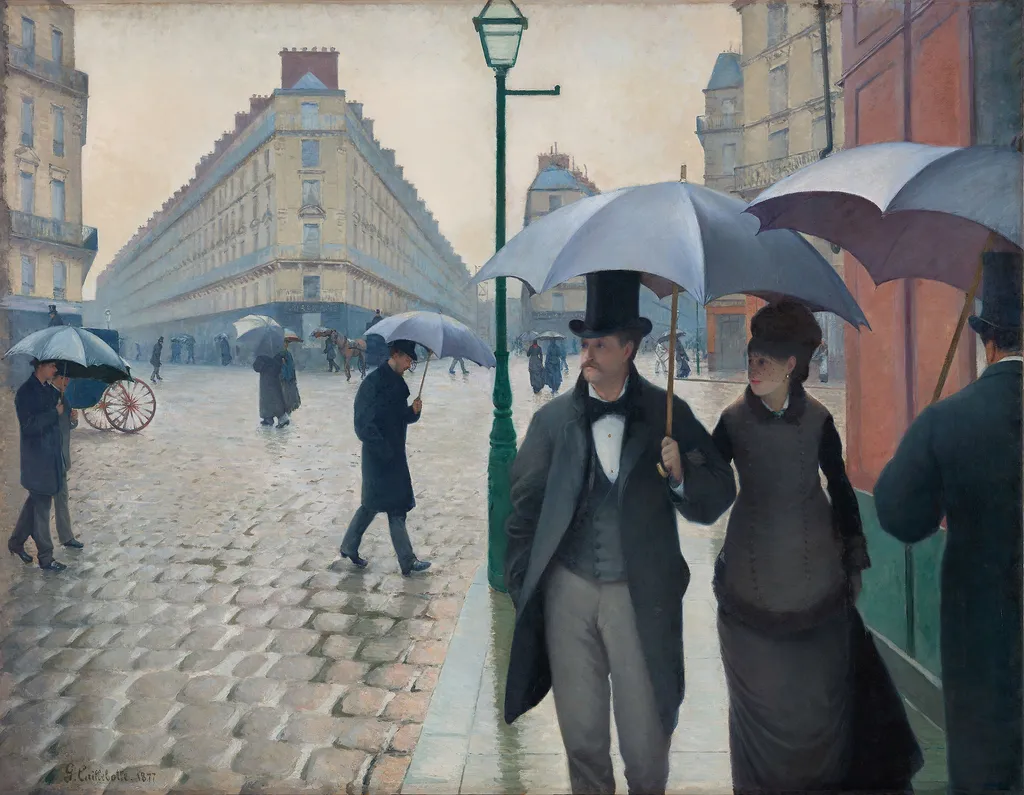
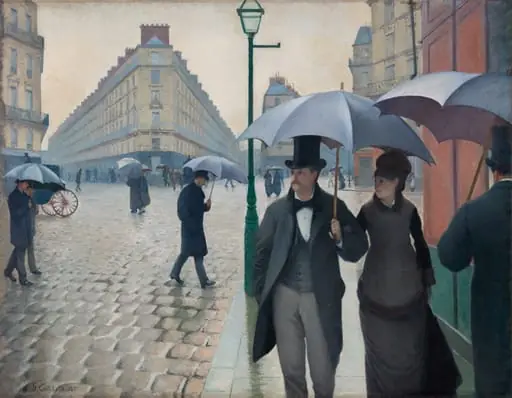
Paris Street; Rainy Day is an oil painting by the French Realist artist Gustave Caillebotte. It dates from 1889 and is held in the collection of the Art Institute of Chicago.
About this work
Subject & Meaning
Paris Street; Rainy Day presents a photorealistic snapshot of Parisian modernity under Haussmannization, capturing a bourgeois couple and 22 other pedestrians crossing an intersection at Place de Dublin during rain. The composition’s two-point linear perspective, sharp geometry, and minute detailing of umbrellas, fabric, and rain-refracted pavements elevate a fleeting urban moment into a monument to the new city. Critics like Émile Zola praised the work for its unflinching realism and bold choice of a contemporary, unheroic subject, viewing it as emblematic of modernity itself.
The rain-soaked streets and angled figures, including the nearly life-size foreground pair, convey the contingent, dynamic pace of modern life, while the spatial compression and repoussoir effects immerse the viewer directly into the scene. By rendering a homogenized, ordered Paris that still teems with anonymous individuals, Caillebotte’s iconography reflects both the emancipating promise and the alienating effects of Haussmann’s redesign.
Technique & Style
The oil on canvas employs a palette dominated by lead white, ochres, chrome yellows, umber, vermilion, cobalt blue, ultramarine, cobalt violet, and viridian.
Paris Street; Rainy Day is an oil painting on canvas measuring 212.2 by 276.2 cm, signed and dated in greyish-brown paint to the lower left: "G. Caillebotte. 1877". Caillebotte prepared the composition through 23 surviving studies in graphite and oil paint, with the most elaborate being a graphite-on-laid-paper sketch focusing on architecture and geometric perspective.
A 2015 Art Institute of Chicago investigation concluded he likely used a camera lucida to assist with the precise view.
The oil on canvas employs a palette dominated by lead white, ochres, chrome yellows, umber, vermilion, cobalt blue, ultramarine, cobalt violet, and viridian. Although classified as Impressionist, the handling is meticulous rather than loose: details such as fabric folds, the woman's fur collar, her dotted veil, and the umbrella's tension creases are minutely rendered. Caillebotte constructs the scene through two-point linear perspective and repoussoir, with a green lamppost bisecting the composition into two halves, each with its own vanishing point.
The work was restored in 1964 and again after the 2012–2013 exhibition cycle, with technical examination via X-ray, infrared, microscopy, and ultraviolet imaging revealing a deteriorated early-1900s varnish layer that had caused fading and dark spots.
History & Provenance
Paris Street; Rainy Day was completed by Gustave Caillebotte in 1877 for the Third Impressionist Exhibition, where it debuted in April of that year at 6 rue Le Peletier in Paris. After the artist's death on 21 February 1894, the painting was shown in a posthumous retrospective at Galerie Durand-Ruel in June 1894. Caillebotte bequeathed the work to his youngest brother Martial Caillebotte, who installed it at the Château de Montglat around 1900.
It subsequently passed to Georges Minoret, Martial's brother-in-law, and by 1950 was held by Mme Albert Chardeau (née Geneviève Caillebotte), Martial's daughter, remaining in the artist's family until the mid-twentieth century.
In 1954 (or 1955 per the French source), brokered by Wildenstein & Company, Walter P. Chrysler Jr. of New York acquired the canvas for his collection. Chrysler sold it in 1964 to the Art Institute of Chicago, where it has remained since, entering the collection during a broader reappraisal of Caillebotte's work.
Paris Street; Rainy Day is part of the permanent collection of the Art Institute of Chicago, where it has been since its acquisition in 1964. The painting entered the museum after being bought from collector Walter P. Chrysler Jr., who had owned it since 1954. Its earliest public showing occurred in April 1877 at the Third Impressionist Exhibition in Paris, and it was later included in a posthumous retrospective of the artist’s work that opened in June 1894.
The canvas has subsequently been featured in major exhibitions, notably the 1994‑1995 Grand Palais retrospective in Paris and a 2012‑2013 showing at the Alte Nationalgalerie in Berlin.
Context
Paris Street; Rainy Day was acclaimed at the Third Impressionist Exhibition in April 1877, praised for its photorealistic precision and modern urban subject. Critics such as Émile Zola singled out the painting’s depiction of a fashionable Parisian couple in the foreground as evidence of Caillebotte’s bold engagement with contemporary life, contrasting with earlier, more critical views of his work.
The work’s technical rigor, linear perspective, exacting detail, and subtle effects of rain, distinguishes it from the looser brushwork typical of Impressionism. Its careful preparation, including numerous graphite and oil studies, aligns it with the artist’s broader practice and underscores his interest in modernity and Haussmann’s transformation of Paris. After decades in family hands, its eventual sale to Walter P. Chrysler Jr. in 1954 and acquisition by the Art Institute of Chicago in 1964 secured its place in American public collections and renewed scholarly attention, culminating in major retrospectives in the late twentieth century.
Legacy
Widely praised for its photorealism upon its 1877 debut, the painting was not publicly displayed again until a posthumous retrospective in 1894. It became a centerpiece of the first major modern retrospective of Caillebotte's work in Paris in 1951, marking a significant reappraisal of the artist. Following its acquisition by the Art Institute of Chicago in 1964, the work toured extensively across the United States and Europe, including a revelatory 1994 exhibition at the Grand Palais that introduced it to a broad French audience.
Curator Gloria Groom has characterized the piece as the definitive image of late nineteenth-century urban life. Its reputation was further amplified by photographer Thomas Struth, who featured the work in his museum series, and by its inclusion in major international exhibitions through 2016.
Overview
Gustave Caillebotte's "Paris Street; Rainy Day," an oil painting from 1877, captures a specific moment in the French capital. This large-scale work depicts pedestrians navigating a wide boulevard intersection in the rain, a scene set in what is now Place de Dublin. The painting is notable for its blend of Impressionist sensibilities with a precise, almost photographic rendering of urban life, reflecting the artist's engagement with the changing face of Paris.
Own this work as a print
Artist & collection

Artist
Gustave Caillebotte (French: ; 19 August 1848 – 21 February 1894) was a French painter who was a member and patron of the Impressionists, although he painted in a more realistic manner than many others in the group.