Artwork
North River Dock, New York
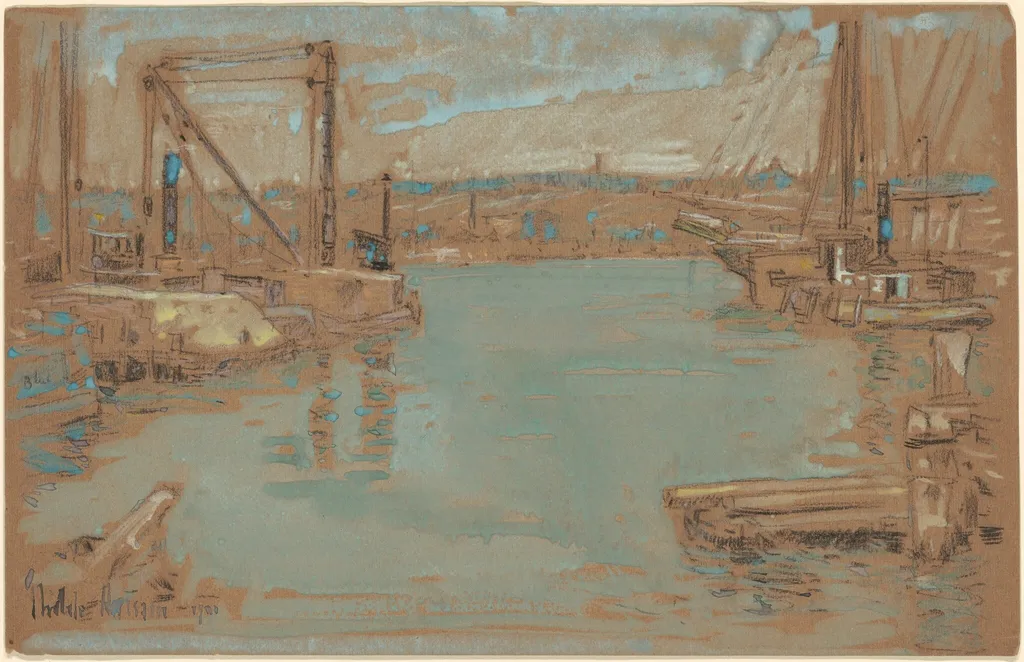
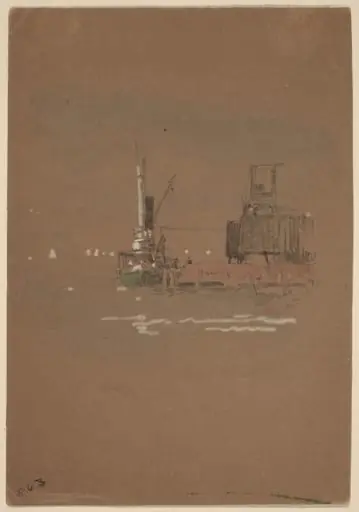
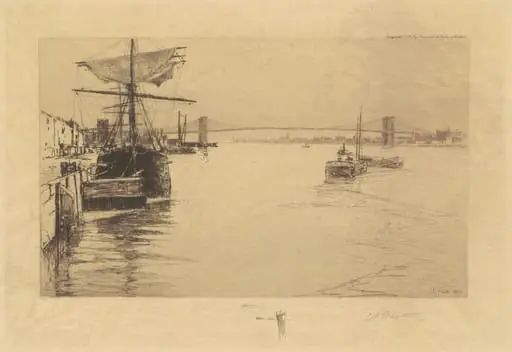
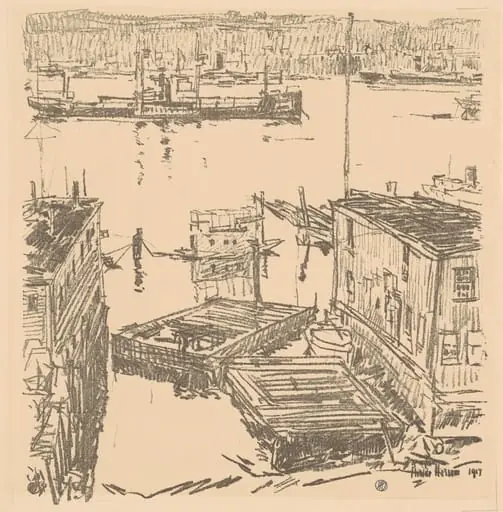
North River Dock, New York is a charcoal drawing by Childe Hassam. It dates from 1901 and is held in the collection of the National Gallery of Art.
- Inscription
- Inscribed:center left in charcoal: Blue; lower left in black gouache: Childe Hassam 1901; lower left verso in graphite: North River Dock; center right verso in graphite by unknown hand: 17736
About this work
Overview
Childe Hassam's 'North River Dock, New York' is a drawing executed in charcoal and gouache on the reverse side of an Encyclopedia Britannica advertisement.
Childe Hassam's 'North River Dock, New York' is a drawing executed in charcoal and gouache on the reverse side of an Encyclopedia Britannica advertisement. The work captures a moment of industrial activity along the Hudson River, rendered with immediacy and minimal refinement. Its unconventional support reflects the artist’s pragmatic use of available materials, contributing to its raw, unpolished character.
Subject & Meaning
The scene portrays a working waterfront teeming with cranes, ships, and dock structures, viewed from a modest elevation. There is no idealization of the harbor; instead, Hassam presents it as a functional, lived-in space. The absence of human figures emphasizes the machinery and architecture as the true agents of urban motion, suggesting a quiet reverence for labor and infrastructure.
Technique & Style
Charcoal provides loose, expressive outlines, while gouache, applied in thin, flat washes, adds muted color without gloss. The fast-drying nature of gouache enhances the sketchlike quality, producing a chalky, matte surface that resists polish. The combination yields a tactile, unfinished aesthetic, reinforcing the spontaneity of the moment and the artist’s direct engagement with the scene.
History & Provenance
The drawing was made on the reverse of a commercial advertisement, a common practice among artists seeking economical surfaces. This reuse underscores the practical conditions under which Hassam worked during this period. Its survival as a standalone work reflects later recognition of its artistic value, despite its humble origins as scrap material.
Context
Created in the early 20th century, the piece aligns with Hassam’s broader interest in urban and maritime subjects during his New York years. While contemporaries often idealized city life, Hassam focused on its working edges, docks, warehouses, and transit zones, offering a grounded counterpoint to the era’s more romanticized depictions of modernity.
Legacy
The work exemplifies Hassam’s willingness to embrace imperfection and material constraint as expressive tools. Its unvarnished quality has since influenced perceptions of his draftsmanship, revealing a side of his practice less concerned with finish than with observation. It stands as a quiet testament to the artistic potential of everyday materials.
Own this work as a print
Artist & collection

Artist
Frederick Childe Hassam (; October 17, 1859 – August 27, 1935) was an American Impressionist painter, noted for his urban and coastal scenes.