Artwork
Bathers by a River
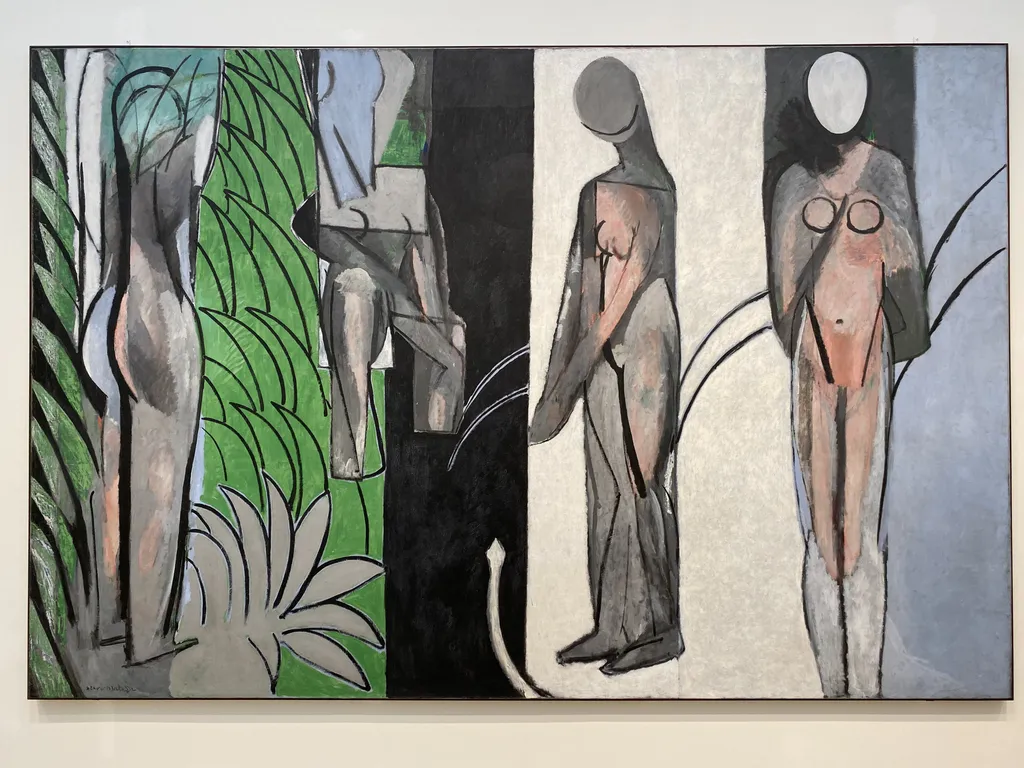
Bathers by a River is an oil painting by the Cubism Synthetic artist Henri Matisse. It dates from 1916 and is held in the collection of the Art Institute of Chicago.
About this work
Subject & Meaning
The stream itself was altered from a blue flow into a stark black band.
The work depicts four monumental, stone-colored nude figures positioned beside a river, a composition that evolved significantly from its original conception as a pastoral scene featuring five women near a waterfall. Initially intended to show Arcadian leisure, the final version transforms the figures into abstract, hieratic forms resembling prehistoric goddesses or demigoddesses isolated against vertical bands of green, black, white, and gray-blue. The stream itself was altered from a blue flow into a stark black band.
A narrow, pointed white shape rising from the bottom edge is interpreted by some as a serpent, potentially evoking an archaic Eve and introducing an element of danger. This shift from a lightweight, colorful beach scene to a sombre, monumental image is widely seen as reflecting the artist's anxieties during the World War I era, balancing tension with peace.
Technique & Style
The painting is executed in oil on canvas, a medium noted in the source records. It measures 262 cm in height by 391 cm in width, as documented in the artwork’s specifications. Infrared reflectograms, X‑ray imaging and early photographs reveal successive layers of alteration, showing how Matisse initially conceived a pastoral scene of five nude women beside a waterfall and later removed one figure, transformed the remaining forms into massive, stone‑grey silhouettes, and suppressed the waterfall into a black band.
These interventions produced a composition of monumental, abstracted nudes set against vertical planes of green, black, white and pale gray, with a striking white serpentine element emerging from the lower edge of the canvas. The work thus combines a traditional pastoral subject with radical abstraction, reflecting both the artist’s evolving style and the impact of the war period on its final form.
History & Provenance
Henri Matisse painted Bathers by a River between 1909 and 1917, initially commissioned by Russian collector Sergei Shchukin for a decorative panel series that included Music and Dance. Shchukin rejected the work after seeing an early watercolor study, prompting Matisse to continue refining the canvas through multiple phases. The painting evolved dramatically, with Matisse altering composition, simplifying forms, and suppressing naturalistic details such as a waterfall, ultimately creating a monumental arrangement of four nude figures against stark vertical planes.
Technical analysis using infrared reflectograms, X-rays, and early photographs confirms changes made during 1913 while Matisse worked in Morocco. The canvas remained in his studio until 1953, when the Art Institute of Chicago acquired it shortly before the artist’s death. Ownership subsequently passed through Paul Guillaume, Domenica Walter, and Henry Pearlman before entering the museum’s permanent collection.
The work has been exhibited widely, including in MoMA’s 1992–1993 Matisse retrospective and the Art Institute’s 2010 Radical Invention exhibit.
Bathers by a River has been in the collection of the Art Institute of Chicago since 1953, the year before Matisse's death. It is held in the museum's permanent collection and remains on display there.
The painting has appeared in several exhibitions, including the 2010 "Matisse: Radical Invention" show, which originated at the Art Institute of Chicago and featured the work as its centerpiece. It was also shown at the Museum of Modern Art in New York as part of "Henri Matisse: A Retrospective" from September 24, 1992 to January 19, 1993, and was exhibited alongside Paul Cézanne's Large Bathers at the Philadelphia Museum of Art in 2012.
Context
Bathers by a River is widely regarded as a pivotal work in Matisse’s oeuvre and a touchstone in early modernist experimentation. The painting’s radical transformation from an Arcadian scene to a compressed, vertical composition of monumental, near-abstract figures has been central to its reception. Scholars highlight its stylistic shift, evident in technical studies such as X-radiography and infrared imaging, which reveal how Matisse distilled four bathers into static, columnar forms framed by vertical bands of green, black, white, and grey-blue, suppressing naturalistic detail in favor of hieratic structure.
Its place in art history is often discussed alongside Cézanne’s Large Bathers, with which it was exhibited in 2012. Critics note the painting’s dual resonance with ancient and modern impulses, framing it as both an archaic icon and a modernist rupture. The Art Institute of Chicago, which acquired the work in 1953, situates its final form within the cultural climate of World War I, underscoring its sobriety and latent tension.
The work’s influence extends to later artists, including Grace Hartigan, Sean Scully, and Anthony Caro, who cite it as a key reference.
Legacy
Bathers by a River is widely regarded as a pinnacle of Henri Matisse's career, though critics have described it as one of the most difficult and least ingratiating modernist masterpieces due to its rigid, experimental nature. The work has directly influenced subsequent generations of artists, serving as inspiration for Grace Hartigan's River Bathers (1953) and Sean Scully's The Bather (1983). Additionally, abstract sculptor Anthony Caro has cited the painting as a significant influence on his own creations.
Beyond the art world, the painting achieved popular cultural recognition through its inclusion in the 1980 BBC series 100 Great Paintings and a prominent role in the 1986 film Ferris Bueller's Day Off.
Overview
Henri Matisse’s oil painting Bathers by a River, executed between 1909 and the autumn of 1917, measures a considerable size and depicts three stylised figures beside a riverbank. The work is known in French as Les Demoiselles à la rivière and is sometimes shortened to Bathers.
Artist & collection
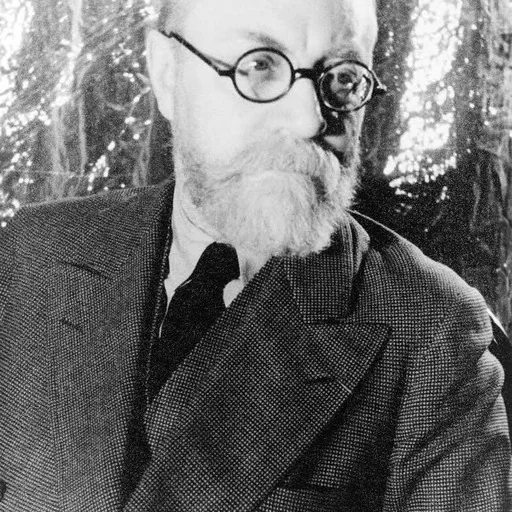
Artist
Henri Émile Benoît Matisse (French:; 31 December 1869 – 3 November 1954) was a French visual artist, known for both his use of colour and his fluid and original draughtsmanship.