Artwork
To the Memory of the Benevolent Howard
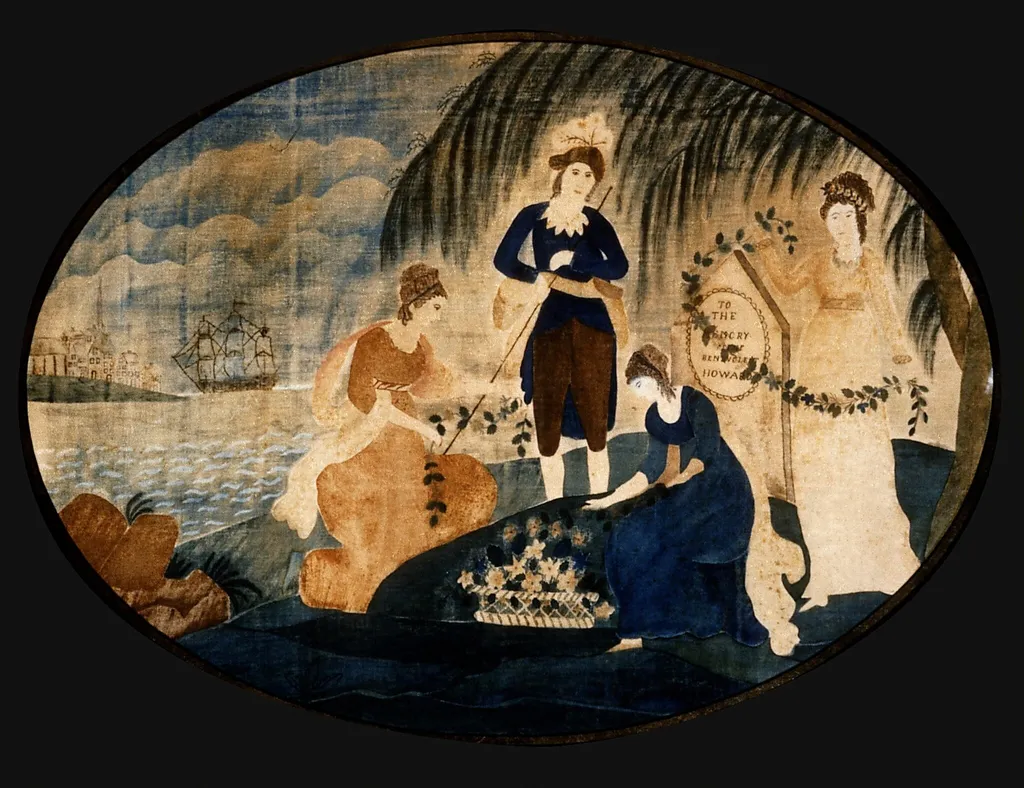
To the Memory of the Benevolent Howard is a watercolor painting by the Biedermeier artist Salome Hensel. It dates from 1823 and is held in the collection of the National Gallery of Art.
- Inscription
- Inscribed:center right on monument: TO / THE / MEMORY / OF THE / BENEVOLENT / HOWARD
About this work
Subject & Meaning
The work depicts a single, leafy tree rising from a grassy mound against a pale sky, its branches forming a rounded canopy that frames the composition.
The work depicts a single, leafy tree rising from a grassy mound against a pale sky, its branches forming a rounded canopy that frames the composition. The tree's upright form and verdant foliage have been interpreted as emblematic of life, growth, and enduring virtue, qualities associated with the person commemorated. In the context of early nineteenth-century American mourning art, the isolated tree often functioned as a symbol of the deceased's moral character and the promise of spiritual renewal.
The choice of a theorem-style presentation, precise outlines filled with watercolor, further underscores the work's commemorative intent, blending didactic clarity with affective resonance.
Technique & Style
The work is a watercolor executed on a velveteen support, a technique associated with "theorem painting" in which pigments are applied to a textured fabric ground to simulate embroidery or needlework effects.
The composition centers on a stylized tree motif rendered with flat, saturated color fields and crisp outlines, a hallmark of theorem imagery intended to resemble a painted sampler or decorative panel. Handling emphasizes linear clarity and uniform color application, with minimal modulation and no visible brushwork texture.
Dimensions are 63.5 cm in height and 82.6 cm in width.
History & Provenance
Created in 1823, the watercolor on velveteen titled To the Memory of the Benevolent Howard was executed by Salome Hensel. The work remained in the artist's possession before passing to her daughter, Mrs. Emily C. Albright Knight. By November 1886, the daughter and her husband, Dr. H.D. Knight, had the piece framed.
The painting was subsequently acquired by Robert Carlen of Philadelphia and sold in 1948 to collectors Edgar William and Bernice Chrysler Garbisch. It entered the permanent collection of the National Gallery of Art in Washington, D.C., as a gift from the Garbisch family in 1971.
Overview
Salome Hensel's painting, To the Memory of the Benevolent Howard, created in 1823, presents a singular tree rendered in watercolor on velveteen. This early work by Hensel exemplifies a distinctive approach to still life, utilizing a fabric support to achieve unique visual qualities. The composition focuses solely on the arboreal subject, inviting contemplation of its form and presence.
Context
Salome Hensel completed this painting in 1823, at the age of twenty-three. While she would later marry another artist, this early piece demonstrates her independent artistic sensibilities. The work represents a specific moment in her development, showcasing her engagement with materials and subject matter before her later biographical developments.
Own this work as a print
Artist & collection


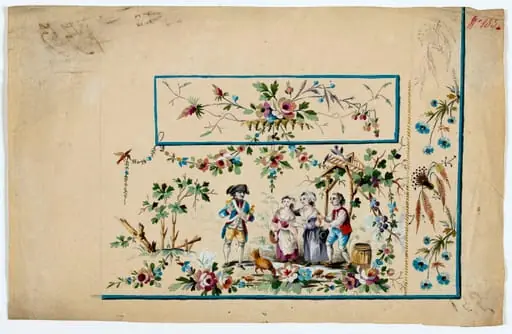
- Gilet décor Louis Gillet parlant avec 2 paysans et leur fille, projets de broderies de gilet, XVIIIème siècle
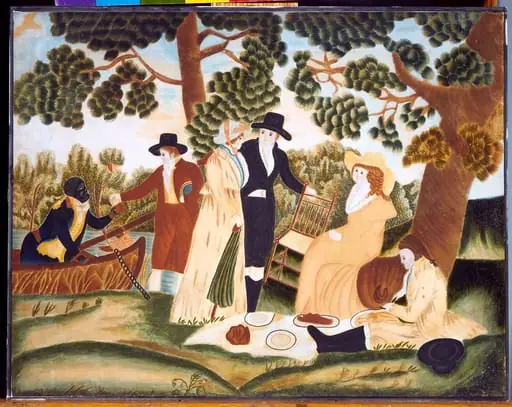 The Picnic
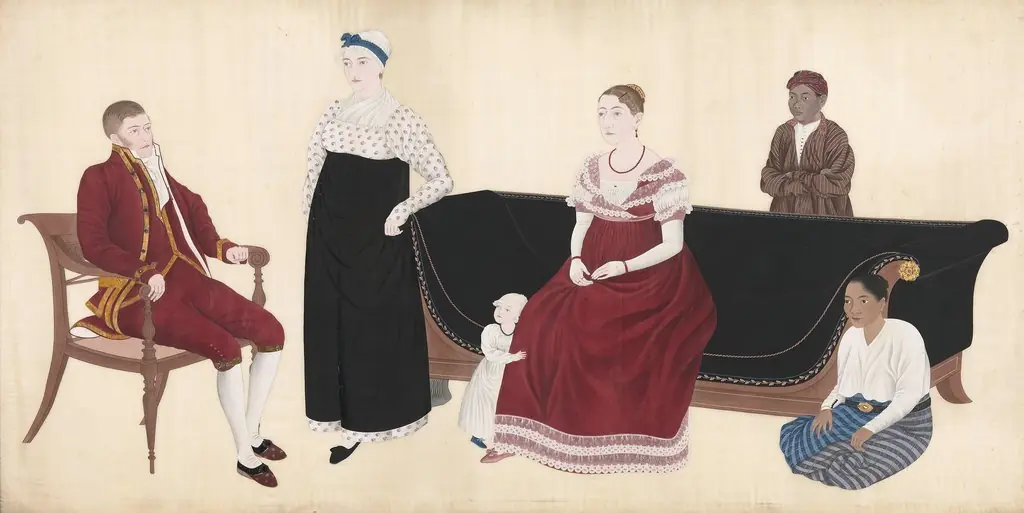 Portrait of the Cock Blomhoff Family
 Gilet décor fête paysanne, projets de broderies de gilet, XVIIIème siècle
 Digging China Clay
 Gilet décor jeune couple assis dans les blés, projets de broderies de gilet, XVIIIème siècle
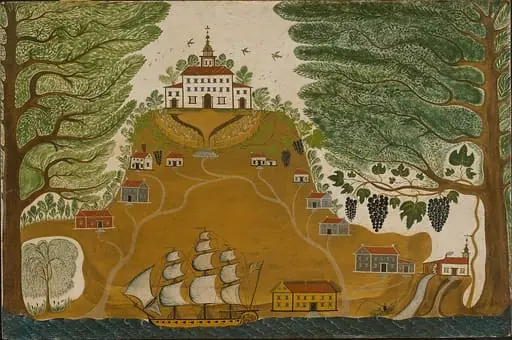 The Plantation
 Gilet décor scène de bergers, projets de broderies de gilet, XVIIIème siècle
 Woman and Boy with Provisions
 Gilet décor de paysage avec guerriers, projets de broderies de gilet, XVIIIème siècle
 The Prodigal Son Taking Leave of His Father
 The Prodigal Son Wasted His Substance