Artwork
Sibylla Samia

Sibylla Samia is an unspecified painting by Hermann tom Ring. It dates from 1568 and is held in the collection of the Bavarian State Painting Collections.
About this work
Subject & Meaning
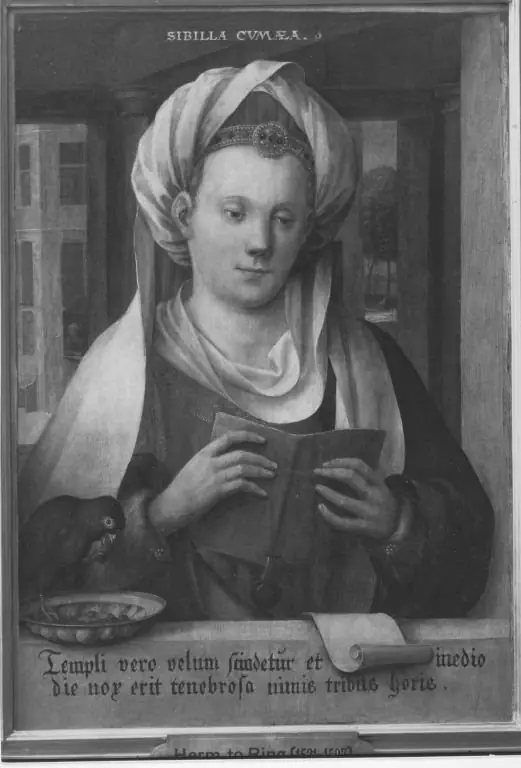
She is shown holding a book, representing her prophetic writings, alongside a nautilus cup and a pearl, which serve as attributes associated with her figure.
The painting depicts a portrait of the Sibyl Samia, characterized by specific symbolic objects that define her identity and prophetic role. She is shown holding a book, representing her prophetic writings, alongside a nautilus cup and a pearl, which serve as attributes associated with her figure. The inclusion of a galleon or ship in the composition further enriches the iconography, likely alluding to her legendary origins or the maritime nature of her prophecies.
These elements combine to present the subject not merely as a historical figure but as an embodiment of divine foresight, with the objects acting as visual shorthand for her narrative and spiritual significance.
History & Provenance
Sibylla Samia is held by the Bavarian State Painting Collections in Munich, where it is accessioned under a standard inventory number for the institution's holdings. The work was displayed in the exhibition "German Portraits from the 17th Century" at the Alte Pinakothek in 1998.
Context
Hermann tom Ring painted Sibylla Samia as an emblem of maritime virtue, combining a nautilus cup, pearl, and ship motifs that reference seafaring resilience and feminine intellect. The portrait's composition situates the sitter within a broader tradition of allegorical personifications in Northern European art, reflecting Renaissance interests in emblematic symbolism and the moral virtues associated with trade and exploration. Its placement in the Bavarian State Painting Collections at the Alte Pinakothek underscores the work's significance within German art-historical narratives of the 17th century, where portraiture often merged personal likeness with didactic symbolism.
Scholarship highlights the painting's role in contextualizing Ring's output within the regional school of portraiture that blended realism with emblematic allegory, reinforcing discussions of gendered representations of power in early modern Europe.
Overview
Hermann tom Ring, a 16th‑century painter from Münster, executed the oil painting Sibylla Samia circa 1568. The work is part of the German Renaissance corpus and is presently housed in the Alte Pinakothek in Munich. It presents a solitary female figure surrounded by carefully chosen objects that convey status and learning.
Technique & Style
Tom Ring employs the restrained palette and precise detailing characteristic of the German Renaissance. The composition balances a subdued background with illuminated objects, creating a subtle chiaroscuro that models the forms and gives depth to the still‑life elements such as the book, cup and ship.

Artist & collection

Artist
Hermann tom Ring (German pronunciation:; 2 January 1521 in Münster – 18 October 1596 in Münster), was a German Renaissance painter.