Artwork
The Ass at School
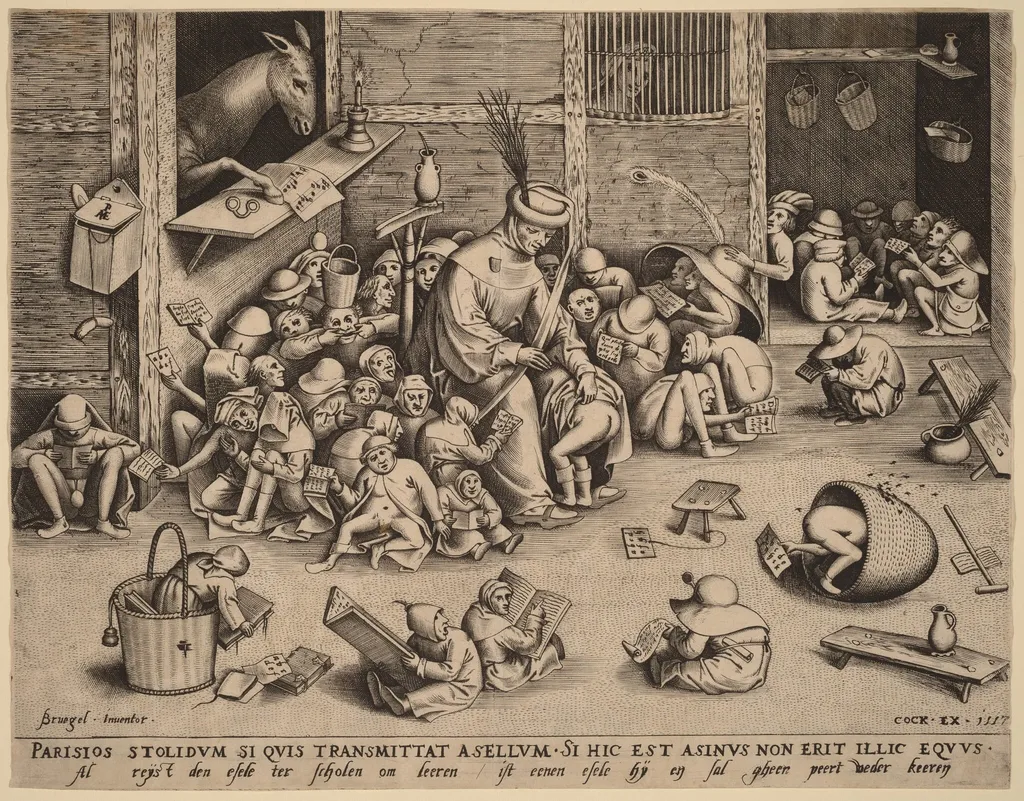
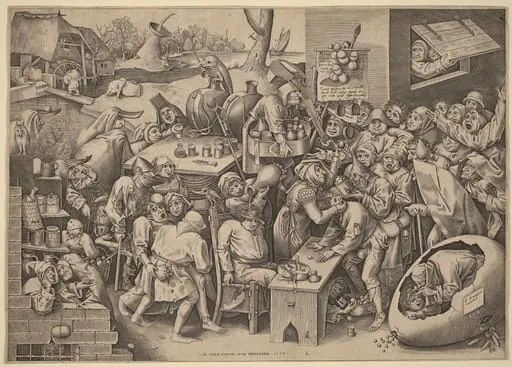
The Ass at School is an ink print by the Renaissance artist Pieter van der Heyden. It dates from 1557 and is held in the collection of the National Gallery of Art.
- Inscription
- Inscribed:lower left, in image, in plate: Bruegel . inventor.; lower right, in plate, in image: COCK. EX. 1557; in lower margin, in plate: PARISIOS STOLIDVM SI QVIS TRANSMITTAT ASELLVM. SI HIC EST ASINVS NON ERIT ILLIC EQVVS. / Al reÿst den esele ter scholen om leeren ist eenen esele hÿ en sal gheen peert weder keeren (If you send a stupid ass to Paris, if it is an ass here, it will not be a horse there. / Although the ass goes to school in order to learn, if it is an ass, it will not return [as] a horse) [translation from Nadine Orenstein, ed., Pieter Bruegel the Elder: Drawings and Prints. Exhibition catalogue. New York: Metropolitan Museum of Art, 2001, p. 142.]
About this work
Overview
Pieter van der Heyden, a Flemish engraver active in the mid-1500s, produced this print in 1557 as part of a broader tradition of reproductive printmaking.
Pieter van der Heyden, a Flemish engraver active in the mid-1500s, produced this print in 1557 as part of a broader tradition of reproductive printmaking. His work often translated designs by leading artists into engraved form, facilitating the spread of imagery across Europe. This piece exemplifies the collaborative nature of Renaissance print production, where one artist’s concept was adapted by another for wider circulation.
Subject & Meaning
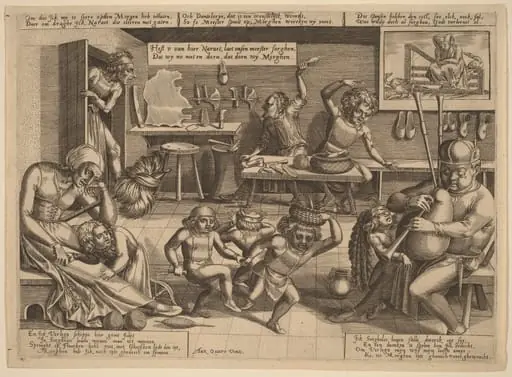
The scene portrays a donkey seated at the front of a classroom, mimicking a teacher, while student children display distraction or disengagement. Books, instruments, and cluttered objects fill the space, reinforcing disorder. The Latin inscription beneath, translating to a warning that an ass cannot become a horse, frames the image as a satirical commentary on misplaced education. The absurdity underscores the futility of expecting insight from those fundamentally unsuited to it.
Technique & Style
Executed in fine-line engraving, the print displays meticulous detail in textures: wood grain on walls, fabric folds, and the donkey’s coarse fur. The composition is densely packed, with figures arranged in a shallow, stage-like space. Van der Heyden’s controlled line work enhances the humor through precise gestures, slumped postures, vacant stares, while maintaining clarity amid visual chaos.
History & Provenance
The design likely originated from a lost drawing by another artist, possibly Pieter Bruegel the Elder, whose thematic interests in folly and social satire align closely. Van der Heyden’s engraving was one of several prints circulating in the 1550s that adapted such imagery for a literate, urban audience. Surviving impressions are held in major European collections, indicating its early and sustained distribution.
Context
In mid-16th-century Flanders, printmaking served as a vehicle for moral and social commentary, often using allegory to critique education, class, and human folly. This image fits within a broader genre of satirical prints that mocked pretensions to learning, particularly targeting those who pursued knowledge without aptitude or proper guidance. The donkey, a traditional symbol of stubborn ignorance, reinforced this message for viewers familiar with proverbial wisdom.
Legacy
The print contributed to a lasting visual language of educational satire in Northern European art. Its combination of precise technique and sharp social observation influenced later caricaturists and satirical illustrators. Though not widely reproduced in modern times, it remains a key example of how Renaissance printmakers used humor to interrogate societal norms through accessible imagery.
Own this work as a print
Artist & collection

Artist
Pieter van der Heyden (c. 1530 - after March 1572) was a Flemish printmaker who is known for his reproductive engravings after works by leading Flemish painters and designers of the 16th century.