Artwork
Plate 2: Two Eagles
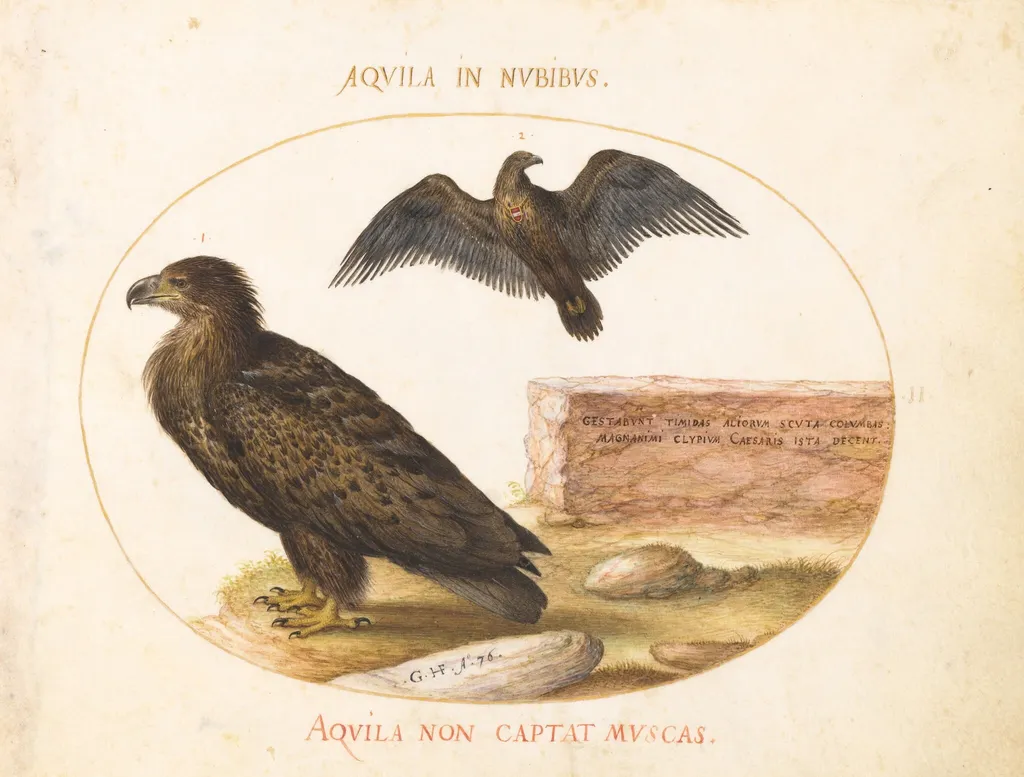
Plate 2: Two Eagles is a gouache drawing by the Renaissance artist Joris Hoefnagel. It dates from 1576 and is held in the collection of the National Gallery of Art. Created in 1576, this miniature drawing presents two eagles rendered in watercolor and gold on parchment.
- Inscription
- Inscribed:Upper center in (gold?): AQVILA IN NVBIBVS. (“An eagle in the clouds.” Erasmus, _Opera Omnia_, 2:2:342 (1.9.20) (trans. Bass 2019, 22); center right in (gold?): .II.; birds in image numbered .1. and .2., in red ink; center right on stone block in image, in black ink: GESTABVNT TIMIDAS ALIORVM SCVTA COLVMBAS : / MAGNANIMI CLYPIVM CAESARIS ISTA DECENT. (“The shields of others will carry timid doves; those [eagles] of yours [alone] fit the shield of magnanimous Caesar.”) (trans. Bass 2019, 21); lower center on rock in image, in black ink: .G.HF.Ao.76.; lower center in red ink: AQVILA NON CAPTAT MVSCAS. Facing page: Upper center in black ink: Ne erigas oculos tuos ad opes, quas no[n] potes habere: quia / faciunt sibi pennas quali Aquilae, et volabunt In Coelum; lower center in black ink: Tentanda via est, qua me quoq[ue] possum / Tollere humo, via q[ue] virum volitare supra ora.
About this work
Overview
Created in 1576, this miniature drawing presents two eagles rendered in watercolor and gold on parchment. The composition is confined within a circular frame, the larger bird perched on the left and the smaller one soaring above, its wings outstretched. A pale beige ground and a subtle oval border frame the scene, emphasizing the birds as the focal point.
Subject & Meaning
The work juxtaposes a stationary, mature eagle with a younger, airborne counterpart, suggesting a contrast between grounded authority and dynamic freedom. The careful rendering of plumage and posture reflects a keen observation of avian anatomy, typical of Hoefnagel’s interest in natural history.
Technique & Style
Hoefnagel employed fine watercolor washes to model the brown feathers, accentuating light and shadow with delicate tonal shifts. Gold paint highlights the beak and talons, adding a luminous quality. The precision of line and the miniature scale align the piece with the late Renaissance tradition of illuminated manuscripts.
History & Provenance
Joris Hoefnagel, a Flemish painter and miniaturist, was among the final generation of manuscript illuminators. His career spanned naturalistic studies, topographical maps, and mythological scenes, and this drawing exemplifies his contribution to the emergence of northern European floral and animal still‑life motifs.
Context
The piece belongs to a period when detailed observation of the natural world was gaining scholarly interest, intersecting art and early scientific illustration. Hoefnagel’s work bridges the decorative illumination of medieval books and the more empirical approach that would later characterize botanical and zoological atlases.
Own this work as a print
Artist & collection

Artist
Joris Hoefnagel or Georg Hoefnagel (1542 – 24 July 1601) was a Flemish painter, printmaker, miniaturist, draftsman and merchant.

 Forum Vulcani: The Hot Springs at Pozzuoli
 Plate 76: Insects with a Pink and Cream Columbine
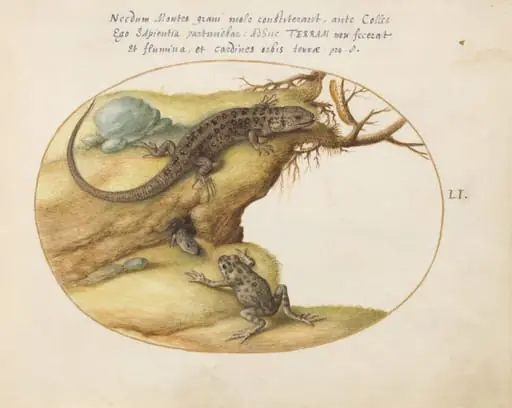 Plate 51: Two Sand Lizards, a Common Parsley Frog(?), and a Caterpillar
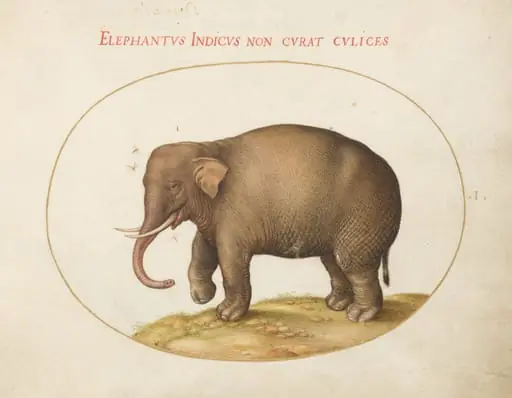 Plate 1: Elephant with Insects
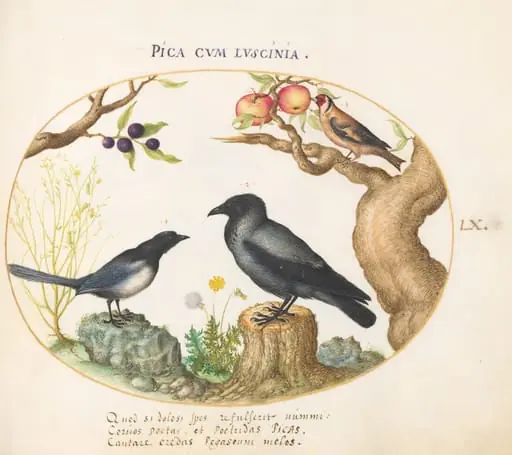 Plate 60: Magpie, Crow, and Goldfinch
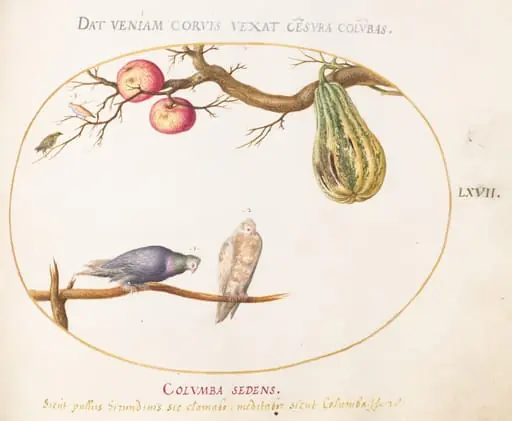 Plate 67: Two Doves beneath a Gourd and Apples
 Plate 31: Seven Moths
 Plate 21: Swamp Hen and Woodcock with a Streaked Rosefinch, a Finch, and Oak Galls
- Plate 8: Bearded Vulture with Two Birds of Prey
 Two Eagles, Both with Heads Turned to the Right
 Plate 3: Two Hawks
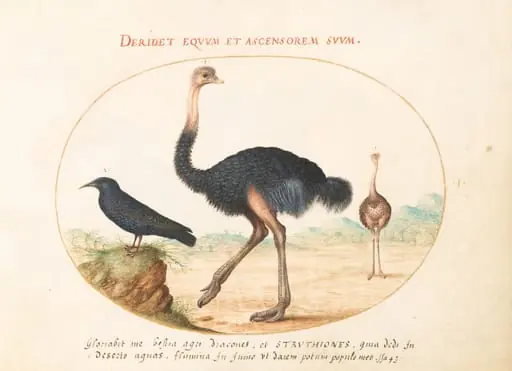 Plate 1: Two Ostriches and a Starling
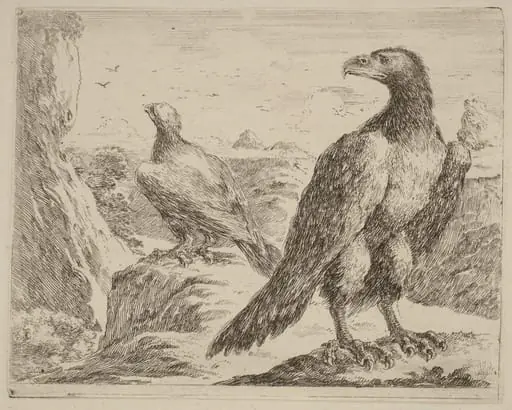 Two Eagles, Both with Heads Turned to the Left
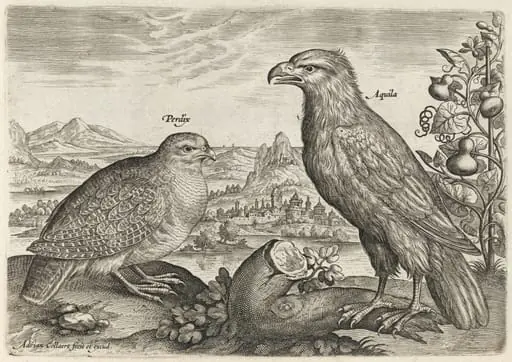 Partridge and Eagle
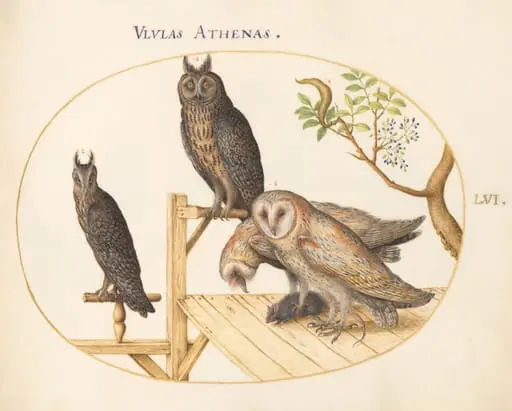 Plate 56: Barn Owls with a Mouse, Eagle Owl(?) and Another Owl
 Plate 9: Two Pheasants with Fruiting Plants
 Eagle and Young