Artwork
Plate 40: European Bee-Eater and Exotic Chicken
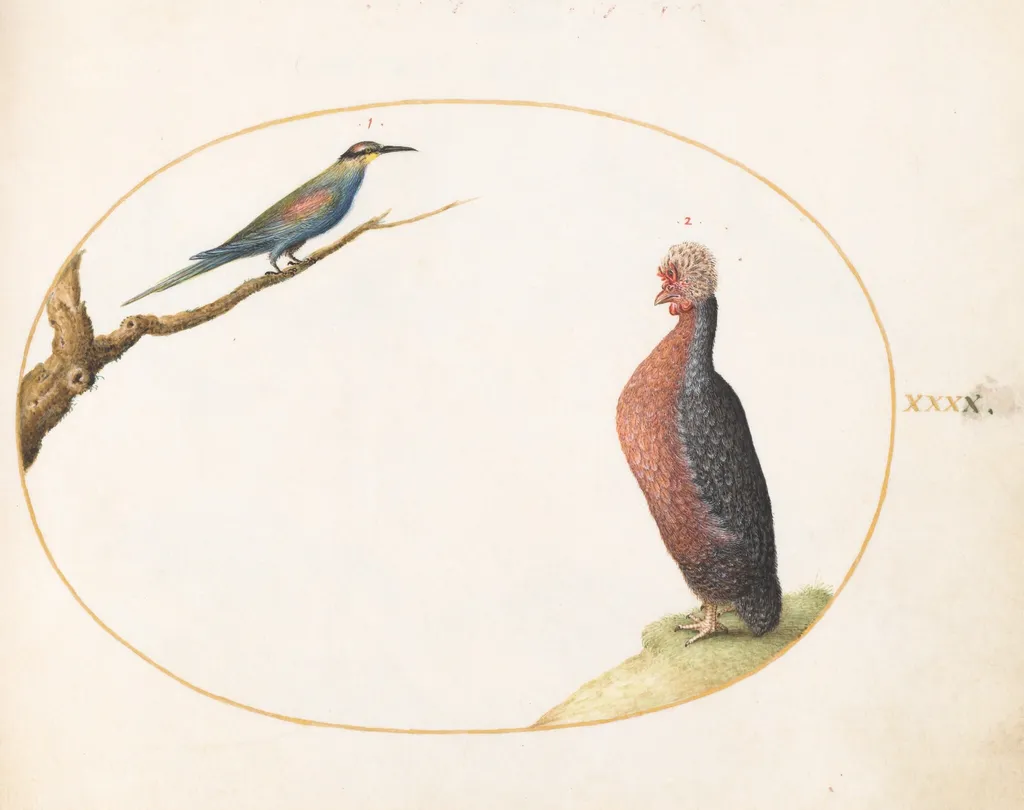
Plate 40: European Bee-Eater and Exotic Chicken is a gouache drawing by the Renaissance artist Joris Hoefnagel. It dates from 1594 and is held in the collection of the National Gallery of Art.
- Inscription
- Inscribed:Center right in (gold?): XXXX.; birds in image numbered .1. and .2., in red ink Facing page: Upper center in red/violet ink: DEVS NOSTER IN COELO omnia / qu[a]ecumq[ue] voluit fecit ps:113. (“Our God is in heaven; he has done all things whatsoever he would.” Psalms 113:11) (Latin Vulgate Bible); lower center in blue/black ink: Qui aedificat in COELO ascensionem suam, et / fasciculum suum super terra fundavit.Amos.9. / dominus nomen eius. (“He that builds his ascension in heaven and has founded his bundle upon the earth...The Lord is his name.” Amos 9:6) (Latin Vulgate Bible)
About this work
Overview
Created around 1594 by Flemish artist Joris Hoefnagel, this work is a watercolor and gold paint drawing on parchment, part of a larger manuscript tradition.
Created around 1594 by Flemish artist Joris Hoefnagel, this work is a watercolor and gold paint drawing on parchment, part of a larger manuscript tradition. It belongs to a series of natural history illustrations that merge precise observation with decorative artistry. The piece exemplifies the late Renaissance manuscript culture, where scientific inquiry and aesthetic refinement coexisted in finely crafted pages.
Subject & Meaning
The illustration depicts two birds: a European bee-eater on the left, with vivid blue, green, and yellow plumage, and an exotic chicken on the right, rendered in muted browns and grays. Both are shown in naturalistic poses, isolated against a blank background. The pairing suggests an interest in comparative ornithology, possibly reflecting curiosity about European and imported species during an era of expanding global exchange.
Technique & Style
Hoefnagel applied watercolor with meticulous layering to capture the texture of feathers, using fine brushwork to distinguish individual barbs and patterns. Gold paint outlines the oval frame, adding luminosity without overwhelming the subject. The absence of landscape or context focuses attention on anatomical detail, aligning with the tradition of scientific illustration while retaining the elegance of illuminated manuscript practice.
History & Provenance
This plate was likely produced as part of a commissioned manuscript, possibly for a noble or scholarly patron interested in natural curiosities. Hoefnagel’s work in this period often circulated in elite circles, and his illustrations were later used as models for printed natural history texts. The survival of such parchment sheets is rare, making this a valuable artifact of pre-modern zoological documentation.
Context
In late 16th-century Europe, interest in natural specimens surged due to exploration and the rise of cabinets of curiosities. Hoefnagel’s drawings responded to this trend, bridging medieval illumination techniques with emerging empirical methods. His work preceded the formalization of biological illustration, preserving a transitional moment where art served both aesthetic and investigative purposes.
Legacy
Hoefnagel’s detailed avian studies influenced later naturalists and illustrators, contributing to the evolution of scientific imagery. His fusion of decorative gold elements with precise rendering became a reference point for artists seeking to elevate observational drawing beyond mere documentation. Though manuscript illumination declined, his approach left a mark on the visual language of natural history.
Own this work as a print
Artist & collection

Artist
Joris Hoefnagel or Georg Hoefnagel (1542 – 24 July 1601) was a Flemish painter, printmaker, miniaturist, draftsman and merchant.

 Forum Vulcani: The Hot Springs at Pozzuoli
 Plate 76: Insects with a Pink and Cream Columbine
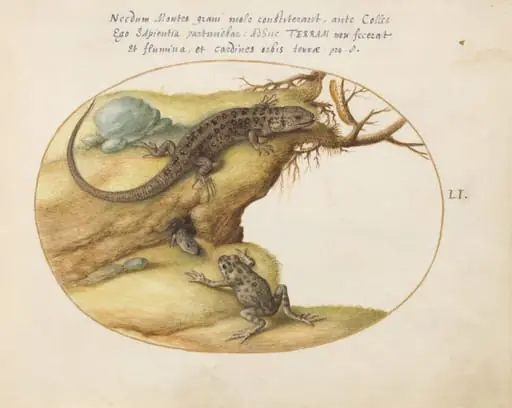 Plate 51: Two Sand Lizards, a Common Parsley Frog(?), and a Caterpillar
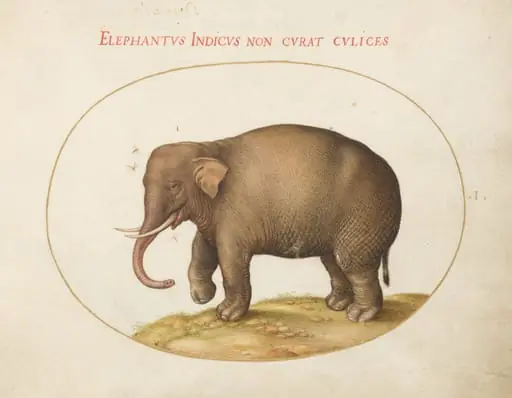 Plate 1: Elephant with Insects
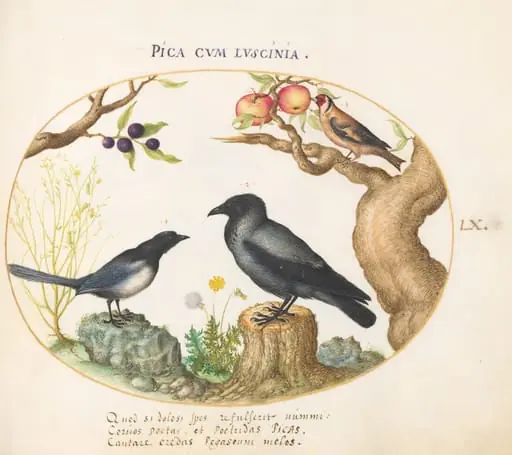 Plate 60: Magpie, Crow, and Goldfinch
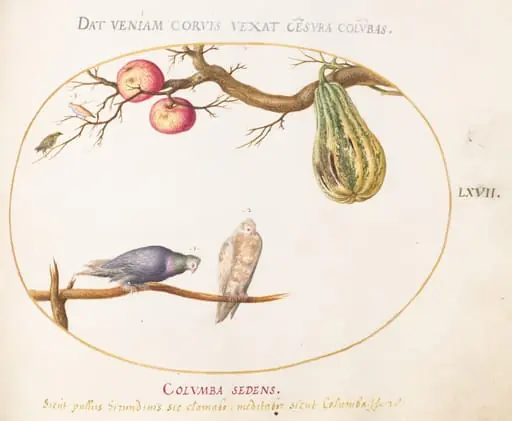 Plate 67: Two Doves beneath a Gourd and Apples
 Plate 31: Seven Moths
 Plate 21: Swamp Hen and Woodcock with a Streaked Rosefinch, a Finch, and Oak Galls
 Plate 30: A Muscovy(?) Duck, a Four-Legged Duck, and Two Other Birds
 Plate 28: Barnacle Goose with Shrikes and Other Birds
 Plate 50: An Avocet with Two Other Birds
 Plate 68: A Ptarmigan, Swallows, and Other Birds
 Plate 51: Crossbeak, Chough, Bee-Eater, and Other Birds
 Plate 13: Two Curly Gray Chickens (Silkie Chickens?)