Artwork
Tailpiece, or The Bathos
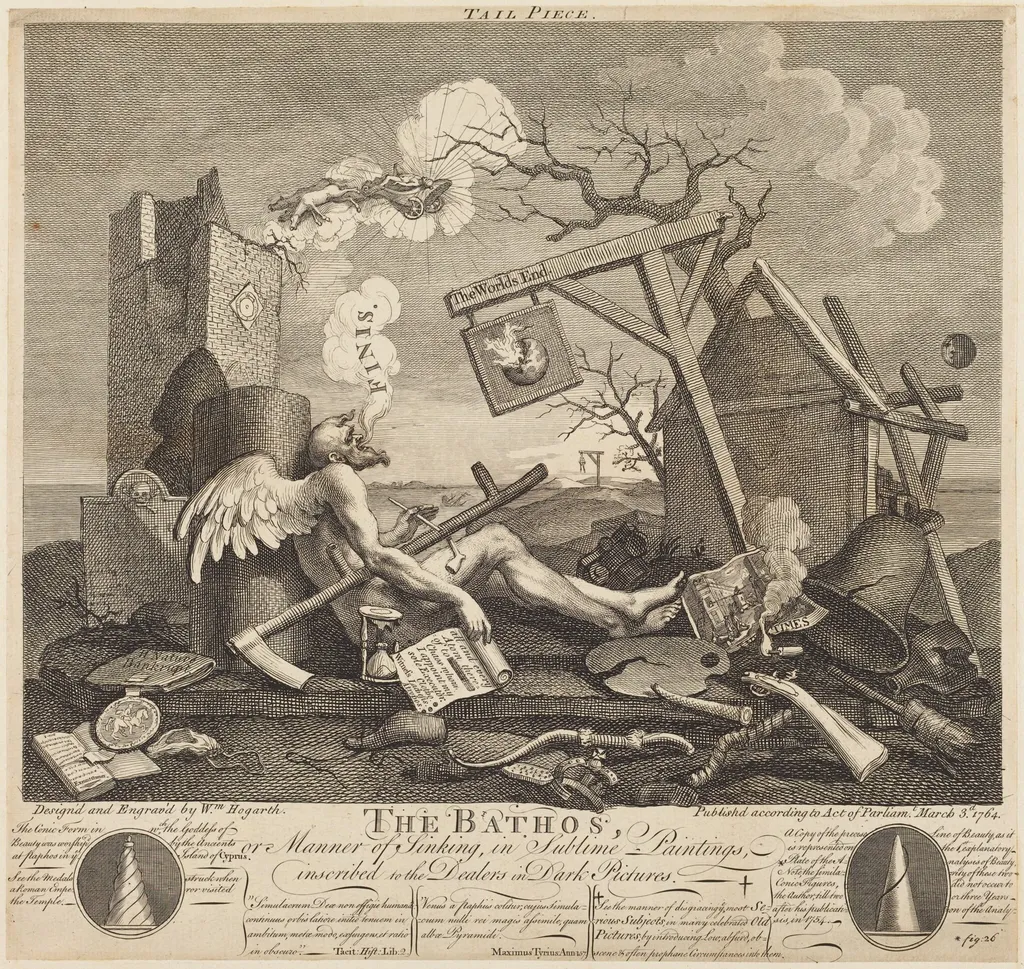
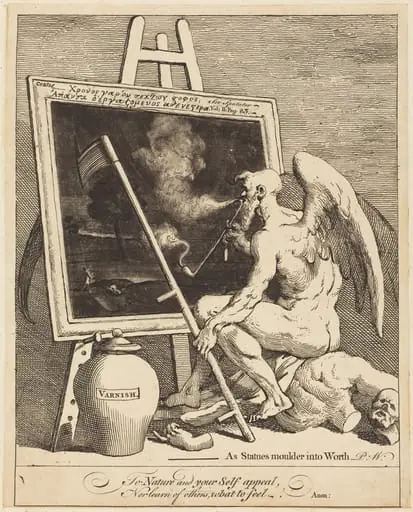
Tailpiece, or The Bathos is an ink print by the Romanticist artist William Hogarth. It dates from 1764 and is held in the collection of the National Gallery of Art.
About this work
Overview
It was intended as a companion to his earlier narrative series, functioning both as a closing image and a self-referential commentary.
Created in 1764, shortly before his death, William Hogarth’s Tailpiece, or The Bathos is a final etching and engraving that serves as a visual summation of his satirical career. It was intended as a companion to his earlier narrative series, functioning both as a closing image and a self-referential commentary. The work distills his lifelong engagement with moral and aesthetic decline through a single, densely packed scene.
Subject & Meaning
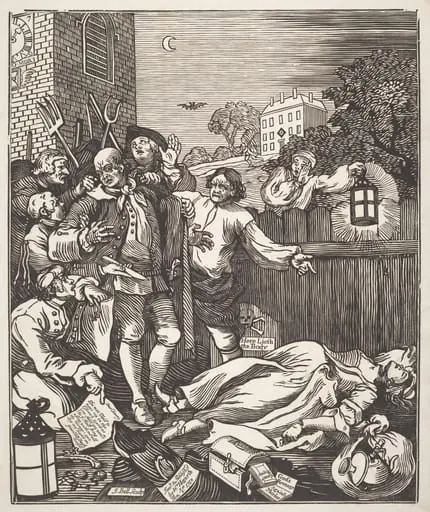
The print depicts a man sprawled amid the wreckage of symbolic objects, clock, harp, book, mirror, all shattered or inverted. Above, gnarled trees mirror the disorder below. The title, referencing the rhetorical term for an abrupt descent from the sublime to the trivial, suggests a critique of failed ambition. The distant onlookers and observing bird imply detached judgment, reinforcing the theme of human folly rendered absurd.
Technique & Style
Hogarth employed fine etching and engraving lines to render intricate detail across a chaotic composition. The dense cross-hatching and precise contours create texture in the debris and foliage, while the lack of background depth focuses attention on the cluttered foreground. His controlled hand contrasts with the visual disorder, a hallmark of his ability to impose order on chaos to heighten narrative impact.
History & Provenance
Produced in the final year of Hogarth’s life, the print was published posthumously in 1765 as part of a collected edition of his works. It was not commissioned but rather a personal statement, likely intended to cap his career. Early owners included collectors of British satirical prints, and it later entered institutional collections as part of broader efforts to preserve his legacy.
Context
In mid-18th-century England, print culture flourished as a medium for public critique. Hogarth’s work responded to rising literacy, the growth of the middle class, and debates over taste and morality. The Bathos reflects contemporary anxieties about the erosion of artistic and intellectual seriousness, positioning satire as both entertainment and warning against cultural decline.
Legacy
Though less widely known than his narrative series, The Bathos became a touchstone for later illustrators and cartoonists drawn to its compressed symbolism and dark humor. Its influence is visible in 19th-century political cartoons and 20th-century graphic satire, where the juxtaposition of grandeur and ruin remains a potent device for social commentary.
Own this work as a print
Artist & collection
Artist
William Hogarth (; 10 November 1697 – 26 October 1764) was an English painter, engraver, satirist, cartoonist and writer.