Artwork
Hound and Hunter
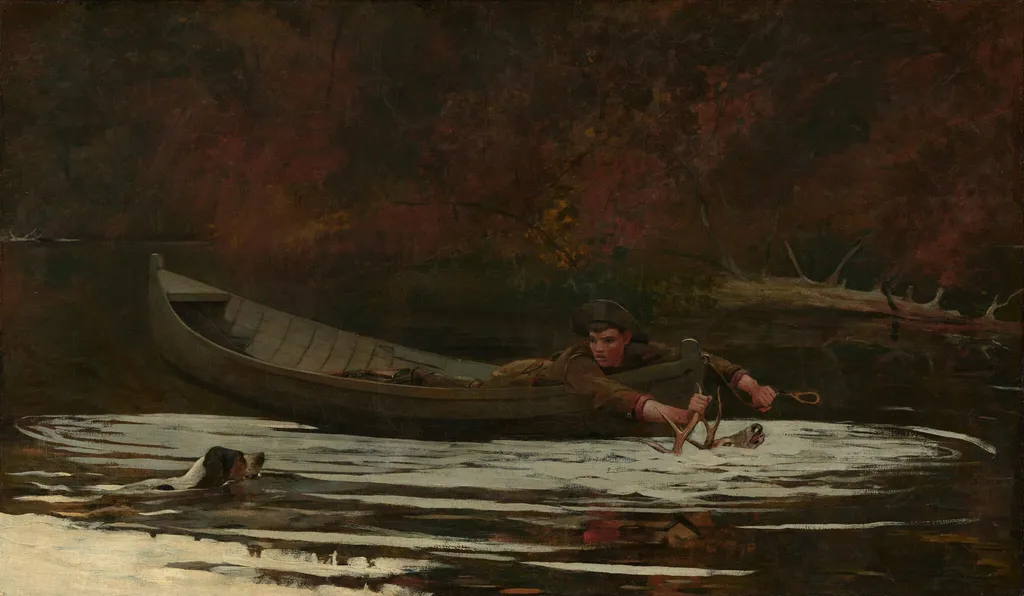
Hound and Hunter is an oil painting by the American Impressionist artist Winslow Homer. It dates from 1892 and is held in the collection of the National Gallery of Art.
- Inscription
- Inscribed:lower right: Winslow Homer 1892
About this work
Technique & Style
Classified as a painting, it depicts a young hunter in a boat with his hound, drawing on Homer's Adirondack hunting subjects of this period.
Winslow Homer executed Hound and Hunter in 1892 using oil paint on a canvas support. The work measures approximately 71.8 cm in height and 122.3 cm in width. Classified as a painting, it depicts a young hunter in a boat with his hound, drawing on Homer's Adirondack hunting subjects of this period.
The physical construction relies on the traditional combination of oil pigments applied to a woven canvas ground, a standard medium for Homer's mature easel paintings.
History & Provenance
Hound and Hunter was painted in 1892 by Winslow Homer and depicts a young hunter in a boat hauling a slain deer from the water while his hound swims nearby, a scene rooted in Homer's Adirondack hunting experiences. The work was first consigned by the artist between 1900 and 1902 to M. Knoedler & Co. in New York. By 1908 it was in the possession of Louis Ettlinger of New York, who lent it to the 12th annual exhibition at the Carnegie Institute in Pittsburgh that year.
Upon Ettlinger’s death in 1927, the painting passed to his daughters, Flora Ettlinger Whiting and Josephine Ettlinger McFadden. By the mid-1930s it had descended to Flora Whiting and her nephew Louis E. McFadden, who sold it through Wildenstein & Co. in New York on 20 March 1946 to Stephen C. Clark. Clark gifted the painting to the National Gallery of Art, Washington, D.C., in 1947, where it remains.
Overview
Winslow Homer's 1892 oil on canvas, Hound and Hunter, presents a dramatic nocturnal scene. A young hunter, positioned in a small boat, aims his rifle at a fleeing deer in the water. Alongside, a dog is captured mid-leap, creating splashes as it pursues the animal.
The entire encounter is illuminated by a stark moonlight. This painting is part of the collection at the National Gallery of Art in Washington.
Subject & Meaning
The artwork depicts a critical moment of pursuit, underscoring the raw and often perilous aspects of the wilderness. Homer captures the tension between human intervention and animal instinct, exploring themes of survival, danger, and the choices made in the face of nature's power. The dramatic lighting further emphasizes the gravity of this interaction, moving beyond simple landscape depiction to a more profound commentary on the natural order.
Context
Homer completed Hound and Hunter after a series of trips to the Adirondack Mountains, an experience that profoundly shaped his artistic perspective. These excursions inspired him to portray the ruggedness of the American wilderness and the complex relationship between its inhabitants. The painting aligns with Homer's broader body of work, which often examines American life and landscape with a directness reminiscent of earlier pieces like Snap the Whip.
Artist & collection
Artist
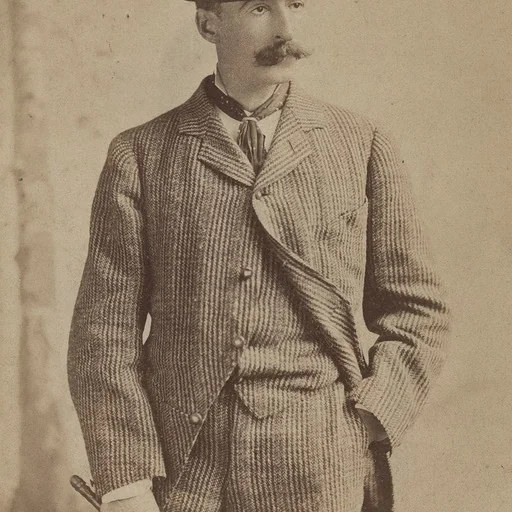
Winslow Homer (February 24, 1836 – September 29, 1910) was an American landscape painter and illustrator, best known for his marine subjects.