Artwork
The Gulf Stream
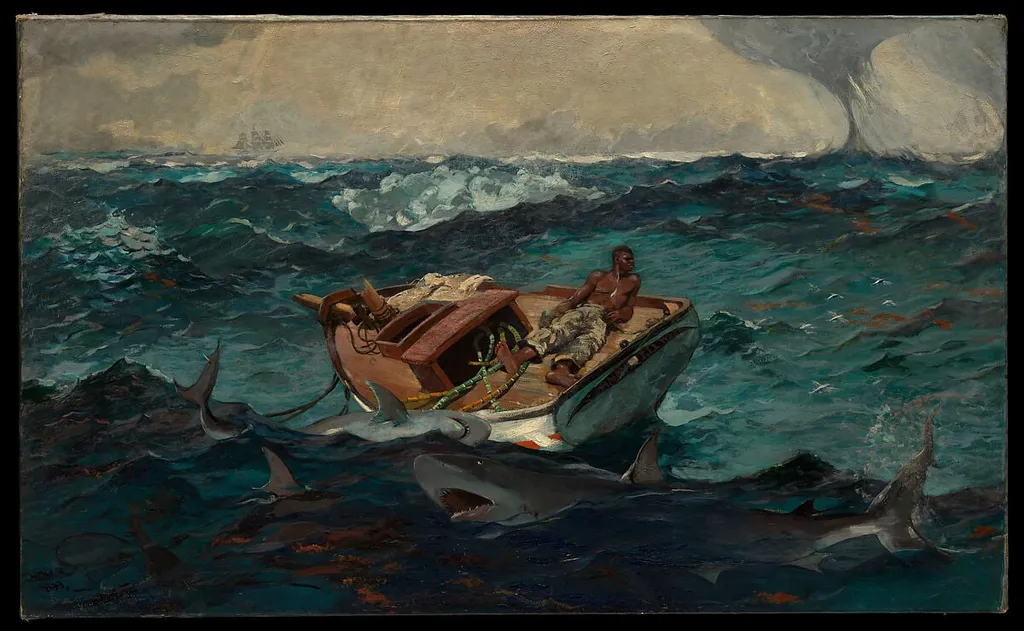
The Gulf Stream is an oil painting by the Naturalist artist Winslow Homer. It dates from 1899 and is held in the collection of the Metropolitan Museum of Art.
About this work
Winslow Homer painted this scene in 1899 after wintering in Nassau and Florida, drawing on a decade of Caribbean voyages.
A lone Black sailor lies sprawled across the deck of a dismasted, rudderless boat named Anna – Key West, while sharks circle and a waterspout looms on the horizon. Winslow Homer painted this scene in 1899 after wintering in Nassau and Florida, drawing on a decade of Caribbean voyages. He later reworked the canvas, adding a distant ship and deepening the sea.
When it appeared at the National Academy of Design in 1906, the jury petitioned the Metropolitan Museum of Art to buy it, and the museum acquired it that same year for the Catharine Lorillard Wolfe Collection.
Subject & Meaning
The painting depicts a Black man in a small, dismasted, rudderless fishing boat, surrounded by storm-tossed waves and sharks, with a waterspout on the horizon and a distant ship at upper left. The subject draws on Homer's experiences crossing the Gulf Stream and visiting the Bahamas. Iconographically, the broken mast and circling sharks convey vulnerability, while the far-off ship suggests society is present but unattainable.
Homer intended an allegory of man's struggle against nature, yet he described the figure as "dazed & parboiled" but ultimately rescued, offering a note of hope. The work alludes to Copley's Watson and the Shark but replaces its imminent rescue with a sense of abandonment, underscoring themes of isolation and stoic endurance.
Technique & Style
Executed in oil on canvas, The Gulf Stream measures 71.4 × 124.8 cm, its horizontal format emphasizing the vast expanse of the sea. Homer's handling of the paint reveals a deliberate reworking: after its first exhibition, he deepened the ocean water, broke the starboard gunwale, added a sail, a red dash near the waterline, made the boat's name legible, and inserted a distant ship on the upper left horizon. These adjustments heightened the sense of isolation and drama.
Formally, the composition centers on a small, dismasted, rudderless boat occupied by a lone figure, surrounded by circling sharks and turbulent waves, with the distant ship suggesting an unreachable society. The accurate anatomical depiction of the sharks and the stoic, resigned pose of the figure contribute to an overall effect of imminent peril and melancholy.
History & Provenance
Winslow Homer painted The Gulf Stream in 1899, inspired by multiple trips to the Caribbean and a visit to Nassau and Florida between December 1898 and February 1899. He began the final oil in September 1899, drawing on watercolor studies dating back to 1885. After exhibiting the work at the Pennsylvania Academy of the Fine Arts in 1900, Homer reworked the canvas, adding details such as a broken gunwale, a sail, and a distant ship.
The painting was later shown at the Carnegie Institute in Pittsburgh. In 1906, it was displayed at the National Academy of Design, where the academy's jury petitioned the Metropolitan Museum of Art to acquire it. The museum purchased the painting later that year, and it has remained in its collection since. No commission or earlier private ownership is documented.
Context
Upon its exhibition, The Gulf Stream elicited mixed critical reactions; viewers reportedly laughed, dubbing it "Smiling Sharks," and one critic noted a "diffusion of interest" atypical of Homer. The Metropolitan Museum of Art acquired the painting in 1906 after a petition from the National Academy jury. Scholarship interprets the work as an enigmatic allegory, curator Bryson Burroughs considered it "a great allegory", and as a meditation on vulnerability following the death of Homer's father in 1898.
Art historian Robert Hughes compared it to John Singleton Copley's Watson and the Shark, emphasizing Homer's accurate shark anatomy and the painting's heightened sense of abandonment versus Copley's imminent rescue. The painting culminates Homer's marine narratives after his Caribbean travels, with Homer himself offering a narrative of eventual rescue though the imagery remains desolate.
Overview
Winslow Homer's 1899 oil painting, The Gulf Stream, depicts a lone mariner adrift in a damaged vessel amidst a turbulent sea. This work encapsulates the artist's long-standing fascination with the power of nature and human vulnerability. The scene, set in the open ocean, reflects Homer's extensive travels and observations in the Caribbean and Florida, where he frequently encountered the formidable forces of the marine environment.
Artist & collection
Artist
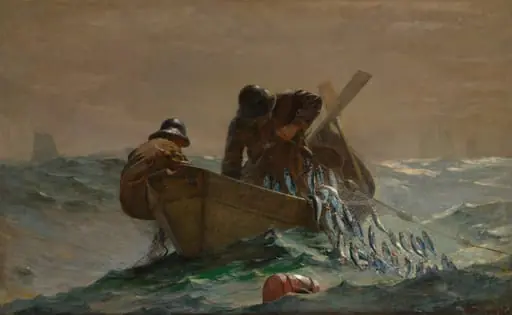
Winslow Homer (February 24, 1836 – September 29, 1910) was an American landscape painter and illustrator, best known for his marine subjects.