Artwork
Breezing Up (A Fair Wind)
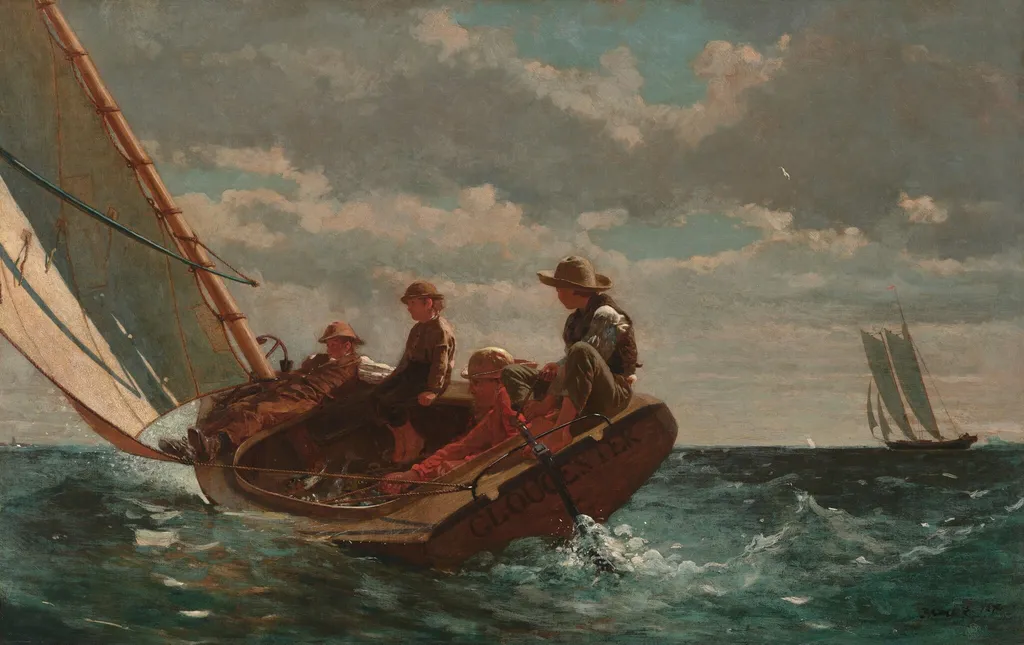
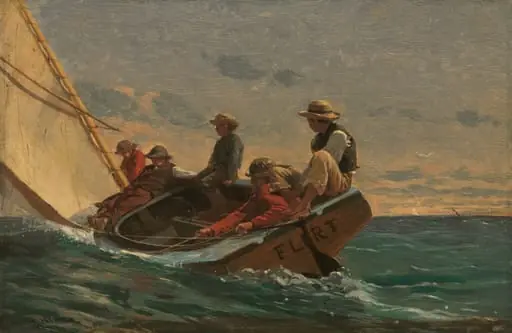
Breezing Up (A Fair Wind) is an oil painting by the American Impressionist artist Winslow Homer. It dates from 1874 and is held in the collection of the National Gallery of Art.
- Inscription
- Inscribed:lower right: HOMER 1876.; lower left: HOMER
About this work
Subject & Meaning
The painting shows the catboat Gloucester cutting through Gloucester Harbor under a fair wind, carrying a man, three boys and their catch【3】.
The painting shows the catboat Gloucester cutting through Gloucester Harbor under a fair wind, carrying a man, three boys and their catch【3】. An anchor placed in the bow where a fourth boy once stood is interpreted as a symbol of hope【3】【4】, while the boy gripping the tiller looks toward the horizon, signalling optimism for his own future and that of the young United States【3】【4】. Despite the choppy sea, the figures appear relaxed, conveying a positive, buoyant mood【3】【4】.
The composition balances an active left side with a sparse right, reflecting Japanese art’s influence on Homer【3】【4】, and also echoes the marine scenes of French painters Courbet and Monet【3】【4】. Today the work is regarded as an iconic American image of nineteenth‑century life, embodying hope and the harmonious struggle between humanity and nature【3】【4】【5】.
Technique & Style
Breezing Up (A Fair Wind) is an oil painting on canvas, measuring approximately 61.5 × 97 cm. Homer began the work in 1873, developing it over three years from watercolor sketches made in Gloucester; infrared reflectography shows numerous compositional revisions, including the elimination of a fourth boy near the mast and a distant schooner, and a shift in the adult’s grip from both sheet and tiller to a single hold. The paint handling is loose and vigorous, reflecting the artist’s “coarse and negligé” technique, while the composition balances an active left half with a sparse right half, a balance influenced by Japanese prints. Stylistically, the work combines realist detail with the loose brushwork and light effects of Courbet and Monet, conveying an elastic, lively motion of the figures and boat under a fair wind.
History & Provenance
Winslow Homer painted Breezing Up (A Fair Wind) between 1873 and 1876, beginning the oil on canvas in New York after his 1873 visit to Gloucester, Massachusetts, and working on it for roughly three years, a process documented through infrared studies that revealed compositional changes such as the removal of a fourth boy and a second schooner. The work, initially titled A Fair Wind, was first shown at the National Academy of Design in 1876 and later acquired by the National Gallery of Art in 1943 after passing through the hands of Charles Stewart Smith, who bought it from the artist by 1878, inherited it to his son Howard Caswell Smith, and sold it to Wildenstein & Co. in 1943.
Breezing Up (A Fair Wind) is held by the National Gallery of Art in Washington, D.C., where it entered the collection on 31 December 1943. Its documented provenance begins with a purchase from the artist by Charles Stewart Smith (1832–1909) of New York by 1878, although his son believed the acquisition may instead have occurred at an auction held on 1–2 March 1877 under Daniel A. Mathews, following a showing at Kurtz Gallery, New York. The painting passed by inheritance to Smith's son, Howard Caswell Smith, of Oyster Bay, New York, who sold it in 1943 through Wildenstein & Co., New York, to the NGA.
The work was first publicly exhibited in 1876 at the National Academy of Design and at the Centennial Exposition in Philadelphia, and by 1879 had acquired the title Breezing Up.
Context
Breezing Up (A Fair Wind) is widely regarded as an iconic work in American art, praised since its debut for its vivid evocation of movement and natural energy. Contemporary critics highlighted its unmediated realism, with one noting the painting’s coarse yet forceful execution and its convincing depiction of wind-driven motion, while another emphasized the figures’ organic rapport with the rolling sea. By 1879 the canvas was popularly titled Breezing Up, a name Homer tolerated, and over time it has come to symbolize both the optimism of post-Centennial America and the artist’s mature engagement with marine subjects.
The work’s compositional balance, between the active left and spare right halves, reflects the influence of Japanese art absorbed during Homer’s 1866–67 sojourn in France, alongside the bravura handling seen in contemporary French marine painting by Courbet and Monet. Today it remains one of the National Gallery of Art’s most celebrated holdings, emblematic of nineteenth-century American genre painting.
Legacy
Since its completion in 1876, Breezing Up (A Fair Wind) has evolved from a celebrated exhibition piece into an iconic image of American art. Initially praised by contemporary critics for its authentic depiction of motion and the "heartier" realism of its figures, the work was first displayed at the National Academy of Design and the Centennial Exposition in Philadelphia. Over time, it gained a reputation as one of Winslow Homer's finest achievements, symbolizing national optimism and the dynamic relationship between humanity and nature.
By 1879, the title Breezing Up had become standard, replacing the artist's original A Fair Wind. In 1943, the National Gallery of Art acquired the painting, subsequently describing it as one of the most beloved and well-known artistic representations of nineteenth-century American life. Today, it remains a defining masterpiece of the genre, widely recognized for its compositional balance and enduring cultural significance.
Overview
Winslow Homer's oil painting, Breezing Up (A Fair Wind), captures a vibrant maritime scene. Executed on canvas, the work depicts a small catboat navigating the waters of Gloucester harbor. The composition conveys a sense of motion and the power of the sea, characteristic of Homer's focus on natural elements and human interaction with them.
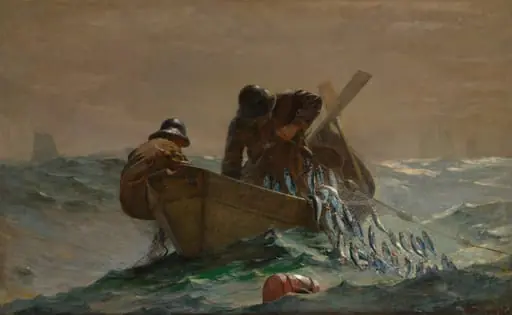
Own this work as a print
Artist & collection
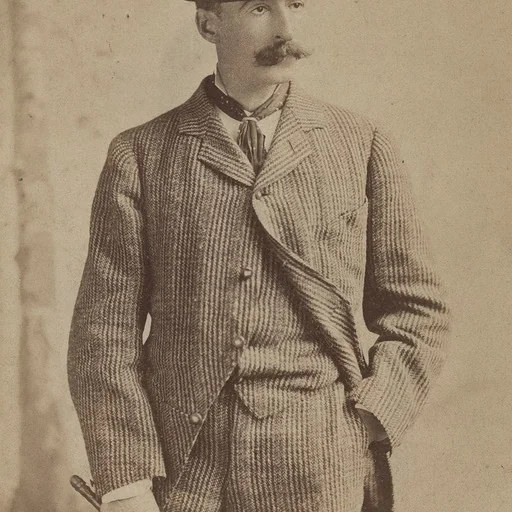
Artist
Winslow Homer (February 24, 1836 – September 29, 1910) was an American landscape painter and illustrator, best known for his marine subjects.