Artwork
Dressing for the Carnival
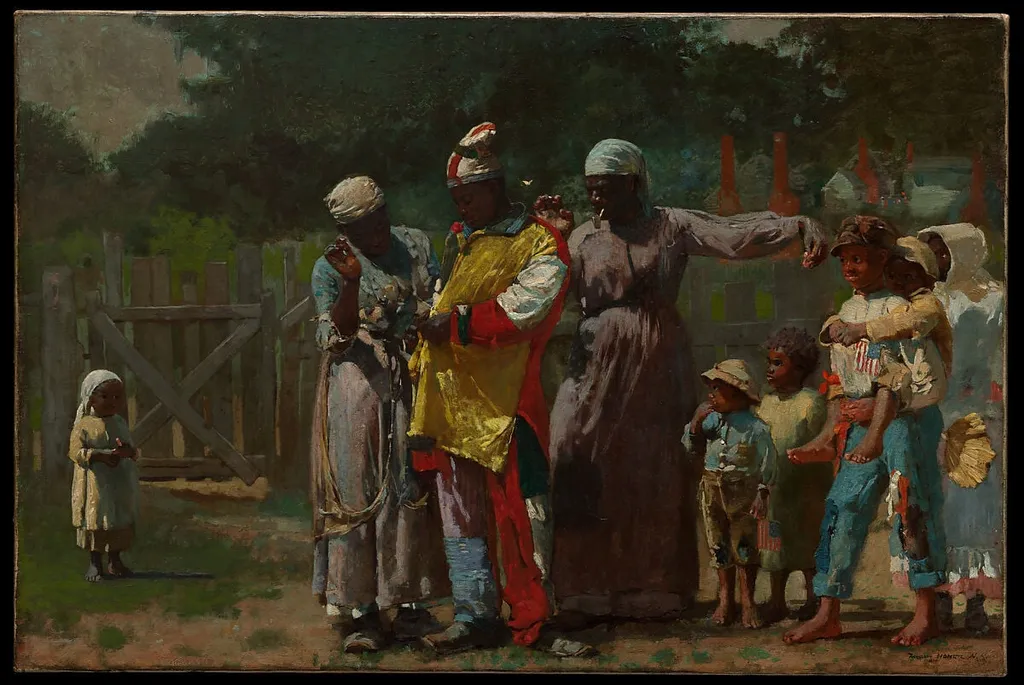
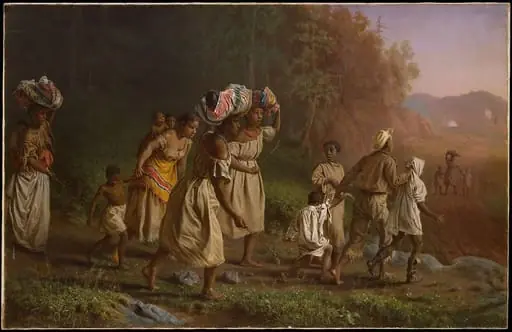
Dressing for the Carnival is an oil painting by the American Impressionist artist Winslow Homer. It dates from 1877 and is held in the collection of the Metropolitan Museum of Art.
- Accession no.
- 22.220
- Credit line
- Amelia B. Lazarus Fund, 1922
About this work
The figure’s Phrygian cap and the child’s American flag signal liberty, yet the withdrawn federal troops made that promise fragile.
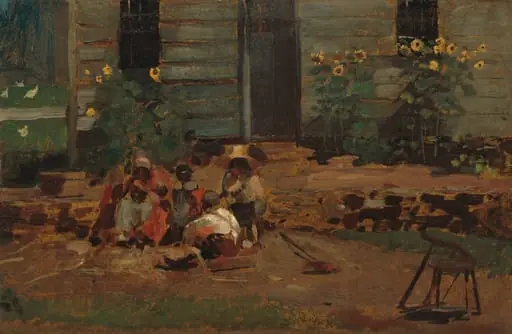
In 1877, two women sew bright strips of cloth onto a man’s costume as children watch in a Virginia yard. Winslow Homer painted the scene during the final year of Reconstruction, capturing preparations for a Jonkonnu festival that merged West African and European traditions. The figure’s Phrygian cap and the child’s American flag signal liberty, yet the withdrawn federal troops made that promise fragile.
Subject & Meaning
The painting depicts a group of African Americans preparing for the festival of Jonkonnu, a tradition blending African and American customs. At center, a man is being costumed in bright, tattered clothes, including a liberty cap, evoking a Harlequin-like Lord of Misrule figure. Two women sew the costume; the woman on the right pulls a thread with a gesture compared to a classical Fate, lending a somber gravity to the scene.
Children watch, one holding a Stars and Stripes flag, signaling that by the Reconstruction era, Fourth of July rituals had been overlaid on the Jonkonnu celebration. Homer deliberately avoids the degrading stereotypes common in contemporary depictions of Black life. Instead, the scene carries a tragic undertone: the festive preparation underscores the distance between the promises of emancipation and the harsh realities facing Black Southerners.
Technique & Style
Homer executed Dressing for the Carnival in oil on canvas, a medium typical of his genre scenes, with dimensions of 50.8 by 76.2 cm. His handling is descriptive and realistic, rendering the bright tatterdemalion costume in yellow, red, and blue, which contrasts with the more subdued tones of the surrounding figures and landscape. The artist employs a deliberate compositional gravity: one woman pulls a long thread through the garment in a gesture that evokes classical solemnity, while children watch with wonder. Stylistically, Homer avoids the stereotypical portrayals of African Americans common in Reconstruction-era imagery, instead imbuing the scene with nuanced, somber realism.
The painting's formal qualities, its modulated palette, careful draftsmanship, and balanced arrangement, support the work's complex thematic undertones.
Context
Critical reception of Dressing for the Carnival has emphasized Winslow Homer's departure from contemporary stereotypes of African Americans during Reconstruction. Unlike the many images of carefree carnival-goers that proliferated in the 1870s and 1880s, Homer's painting is interpreted as a deeply nuanced and tragic scene of preparation. Scholars have noted the symbolic gravity of the woman sewing a costume, likening her to a classical Fate, and observed the overlaying of Fourth of July rituals onto the African American festival of Jonkonnu, underscoring the gap between emancipation and lived reality.
Homer's work is thus positioned in art history as a complex, empathetic counterpoint to the era's typical racial caricatures.
Overview
Dressing for the Carnival (1877) is an oil on canvas by Winslow Homer depicting a moment of preparation for a Jonkonnu festival in Virginia. The composition centers on a man standing in a yard while two women attach bright strips of cloth to his costume; several children observe the activity nearby. Homer executed the work during the final year of Reconstruction, a period marked by significant social and political shifts in the American South.
The painting captures the syncretic nature of the Jonkonnu celebration, which blended West African traditions with European customs. The central figure wears a Phrygian cap, a symbol often associated with liberty, adding a layer of political resonance to the genre scene. Homer's brushwork is loose yet precise, emphasizing the textures of the fabric and the natural light of the outdoor setting.
This work stands as a significant example of Homer's engagement with African American life and culture, moving beyond his earlier Civil War illustrations to explore complex social dynamics. It reflects his interest in the everyday lives of marginalized communities and the enduring cultural practices that persisted despite the end of slavery. The painting remains a key document of post-Civil War American society and Homer's evolving artistic focus.
Artist & collection
Artist
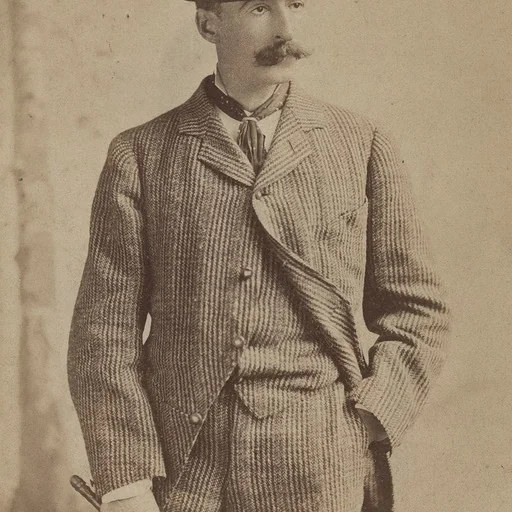
Winslow Homer (February 24, 1836 – September 29, 1910) was an American landscape painter and illustrator, best known for his marine subjects.