Artwork
Prisoners from the Front
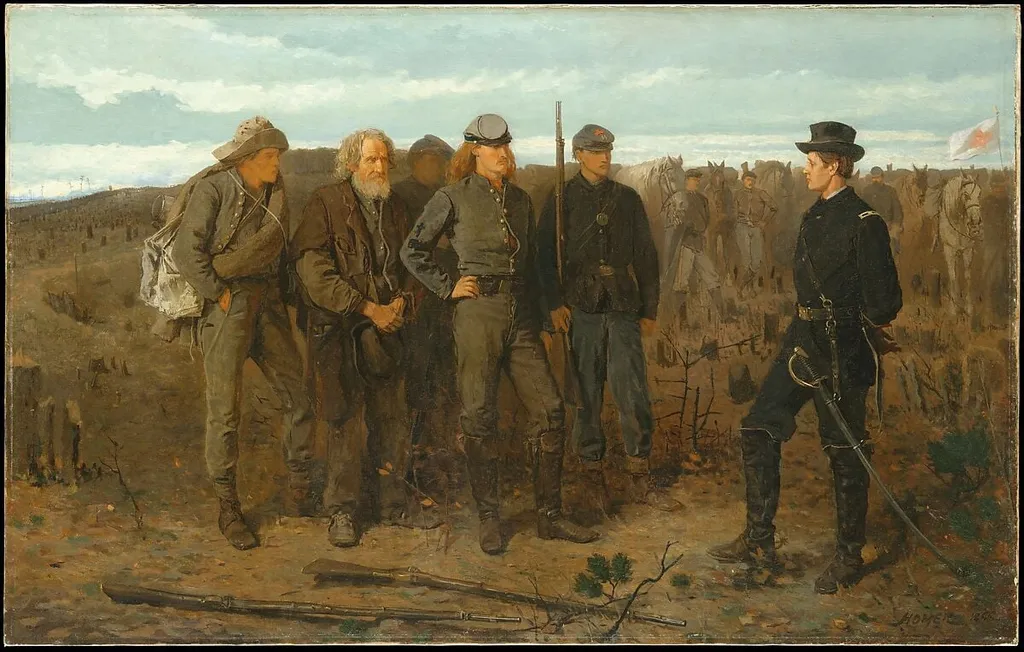
Prisoners from the Front is an oil painting by the Impressionist artist Winslow Homer. It dates from 1866 and is held in the collection of the Metropolitan Museum of Art.
About this work
A group of men stand and sit in a somber field, a rare quiet moment between enemies during the American Civil War. No one is fighting. The soldiers seem to be waiting. Winslow Homer painted it in 1866.
Subject & Meaning
The composition minimizes the visual contrast between victor and vanquished, suggesting the conflict was a 'renegotiation of terms' rather than a total break.
Completed in 1866, this oil painting depicts Confederate officers surrendering to Union Brigadier General Francis Channing Barlow within a barren landscape. While the Union commander is individually identified, the opposing soldiers remain anonymous, representing a cross-section of ages and attitudes. The iconography diverges from traditional submission scenes; although the prisoners have lowered their rifles, they refuse to bow.
Instead, an elderly figure displays submission while a youthful soldier exhibits confident nonchalance with a hand in his pocket. Scholars interpret the work not as a record of a specific battle, but as a symbolic commentary on the Civil War's aftermath. The composition minimizes the visual contrast between victor and vanquished, suggesting the conflict was a 'renegotiation of terms' rather than a total break.
The grim setting and the prisoners' defiant postures symbolize enduring bitterness and the difficult spiritual maturity required for national reconciliation.
Technique & Style
Executed in oil on canvas (oil paint on canvas support), the work measures roughly 60.9 × 96.5 cm and belongs to the genre scene category within the American Wing collection. Homer’s brushwork combines the precise modeling of historical narrative with the looser handling of genre painting, producing a crisp delineation of the Union officer and a more impressionistic rendering of the Confederate prisoners. Infrared examination documented multiple pentimenti, indicating revisions to figure placement and background detail during the painting’s development.
The composition balances stark chiaroscuro with a muted, barren landscape, while the varied poses, ranged from submissive to defiant, convey nuanced interpersonal tension. These formal choices underscore the painting’s hybrid status between historical and genre traditions.
History & Provenance
Winslow Homer painted Prisoners from the Front in 1866 using oil on canvas (60.9 × 96.5 cm). The scene depicts Confederate officers surrendering to Union Brigadier General Francis Channing Barlow and draws on Homer’s wartime reporting experience. Following its completion the painting was acquired by the Metropolitan Museum of Art and has been part of the American Wing collection ever since.
Its provenance therefore moves from the artist’s studio to museum ownership, with no recorded private sales prior to museum accession. The work remains on public display at the Met and is classified as a genre scene within the broader Civil War artistic record.
Prisoners from the Front has been held by the Metropolitan Museum of Art in New York since its acquisition. The painting is inventoried as 67.187 in the museum’s collection, where it remains on view in The American Wing. It was first exhibited publicly at the National Academy of Design in 1866, the year of its completion, and has appeared in major museum reinstallations of American art, including thematic Civil War presentations such as the 1985 exhibition “The Civil War: Twenty-Five Paintings by Winslow Homer” at the Amon Carter Museum.
Context
Prisoners from the Front entered criticism as a singular Civil War image that eluded easy genre classification, prompting debates among scholars about its historical and allegorical dimensions. Peter Schjeldahl later singled it out as the most incisive pictorial statement on the conflict, while infrared analysis and preparatory studies confirmed the painting’s protracted evolution, reflecting Homer’s struggle to balance narrative clarity with interpretive openness. Scholars such as Frances Pohl locate the work’s significance in its refusal of triumphalist closure; by minimizing visual hierarchies between captors and captives, the composition frames the war as a renegotiation rather than a rupture, emphasizing enduring sectional resentments and the need for mutual moral reckoning in Reconstruction.
In broader art-historical terms, the painting exemplifies Homer’s synthesis of history painting, landscape, and emergent photographic realism, positioning it as a pivotal bridge between antebellum narrative traditions and modernist ambiguity.
Legacy
Prisoners from the Front is widely regarded as one of Winslow Homer's most significant early works, celebrated for its ambiguous portrayal of the American Civil War. Art critic Peter Schjeldahl has described it as "the most telling of all paintings about the Civil War," highlighting its unique ability to transcend simple historical documentation. Scholars interpret the piece as a symbolic commentary on postwar reconciliation, suggesting a "renegotiation of terms" between North and South rather than a total victory.
The painting's legacy is further cemented by its enduring presence in popular culture; it appears in the opening credits of the film Gettysburg and is mirrored in a scene depicting a conversation between Lieutenant Thomas Chamberlain and Confederate prisoners. By blending historical and genre elements, the work continues to serve as a complex example of how art can convey the tragic, fratricidal nature of the conflict.
Overview
Winslow Homer's 1866 oil on canvas, "Prisoners from the Front," captures a pivotal moment during the American Civil War. This painting is recognized as one of Homer's significant early achievements, depicting a somber encounter between Union and Confederate forces. It portrays a scene of surrender, highlighting the human element amidst the conflict rather than active combat.
Artist & collection
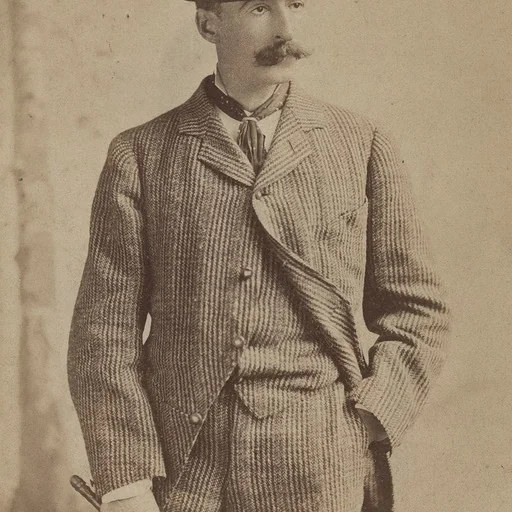
Artist
Winslow Homer (February 24, 1836 – September 29, 1910) was an American landscape painter and illustrator, best known for his marine subjects.