Artwork
墨蕙図 (Bokkei zu)|Orchids
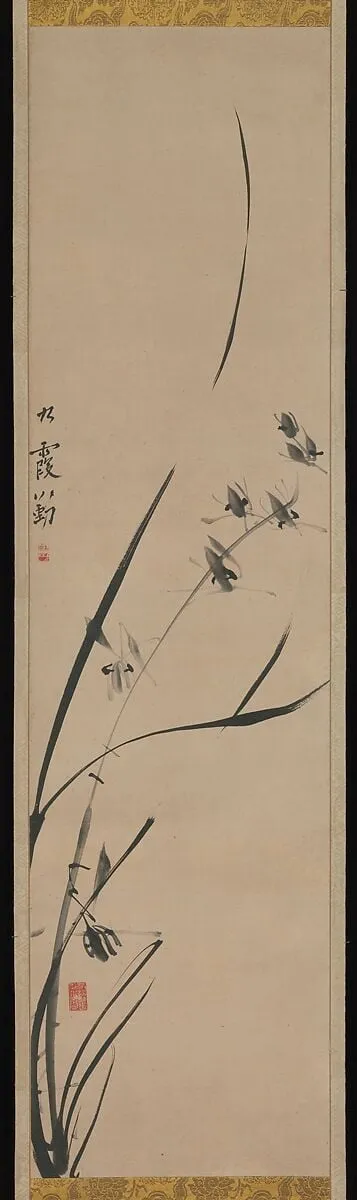
墨蕙図 (Bokkei zu)|Orchids is an ink painting by the Baroque artist Ike Taiga. It dates from 1749 and is held in the collection of the Metropolitan Museum of Art.
About this work
Subject & Meaning
As a hanging scroll executed in ink on paper, the piece relies on the artistic rendering of the orchid to convey its aesthetic and cultural significance.
The work depicts orchids, a subject drawn from the natural world and classified within the still-life genre. In the context of East Asian ink painting, orchids traditionally symbolize refinement, integrity, and the elegance of the solitary scholar, though the specific symbolic intent for this 1749 piece is not detailed in the available records. The title, translated as 'Orchids' or 'Bokkei zu,' directly identifies the floral subject matter.
As a hanging scroll executed in ink on paper, the piece relies on the artistic rendering of the orchid to convey its aesthetic and cultural significance. The depiction focuses solely on the botanical form, presenting the flowers as the central iconographic element of the composition.
Technique & Style
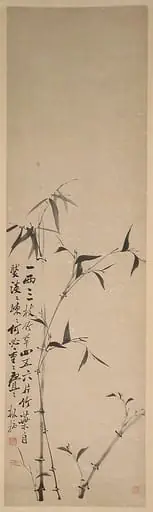
Created in 1749 by Ike Taiga, this work is a hanging scroll executed in ink on paper. The piece measures 96.7 cm in height and 25.2 cm in width, presenting a vertical format typical of the hanging scroll tradition. Stylistically, the painting depicts orchids, utilizing a monochromatic palette restricted to black ink.
The composition focuses on the botanical subject matter within a still-life genre framework, relying on the contrast between the ink and the paper support to define the forms of the flowers and foliage without the application of color.
History & Provenance
Created in 1749 by the Japanese artist Ike no Taiga, this hanging scroll titled Bokkei zu (Orchids) was executed in ink on paper. The work originated in Japan during the mid-eighteenth century. While specific details regarding its original commission or intermediate ownership history are not provided in the available records, the painting is currently held in the collection of the Metropolitan Museum of Art.
The piece measures approximately 96.7 cm in height and 25.2 cm in width, depicting orchids within the still-life genre.
The hanging scroll by Ike Taiga titled 墨蕙図 (Bokkei zu) | Orchids is part of the Metropolitan Museum of Art’s collection in New York. According to the museum’s catalog entry, the work is attributed to Ike no Taiga, created in 1749 in Japan, and is classified as a still‑life painting of orchids. The available documentation lists the museum as the current holding institution but does not provide an explicit inventory or accession number. No exhibition history is recorded in the sources consulted.
Legacy
The hanging scroll by Ike Taiga, created in 1749 and now housed in the Metropolitan Museum of Art, has come to symbolize the refined taste of the Edo‑era literati and shaped subsequent interpretations of orchid imagery in Japanese ink painting. Its composition, characterized by spare brushwork and subtle ink gradations, was repeatedly referenced by later artists seeking to emulate the balance between naturalistic detail and poetic abstraction. Scholars cite the work when discussing the development of the bunjinga aesthetic, noting that its inclusion in major museum inventories helped cement Ike Taiga’s reputation as a master of the genre. The piece continues to appear in exhibitions that explore the transnational dialogue of East Asian art.
Overview
Orchids (Bokkei zu) is an ink on paper hanging scroll by the Japanese artist Ike Taiga, created around 1749. This painting, a still life, features a single orchid rendered with dynamic brushwork. It exemplifies Taiga's early mastery of ink painting, presenting a subject rich in symbolic meaning within East Asian art traditions.
Context
Ike Taiga produced this work when he was approximately 26 years old, placing it early in his prolific career. During this period, Taiga was already establishing himself as a prominent figure in the Nanga school of painting, known for its emphasis on personal expression and scholarly themes. This early piece demonstrates his engagement with traditional subjects and innovative brushwork.
Artist & collection