Artwork
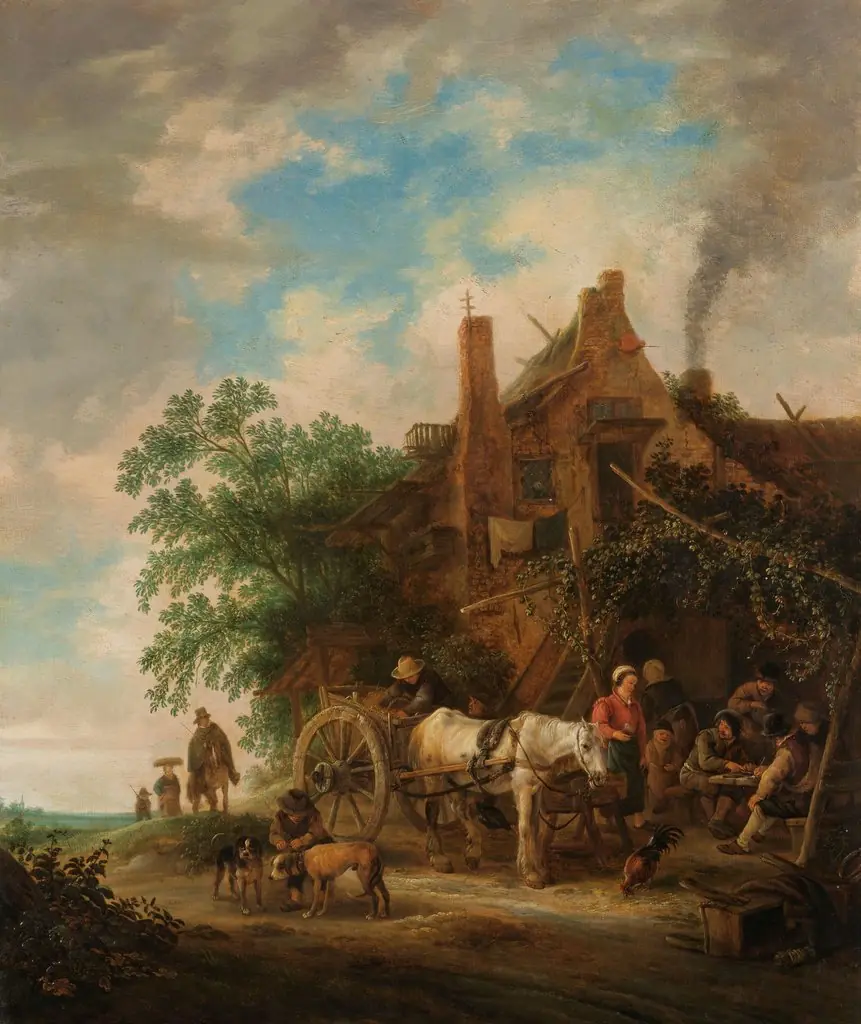
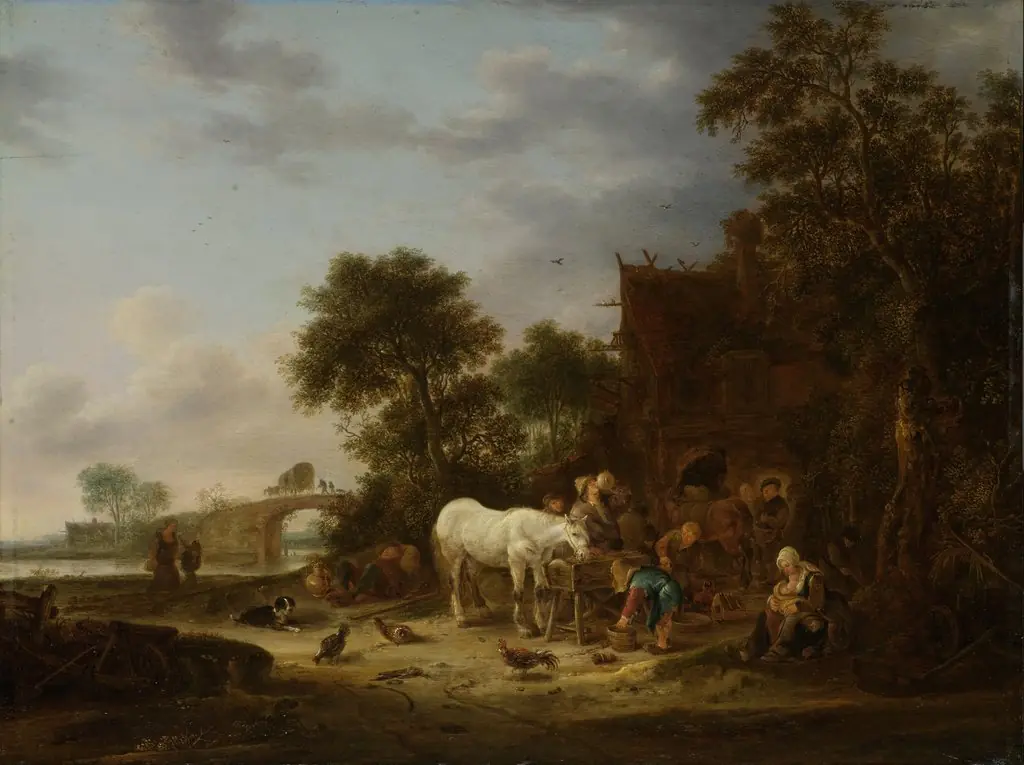
Country inn with a horse at the trough
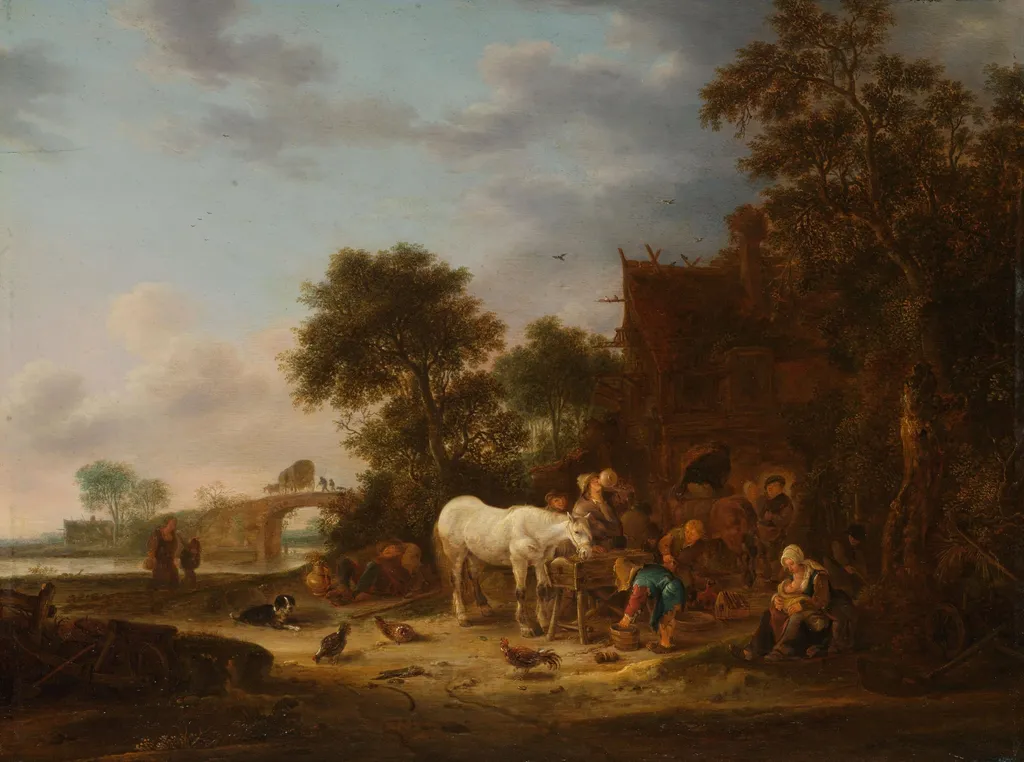
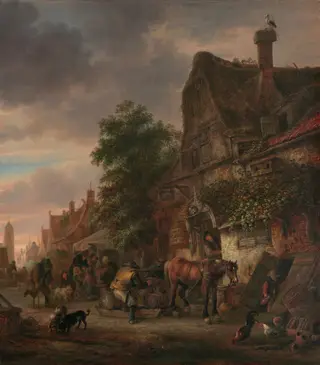
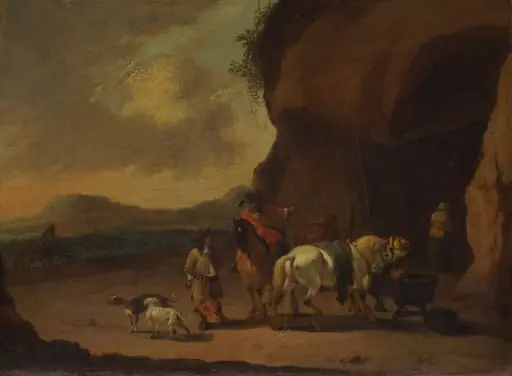
Country inn with a horse at the trough is an unspecified painting by the Dutch Golden Age artist Isaac van Ostade. It dates from 1643 and is held in the collection of the Rijksmuseum. The canvas portrays a rural inn courtyard where travelers pause for rest.
About this work
Subject & Meaning
In Country inn with a horse at the trough (1643), Isaac van Ostade depicts a rural hostelry at a moment of daily routine, emphasizing the horse’s presence at a trough as a compositional anchor.
The scene foregrounds the inn as a social nexus where travelers, animals, and villagers converge, aligning with the artist’s broader focus on village high streets and roadside life during the 1640s. Within his oeuvre, such inn-yard scenes crystallize the period’s fascination with transience and communal exchange, rendered in a warm, hazy atmosphere that evokes the smoke-laden air of Dutch thoroughfares.
The white horse itself recurs across van Ostade’s late works as a visual signature, mirroring the emblematic greys in contemporary battle scenes and underscoring the animal’s role as both utilitarian companion and pictorial device.
Technique & Style
The painting is executed in oil on panel, a common support among Dutch genre painters of the 1640s, favoring the fine grain and stability of wood for detailed handling. Stylistically, it belongs to a late phase in Isaac van Ostade’s career when he shifted from Rembrandtesque interior lighting to sunlit, atmospheric outdoor scenes. The composition balances anecdotal detail with a warm, hazy atmosphere, using umber underlayers for trees and buildings whose edges are heightened with liquid amber varnish to suggest a mellow, smoke-tinged light.
Figures and animals, especially the recurrent white horse at the trough, are rendered with sharp contrasts of light and shade, giving a crisp presence against the softened setting.
Handling shows a preference for crisp, loaded brushwork in highlights and glazed passages for textures such as brickwork or thatched roofs, producing a semi-conventionalized effect. The condition is not documented in the sources, but the technique, layered glazes and varnish mediums, implies a surface sensitive to abrasion and craquelure over time.
History & Provenance
It is recognized as a key example marking the artist's stylistic evolution from enclosed interior scenes to open landscapes with cooler tones.
The painting Country inn with a horse at the trough (1643) by Isaac van Ostade is dated to 1643 based on the artist’s documented activity in Haarlem and his admission to the Haarlem Guild of Saint Luke that same year.
The work belongs to a compact series of roadside inn scenes produced by van Ostade between 1646 and 1649, though this specific composition is earlier and reflects his transition from interior peasant scenes toward open-air village motifs. It is painted on wood, aligning with the artist’s preferred support during the 1640s and his engagement with rural genre subjects.
The painting Country Inn with a Horse at the Trough, dated 1643, is held in the collection of the Rijksmuseum in Amsterdam. The work is executed in oil on wood and measures 52 by 169 cm. It is recognized as a key example marking the artist's stylistic evolution from enclosed interior scenes to open landscapes with cooler tones. While other works by Isaac van Ostade are documented in institutions such as the Wallace Collection, the Louvre, and the National Gallery, specific exhibition records for this particular 1643 panel are not detailed in the available sources.
Context
Isaac van Ostade, younger brother and pupil of Adriaen van Ostade, emerged as a notable Dutch genre and landscape painter in the mid-17th century. Active in Haarlem from 1639 until his death in 1649, he developed a distinct style that evolved from his brother's cottage interior scenes to winter landscapes and roadside inns, characterized by warm, hazy atmospheres and prominent white horses. His works, such as A Village Inn (1643, Amsterdam, Rijksmuseum), The Slaughtered Pig (1639, Munich, Alte Pinakothek), and A Halt Before an Inn (1640, Rotterdam, Museum Boijmans Van Beuningen), are held in major institutions including the Louvre, National Gallery, London, and the Wallace Collection.
Van Ostade's winter scenes, devoid of foliage and smoke, employed opalescent tints to render crisp, luminous effects, while his compositions often featured animated groups of travelers, peasants, and animals. Though he produced around 100 paintings before dying at age 28, his contributions bridged the transitional period between Rembrandt's influence and the Dutch Golden Age landscape tradition, with his roadside inn series marking his final artistic phase.
Overview
The canvas portrays a rural inn courtyard where travelers pause for rest. Horses gather at a trough to drink, while a woman seated nearby nurses her infant. Chickens wander the foreground, and a dog lies asleep beside a reclining man, creating a lively yet tranquil tableau of everyday activity.
Own this work as a print
Artist & collection