Artwork
Bélizaire and the Frey Children
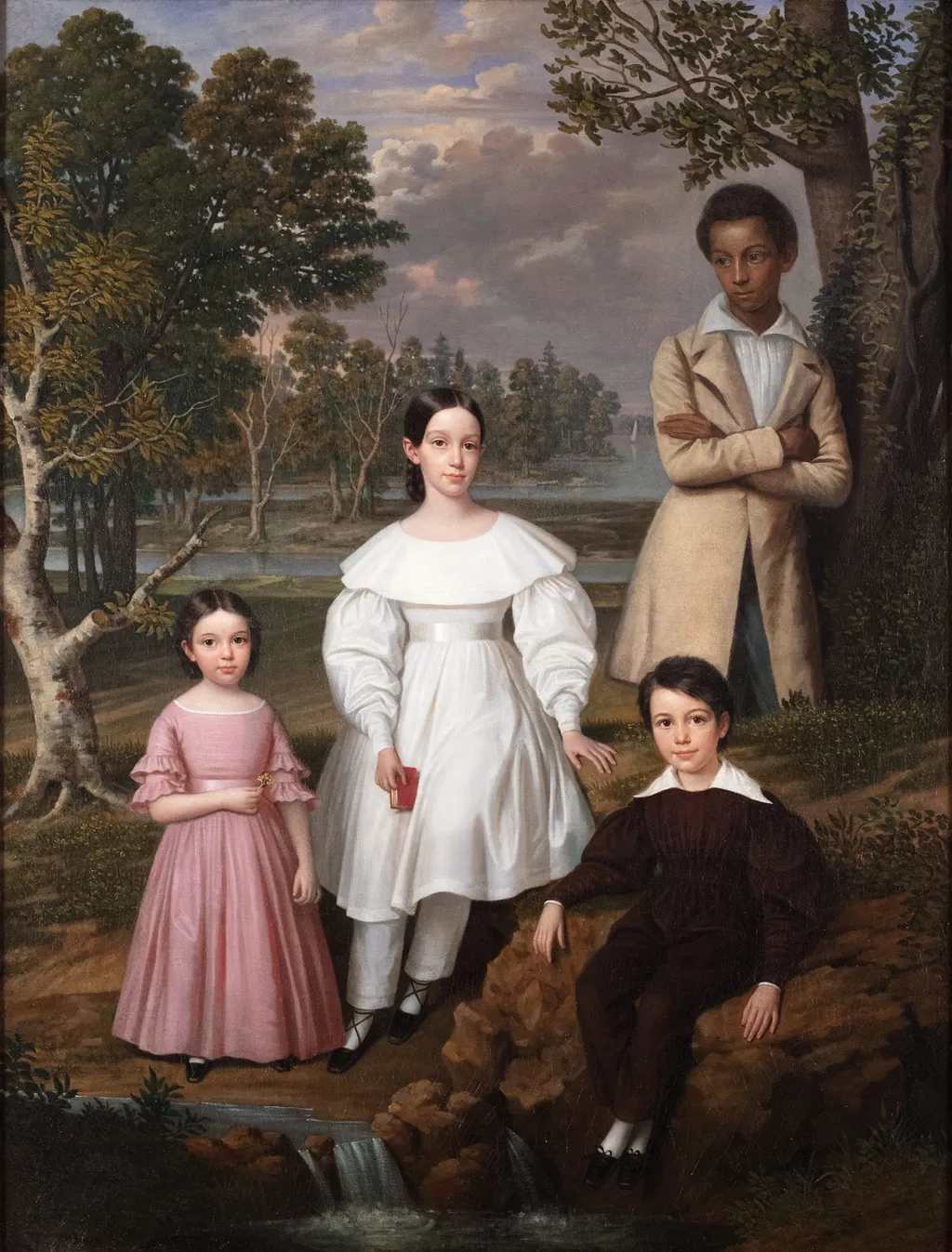
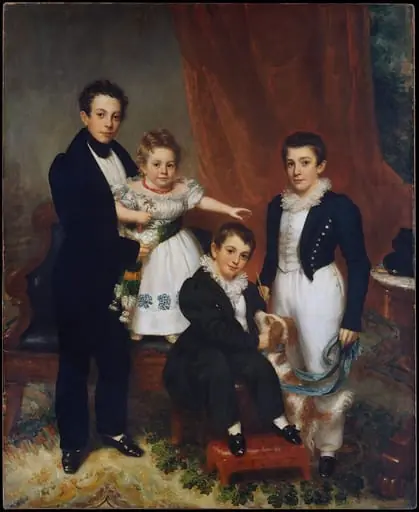
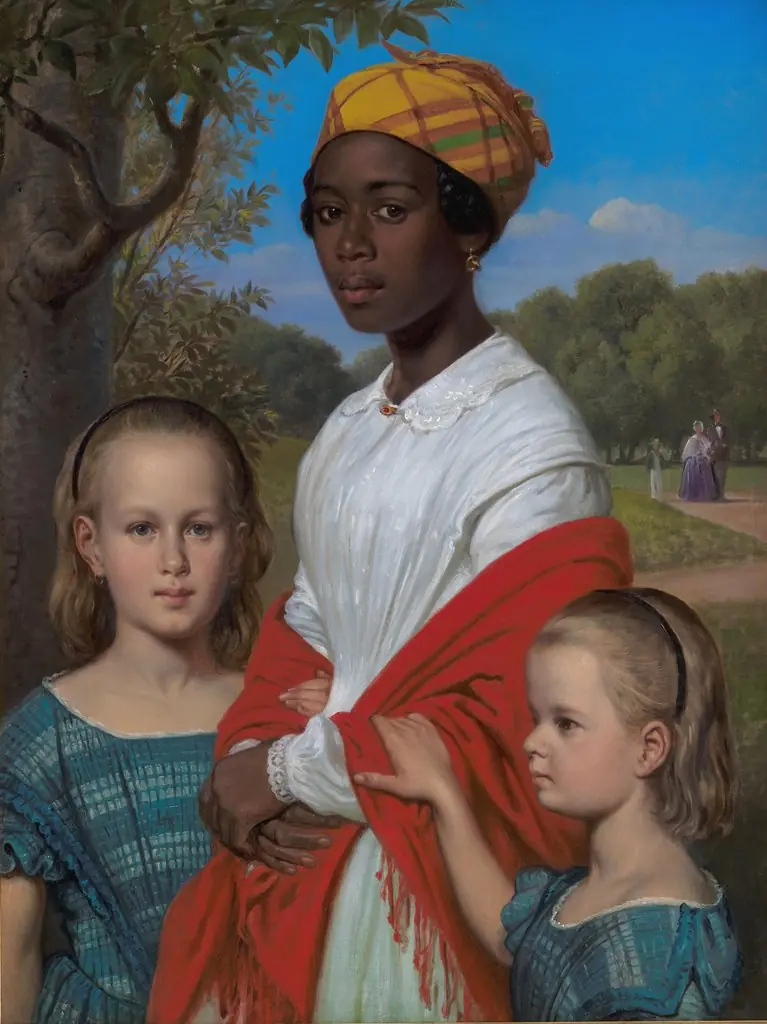
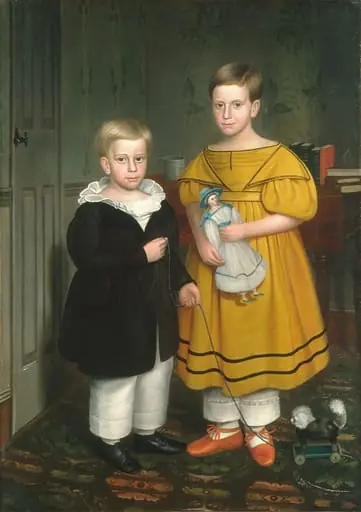
Bélizaire and the Frey Children is an oil painting by the American Folk Art artist Jacques Amans. It dates from 1837 and is held in the collection of the Metropolitan Museum of Art.
About this work
A group portrait of Bélizaire with three children of the Frey family. Amans paints Bélizaire naturally, which was unusual for 1837, while the children sit calm and composed. The oil handling is smooth and detailed throughout.
Subject & Meaning
The work functions as a rare visual document of an enslaved individual integrated into a Southern family unit, challenging typical hierarchies of the genre.
Painted in 1837, this group portrait depicts three white Frey children, Élisabeth Coralie, Frédéric Émile, and Léontine, alongside Bélizaire, an enslaved Afro-Creole teenager. The composition is notable for its naturalistic rendering of Bélizaire, who stands with a confidence and attire comparable to the white children, suggesting a role as a caretaker or possibly a blood relative, though historical records confirm he was purchased separately. The work functions as a rare visual document of an enslaved individual integrated into a Southern family unit, challenging typical hierarchies of the genre.
However, the painting's meaning is complicated by the later erasure of Bélizaire's figure, likely obscured in the early twentieth century due to rising racial tensions or family shame regarding slaveholding. This act of overpainting transformed the work into a symbol of historical suppression, which modern restoration has reversed to recover Bélizaire's identity and presence.
Technique & Style
Painted in 1837, Bélizaire and the Frey Children is an oil-on-canvas group portrait attributed to Jacques Amans. The work measures approximately 120 cm in height by 92.1 cm in width. Stylistically, it is a rare antebellum example of naturalistic portraiture, depicting an enslaved Afro-Creole teenager alongside white children with comparable confidence and attire.
The composition originally included Bélizaire, but technical examination reveals the figure was obscured by overpaint applied to the surface, likely around the turn of the 20th century, after cracks had already formed in the original paint layer. This later repainting concealed the subject for decades until conservators Katja Grauman and later Craig Crawford removed the overpaint in 2005 and 2021, respectively, restoring the naturalistic depiction of Bélizaire. The painting's history involves significant physical alteration, moving from a complete group portrait to a modified image before its modern restoration recovered the original composition.
History & Provenance
Painted in 1837 in New Orleans, Bélizaire and the Frey Children is attributed to the French artist Jacques Amans, though it was previously ascribed to Theodore Sydney Moïse and Trevor Thomas Fowler. The work was commissioned by the wealthy German-born merchant Frédéric Frey to depict his three children alongside their enslaved caregiver, Bélizaire. Following the Frey family's financial decline, Bélizaire was sold in 1841 to settle debts, though he was later repurchased.
After Frédéric Frey's death in 1851, his widow sold Bélizaire and his mother to the Evergreen Plantation in 1857. The painting remained in the Frey family until Audrey Grasser donated it to the New Orleans Museum of Art in 1972. It was deaccessioned and sold at Christie's in 2005 for $7,200, where the overpaint obscuring Bélizaire was removed.
Collector Jeremy K. Simien acquired the piece in 2021, funding further restoration and historical research before the Metropolitan Museum of Art purchased it in August 2023.
Donated by Audrey Grasser to the New Orleans Museum of Art in 1972, the painting was deaccessioned and sold at Christie's on March 2, 2005, for $7,200. Collector Jeremy K. Simien purchased the work in 2021 before its acquisition by the Metropolitan Museum of Art in New York in August 2023. Previously titled Portrait of Three Children in a Louisiana Landscape, the piece was held in storage by the New Orleans institution without exhibition.
Following restoration, it was displayed at the Ogden Museum of Southern Art from July 1, 2022, to January 29, 2023. The Metropolitan Museum subsequently exhibited the work in its American Wing from October 12, 2023, through July 1, 2024.
Context
Jacques Amans’s 1837 portrait occupies a singular place in antebellum American portraiture as a rare naturalistic depiction of an identified enslaved subject integrated into a white family group. Technical studies and later restoration revealed that Bélizaire’s presence was erased in the early twentieth century, reflecting changing racial norms in New Orleans and the impulse to suppress evidence of slavery within domestic imagery. The painting’s rediscovery and re-restoration (completed in 2021) catalyzed scholarly reassessment of Amans’s practice within the francophone Atlantic world and of portraiture as a site where power and intimacy intersected in the slaveholding South.
Its acquisition by The Metropolitan Museum of Art in 2023 underscores its current role in reframing narratives of wealth, race, and erasure in canonical art institutions.
Legacy
Since its restoration in 2005, Bélizaire and the Frey Children has emerged as a focal point in reconsiderations of antebellum portraiture and racial representation in American art. The recovery of Bélizaire’s erased figure catalyzed public discourse on erasure and recovery in cultural memory, positioning the painting as a touchstone for exhibitions addressing slavery’s legacy. In 2022–2023, the Ogden Museum of Southern Art exhibited the work, framing it within broader initiatives at Southern museums to confront histories of enslavement and wealth accumulation.
The Metropolitan Museum of Art acquired the painting in 2023 and placed it on view in its American Wing, explicitly citing its role in dismantling romanticized narratives of U.S. art history and exposing systemic inequities. The restored image has been described as the first naturalistic portrait of an identified Black subject in a Southern landscape within the Met’s holdings, underscoring its transformative impact on institutional practices and public understanding of race in art.
Overview
Attributed to Jacques Amans, the 1837 oil painting "Bélizaire and the Frey Children" is a group portrait now held in The Metropolitan Museum of Art. It features Bélizaire, an enslaved Afro-Creole teenager, alongside three children from the affluent New Orleans family of Frédéric Frey. The artwork is particularly notable for its naturalistic depiction of an enslaved individual, a rare approach in 19th-century portraiture, where such subjects were often marginalized or stereotyped.
Own this work as a print
Artist & collection
Artist
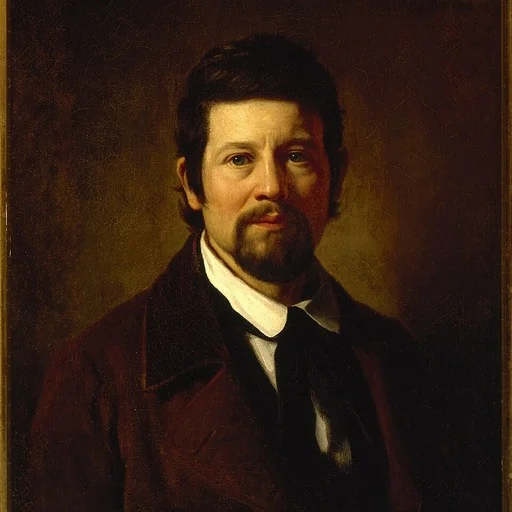
Jacques Guillaume Lucien Amans (29 May 1801 – 10 January 1888) was a French neoclassical portrait painter working in New Orleans in the 1840s and 1850s.