Artwork
Saint Jerome

Saint Jerome is an oil painting by the Northern Renaissance artist Jan Gossaert. It dates from 1512 and is held in the collection of the Statens Museum for Kunst.
About this work
Subject & Meaning
Classified within the religious genre, the piece belongs to a tradition of depicting holy characters to encourage religious reflection and devotion.
The painting presents Saint Jerome as its sole identifiable figure, indicating that the artwork’s subject is the saint himself. Classified within the religious genre, the piece belongs to a tradition of depicting holy characters to encourage religious reflection and devotion. Because the sources do not describe any accompanying attributes or narrative elements, the specific iconography and symbolic meaning traditionally associated with Jerome, such as a lion, cardinal’s hat, or books, cannot be affirmed from the available information. Thus, the work’s meaning rests primarily on its portrayal of Jerome as a venerated Christian figure.
Technique & Style
Executed in 1512, this religious painting by Jan Gossaert utilizes oil paint applied to a canvas support. The work measures 71.0 cm in height and 95.5 cm in width. As a depiction of Saint Jerome, the piece exemplifies the artist's engagement with religious subject matter through the medium of oil on canvas, a material combination characteristic of the period's panel and canvas production.
History & Provenance
Saint Jerome is an oil painting by Jan Gossaert dated 1512, executed on canvas. The work is held in the collection of the Statens Museum for Kunst, where it remains located. No information is available in the provided sources regarding the circumstances of its commission, earlier ownership, or subsequent chain of custody prior to its accession by the museum.
The painting measures 710.0 in height by 955.0 in width, and depicts Saint Jerome as its main subject within the religious genre.
The painting Saint Jerome by Jan Gossaert is housed at the Statens Museum for Kunst, where it holds inventory number KMS1947:1. It was created in 1512 and has been displayed in the museum’s European Paintings gallery as part of the exhibition "Northern Renaissance Masterpieces," which opened in 2018.
Overview
Saint Jerome is a 1512 oil painting by Jan Gossaert, also known as Jan Mabuse, a prominent figure in the Northern Renaissance. The work is characterized by its integration of Italian Renaissance influences, which Gossaert adopted during his travels to Italy and Rome in 1508–09. This blend of styles is reflective of Gossaert's role as a leader in the Romanism style, marking an early instance of Dutch and Flemish artists incorporating Italian elements into their traditional techniques.
Context
Painted during Gossaert's post-Italian journey period, Saint Jerome reflects the artistic cross-pollination between Northern Europe and Italy during the Renaissance. It embodies the early adoption of Italian Renaissance principles by Dutch and Flemish painters.
Legacy
As one of Gossaert's works influenced by his Italian travels, Saint Jerome contributes to the broader legacy of Northern Renaissance artists who bridged traditional northern techniques with southern Renaissance innovations, influencing subsequent generations of painters.

Artist & collection
Artist
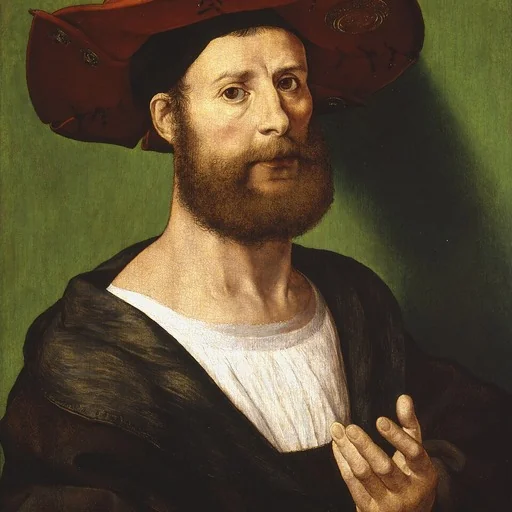
Jan Gossaert (c. 1478 – 1 October 1532) was a French-speaking painter from the Low Countries also known as Jan Mabuse (the name he adopted from his birthplace, Maubeuge) or Jennyn van Hennegouwe (Hainaut), as he called…

![Saint Jerome Penitent [right panel], by Jan Gossaert](https://artifactworldgallery.com/img/jan-gossaert--saint-jerome-penitent-right-panel--0d4ac14f44de87b1-w320.webp)
![Saint Jerome Penitent [left panel], by Jan Gossaert](https://artifactworldgallery.com/img/jan-gossaert--saint-jerome-penitent-left-panel--3d396afbb0f8e738-w320.webp)