Artwork
Esther, Ahasuerus, and Haman
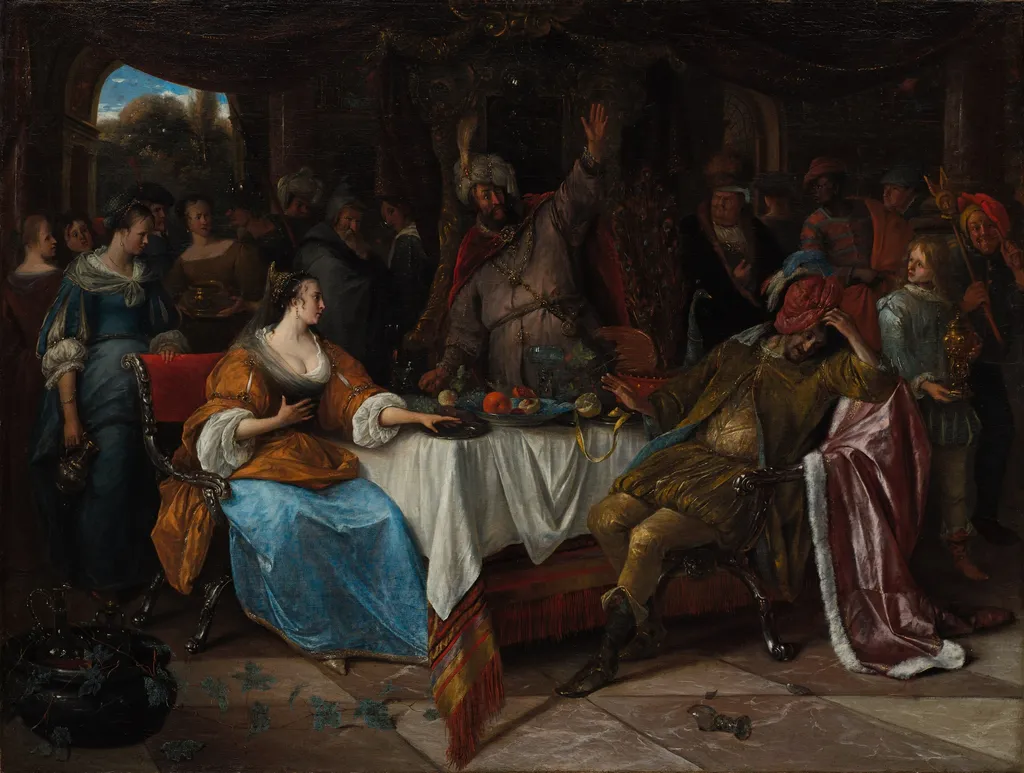
Esther, Ahasuerus, and Haman is an oil painting by the Dutch Golden Age artist Jan Steen. It dates from 1668 and is held in the collection of the Cleveland Museum of Art.
About this work
Subject & Meaning
The figures are arranged in a dynamic diamond formation illuminated by dramatic lighting, with royal status emphasized through red garments.
Jan Steen's painting illustrates a pivotal moment from the biblical Book of Esther, specifically the banquet where Queen Esther reveals her Jewish heritage to King Ahasuerus and exposes Haman's genocidal plot. The composition captures the king's furious reaction as he rises, while Haman, caught by surprise, knocks over his glass. Although the narrative is set in ancient Susa, Steen transposes the scene into a recognizable seventeenth-century Dutch interior, featuring Delftware and römer glasses.
The figures are arranged in a dynamic diamond formation illuminated by dramatic lighting, with royal status emphasized through red garments. Symbolically, the contrast between Ahasuerus's fur-lined cape and Haman's shattered glass underscores the fragility of power. This depiction resonated with contemporary Dutch audiences, who identified with the Jewish struggle against foreign oppression as a mirror of their own fight for independence from Spain.
Technique & Style
Executed in oil on canvas, the work measures approximately 70 × 93 cm and was painted in the Netherlands around 1668‑3). The painting’s support is a stretched canvas, typical of Dutch Golden Age easel painting, and the surface bears the artist’s layered brushwork that creates depth through chiaroscuro. Steen arranges the banquet scene with a central triangular composition, using strong directional light to highlight Esther’s red dress and the king’s purple‑fur‑trimmed coat, while contrasting the broken glass of Haman with the richly patterned tablecloth.
The formal handling emphasizes crisp outlines, subtle tonal modeling, and a decorative interplay of Dutch domestic objects, reinforcing the narrative’s theatrical staging‑3).
History & Provenance
Jan Steen executed the oil painting Esther, Ahasuerus, and Haman in 1668 within the Netherlands. The work depicts a biblical scene set in a Dutch domestic environment, reflecting contemporary theatrical influences. While Steen produced other versions of this subject, including one held in Birmingham, this specific canvas entered the collection of the Cleveland Museum of Art in 1964, where it is cataloged under accession number 1964.153.
The painting's creation is linked to the cultural context of the Dutch Republic, where biblical narratives served as allegories for national struggles against foreign oppression. Scholarly analysis published in 1965 further documents the work's significance within Steen's oeuvre and its acquisition by the Cleveland institution.
Context
Jan Steen’s Esther, Ahasuerus, and Haman (c. 1668) occupies a distinctive place in Dutch biblical painting by merging theatrical staging with domestic realism, reflecting broader cultural exchanges between the visual arts and the rederijker theater in mid-seventeenth-century Netherlands. Scholars highlight Steen’s engagement with contemporary Dutch drama, particularly Johannes Serwouters’s play Esther of 1647, whose frontispiece engraving by Pieter Quast informed other works by the artist, including a version now in the Hermitage. The composition’s dramatic lighting, frozen gestures, and architectural backdrop echo stage conventions of the Amsterdam Oude Kamer, a venue rebuilt in 1638, underscoring the reciprocal influence between guild-affiliated theater and painting.
Steen also drew on earlier masters: the turbaned Assuerus recalls Rembrandt’s drawing of the same subject, while the king’s shocked expression evokes Jan Lievens’s Banquet of Esther (c. 1625) and Pieter Lastman’s Haman Begs Esther (c. 1618). Critical reception emphasizes Steen’s ability to translate biblical narrative into a recognizable Dutch interior, using props like Delftware and Römer glasses to domesticate the Persian court and endow Esther with contemporary Dutch femininity.
Overview
Jan Steen's 'Esther, Ahasuerus, and Haman' (1668) depicts the biblical narrative from the Book of Esther, capturing the moment Esther reveals Haman's plot to the Persian King Ahasuerus. The composition is characterized by Steen's signature crowded interior, where the central dramatic tension is surrounded by a bustling array of secondary figures. Esther, seated calmly in a blue dress at the table, contrasts with the agitated gestures of the surrounding courtiers.
King Ahasuerus, distinguished by his red robe and crown, raises his arm in a gesture of authority and realization, while Haman appears in a state of distress. Steen employs a dimly lit, warm palette typical of his genre scenes, using chiaroscuro to focus attention on the key figures while rendering the background details with lively precision. Created during the height of the Dutch Golden Age, this work exemplifies Steen's unique ability to infuse religious subjects with the chaotic energy and psychological complexity of everyday life.
Rather than a static devotional image, the painting functions as a dynamic theatrical tableau, reflecting the artist's mastery in blending moral storytelling with vivid observation of human behavior.
Own this work as a print
Artist & collection
Artist
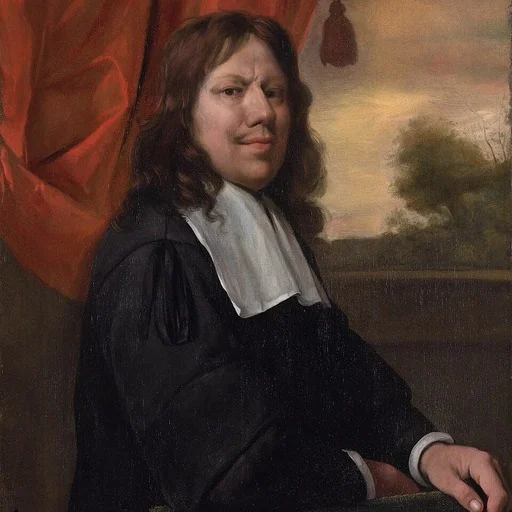
Jan Havickszoon Steen was a Dutch Golden Age painter, one of the leading genre painters of the 17th century.

 The wrath of Ahasuerus
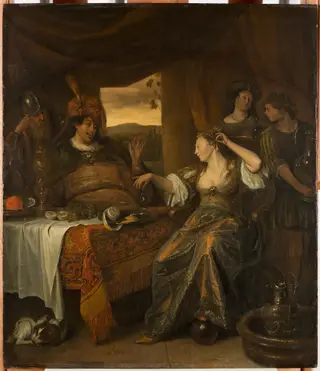 Antonius und Kleopatra
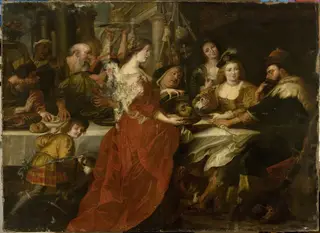 Salome with the head of St. John the Baptist at the banquet (Matthew 14:11; Mark 6:27-28)
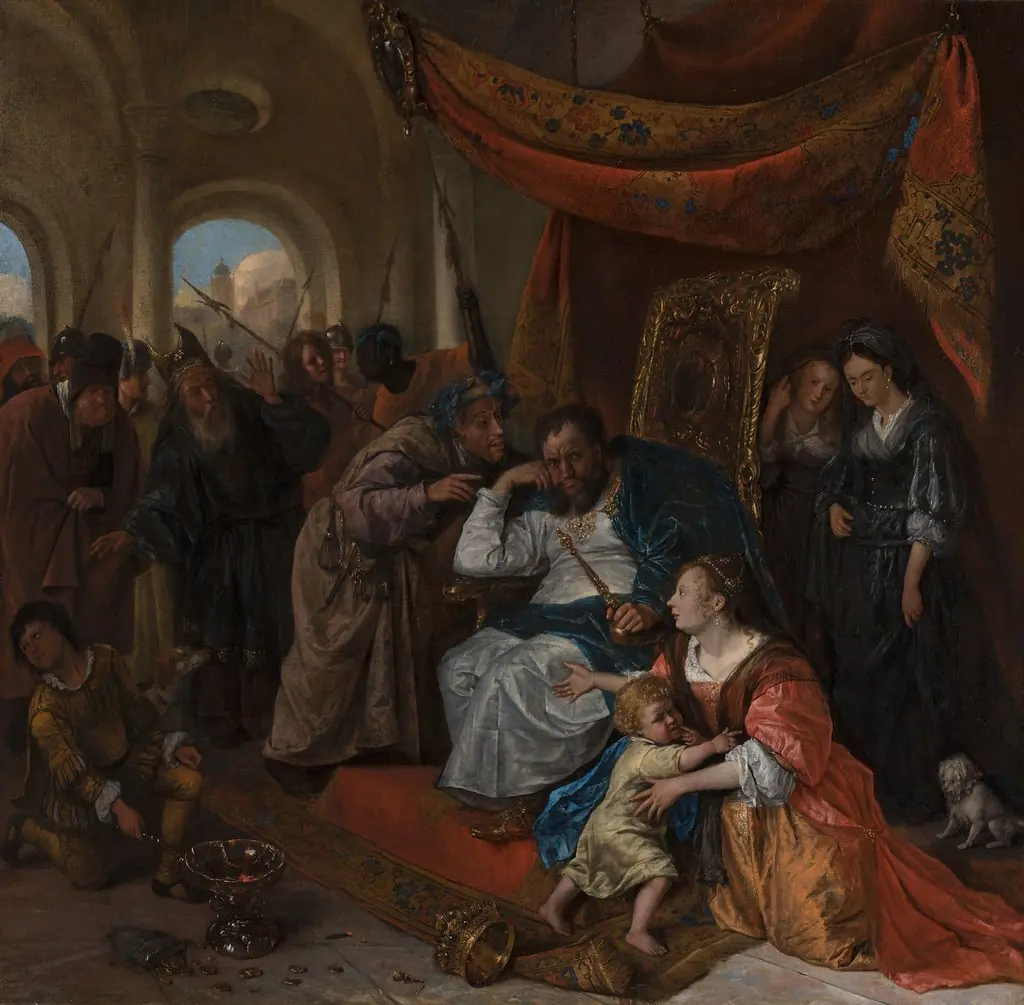 Moses and Pharaoh’s Crown
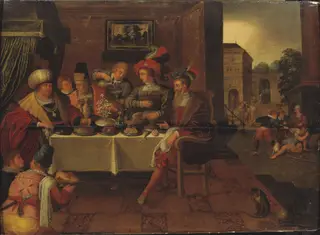 The Rich Man and Lazarus
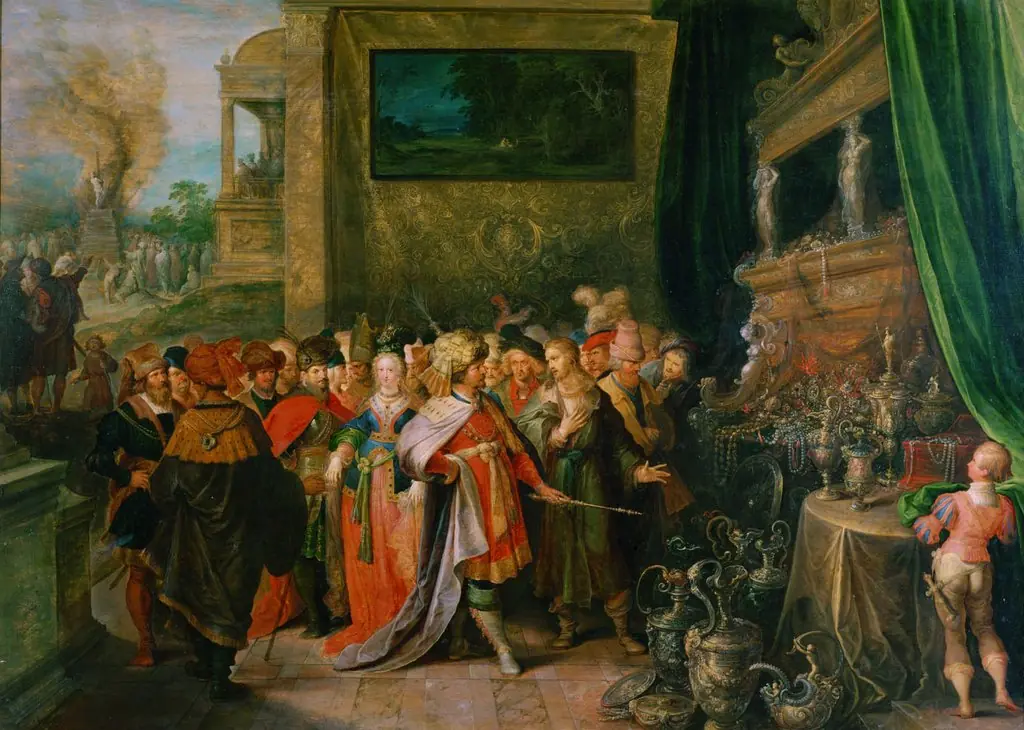 Croesus displays his treasures to Solon
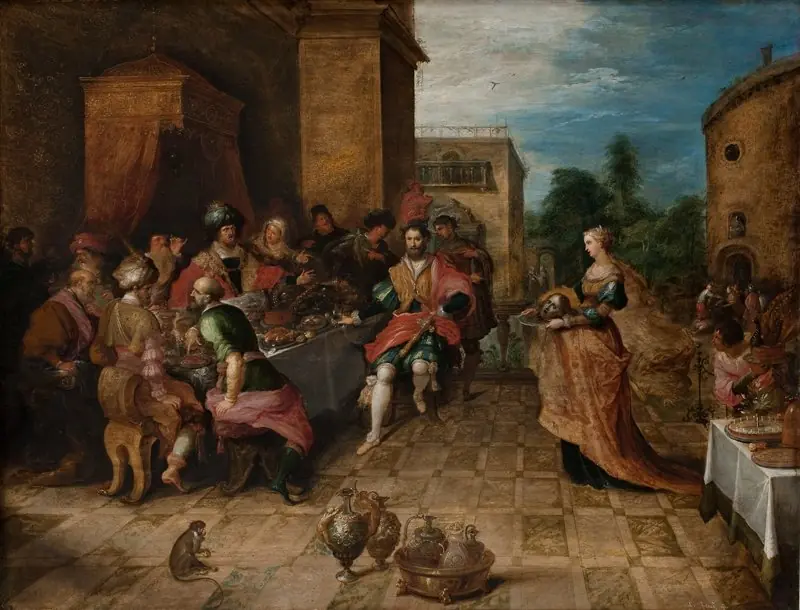 The Banquet of Herod. Salome Presents the Head of John the Baptist
 Belshazzar's feast (Daniel 5:1-31)
 The Banquet of Herod. Salome Presents the Head of John the Baptist