Artwork
Fêtes Vénitiennes
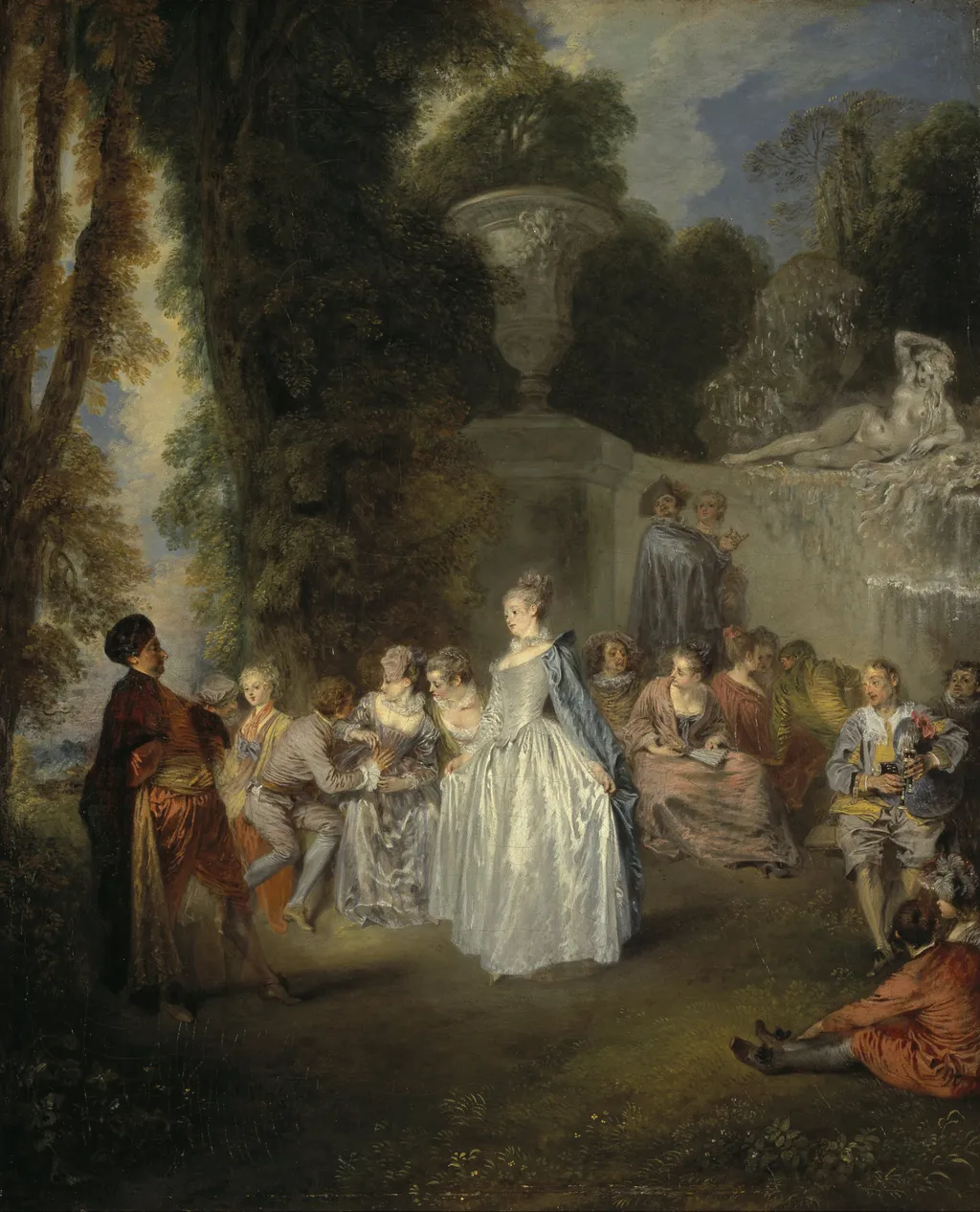
Fêtes Vénitiennes is an oil painting by the Rococo painting artist Jean Antoine Watteau. It dates from 1718 and is held in the collection of the National Galleries Scotland.
About this work
Subject & Meaning
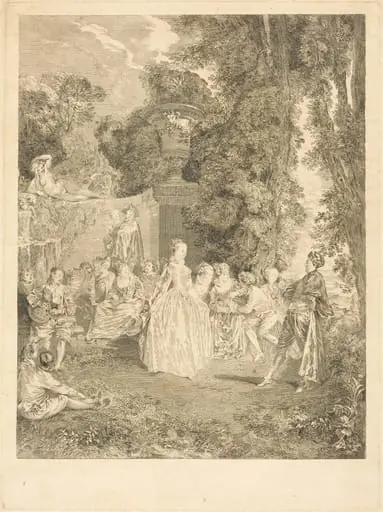
The title, derived from a 1732 engraving, reflects the Venetian thematic elements of costume and dance rather than the French setting of the garden.
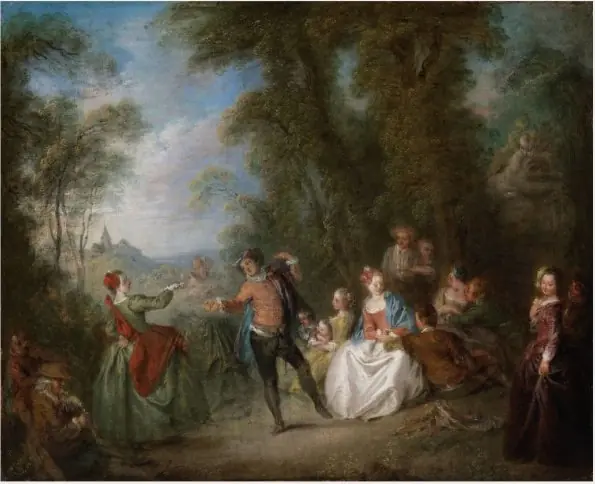
Fêtes Vénitiennes exemplifies the fête galante genre, depicting an outdoor gathering where figures in Venetian-inspired dress and dancing create a unified festive atmosphere. The central couple performs a minuet; the female dancer is often identified as the actress Charlotte Desmares, while her partner in a black hat is linked to the painter Nicolas Vleughels, whose attire suggests Italian commedia dell'arte influences. Behind them, the artist includes a self-portrait as a musician playing a musette de cour, an instrument historically associated with sexual symbolism since the Middle Ages.
Other participants engage in courtship and conversation near a fountain adorned with a statue, possibly representing Venus or a nymph. The title, derived from a 1732 engraving, reflects the Venetian thematic elements of costume and dance rather than the French setting of the garden.
Technique & Style
Fêtes Vénitiennes is executed in oil paint on canvas, adhering to the standard medium for 18th-century French easel painting. The work measures approximately 56 cm in height and 46 cm in width. Stylistically, it exemplifies the fête galante genre, a category pioneered by the artist to depict elegant outdoor amusements.
A defining formal quality of the piece is Watteau's unified handling of diverse textures; he renders materials such as taffeta, water, human skin, stone statues, foliage, and curls with a consistent, fluid touch. This technical approach integrates the figures and the garden setting into a cohesive visual whole. The composition features a central couple dancing a minuet, surrounded by various groups including musicians and conversing figures, all contributing to a festive atmosphere rather than focusing on a single narrative center.
History & Provenance
Jean-Antoine Watteau created Fêtes Vénitiennes between 1718 and 1719 as an oil painting on canvas. The work's title was not original to the artist but was assigned later, derived from an engraving by Laurent Cars published in 1732. The painting entered the collection of the Scottish National Gallery in Edinburgh through the bequest of Lady Murray of Henderland in 1861.
Lady Murray, the widow of John Murray, Lord Murray, had previously owned the work, which was listed under her name as Mary Murray, née Rigby. The piece measures 56 cm in height and 46 cm in width and is cataloged under accession number NG 439.
Fêtes Vénitiennes is held by the National Galleries of Scotland, specifically within the Scottish National Gallery in Edinburgh. The work carries the accession number NG 439. It entered the institution's collection in 1861 following a bequest from Lady Murray of Henderland, the widow of John Murray, Lord Murray.
Prior to this donation, the painting was owned by Mary Murray, née Rigby. The sources do not record specific exhibition histories or loan records for the work, noting only its permanent residence and provenance transfer in the mid-19th century.
Context
Fêtes Vénitiennes belongs to the fêtes galantes genre that Watteau himself established as a new artistic category, making the painting a touchstone for the category's definition. Its title derives from a 1732 engraving by Laurent Cars, who applied the "Venetian" label on the basis of the dancers' costumes and the commedia dell'arte-inspired dress rather than any actual Venetian setting, since the garden depicted is French in character.
The painting has prompted sustained iconographic scholarship. The central female dancer has been claimed, though never proven, by Michael Levey to be the Comédie-Française actress Charlotte Desmares, mistress of the Duke of Orléans. The male dancer in the black hat is widely identified as Watteau's friend Nicolas Vleughels, later director of the French Academy in Rome (1725–36).
Scholars have also read the bagpipe-playing musician as a presumed self-portrait of Watteau, noting the instrument's medieval sexual symbolism, as seen in Hieronymus Bosch's Garden of Earthly Delights. The work was bequeathed to the Scottish National Gallery in 1861 by Lady Murray of Henderland.
Overview
Antoine Watteau’s oil painting Fêtes Vénitiennes, executed in 1719, is held by the Scottish National Gallery in Edinburgh. The work entered the collection through the 1861 bequest of Lady Murray of Henderland, the widow of John Murray, Lord Murray. Its title, applied after a 1732 engraving by Laurent Cars, references the Venetian costumes and dance motifs that dominate the scene.
Own this work as a print
Artist & collection
Artist
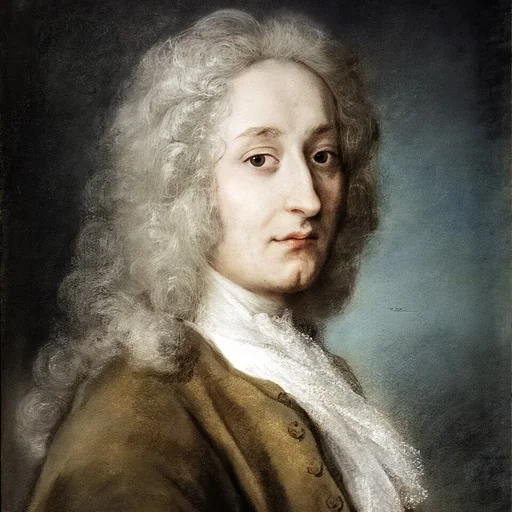
Jean-Antoine Watteau was a French painter and draughtsman whose brief career spurred the revival of interest in colour and movement, as seen in the tradition of Correggio and Rubens.