Artwork
Mezzetin
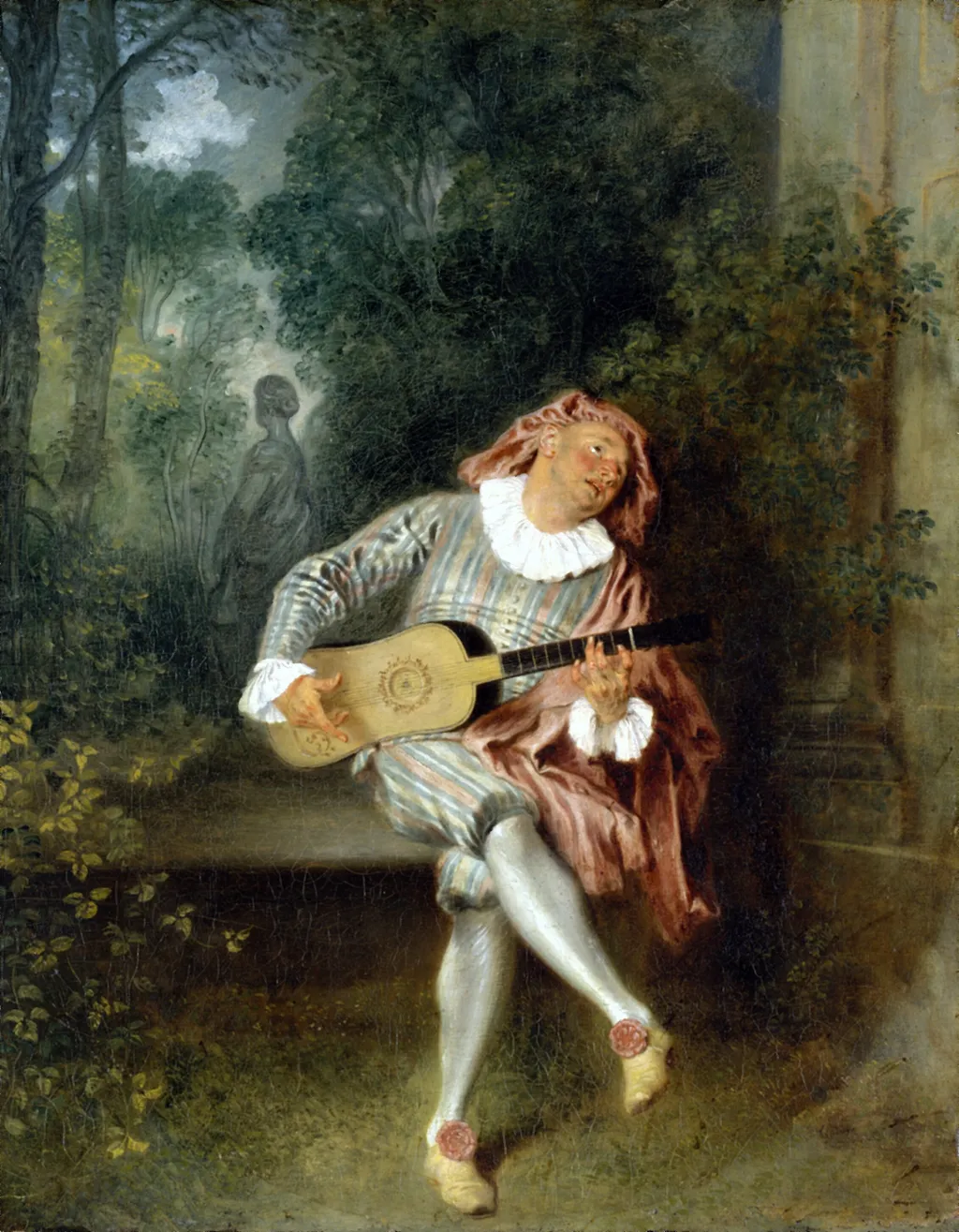
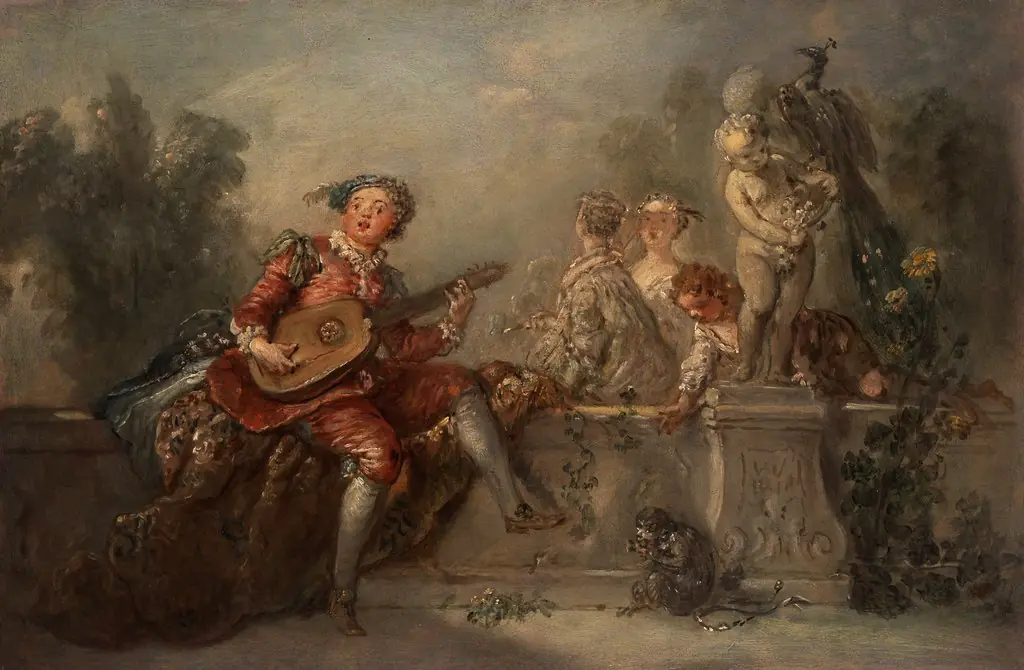
Mezzetin is an oil painting by the Rococo painting artist Jean Antoine Watteau. It dates from 1717 and is held in the collection of the Metropolitan Museum of Art.
About this work
Subject & Meaning
Seated on a stone bench in a garden, the figure plays a guitar and sings with his eyes lifted toward an unseen balcony, serenading a woman who is not visible.
Mezzetin depicts the eponymous commedia dell'arte character, a variant of Harlequin introduced by the Théâtre italien actor Angelo Costantini on October 16, 1683. Seated on a stone bench in a garden, the figure plays a guitar and sings with his eyes lifted toward an unseen balcony, serenading a woman who is not visible. Behind him stands a statue of Venus turned away, a compositional choice that, within Watteau's pictorial symbolism, signals that the singer's affections are unrequited by the lady the goddess represents.
Watteau deviates from theatrical tradition by adding pale blue stripes to Mezzetin's satin tunic and breeches, which were conventionally white and red. The pose also recalls Titian's Pastoral Concert, a work Watteau is thought to have seen at the Louvre. Although the model has not been identified, the painting idealizes the character as a lovesick, big-hearted musician rather than the scheming intriguer described in stage tradition.
Technique & Style
Executed in oil on canvas, Mezzetin measures 55.2 cm in height and 45.2 cm in width. The handling combines delicate, blended brushwork in the figure and costume with looser, atmospheric handling in the surrounding foliage, producing a soft-focus effect that dissolves edges and unifies the composition. The palette is muted yet luminous, with silvery greens, pearly satin whites and blues, and warm flesh tones that subtly modulate under raking light.
Stylistically, the work exemplifies Watteau’s mature Rococo idiom, characterized by rhythmic contrapposto in the seated figure, a lyrical arabesque of the left arm, and a studied asymmetry that guides the viewer’s eye across the tilted plane. The turned-back Venus in the background reinforces the theme of unrequited love through a deliberate denial of reciprocal gaze.
History & Provenance
Mezzetin is dated by its creators to 1717–1719 and is one of several single-figure compositions by Watteau featuring the commedia dell’arte character Mezzetino. It was commissioned or at least collected early by Jean de Jullienne, Watteau’s friend and patron, who supervised the posthumous print edition after the artist’s works and retained Mezzetin in his own holdings until his death in 1766. After Jullienne’s death, the painting entered the imperial collection of Catherine II in Saint Petersburg; it remained in the Hermitage until the Soviet sales of the 1920s–1930s, when it was acquired by Calouste Gulbenkian.
It subsequently passed through the Wildenstein firm before being purchased by the Metropolitan Museum of Art in 1934, where it remains.
Mezzetin is held in the collection of the Metropolitan Museum of Art in New York, having been acquired by the institution in 1934 from the Wildenstein art firm. Prior to this, the painting passed through several notable owners: it was originally kept by Jean de Jullienne, Watteau's patron, until his death in 1766, after which it entered the Hermitage Museum in Saint Petersburg under Empress Catherine II. During the Soviet sales of the 1920s and 1930s, the work was sold to Calouste Gulbenkian before reaching Wildenstein.
While specific exhibition titles are not detailed in the provided records, the work's history includes its engraving by Benoit Audran the Elder for Jullienne's printed catalog of Watteau's oeuvre. The Metropolitan Museum also retains a preparatory drawing of the figure's head associated with the canvas.
Context
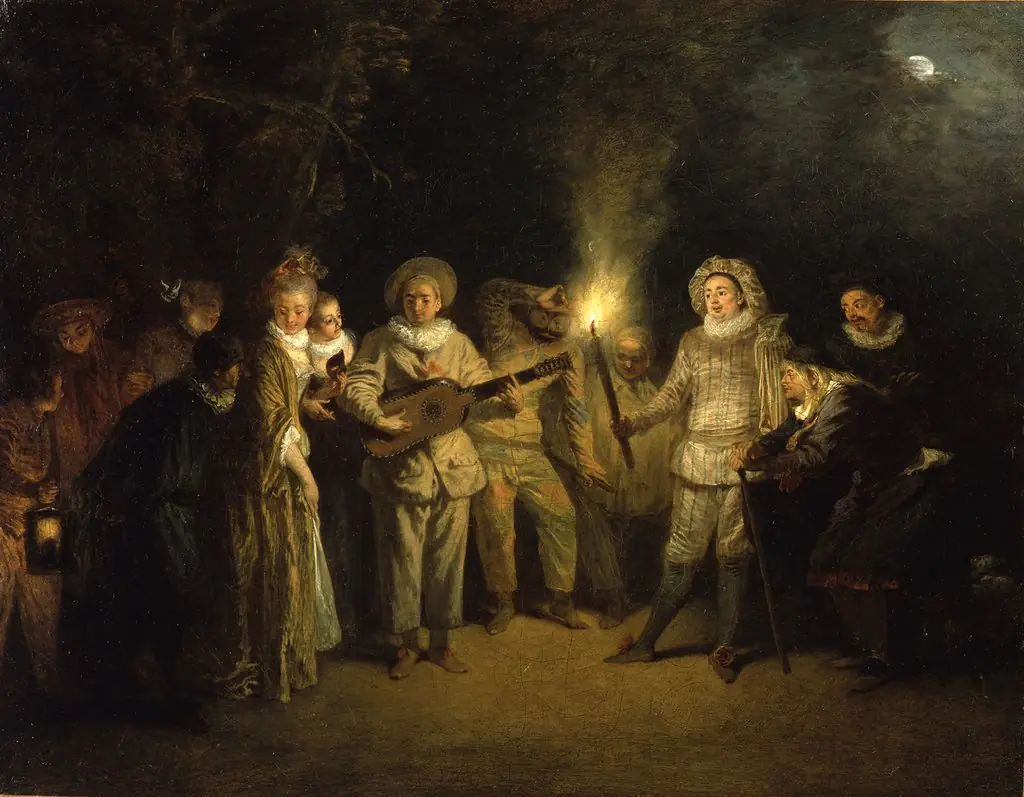
Watteau's Mezzetin sits within the artist's sustained engagement with commedia dell'arte, a subject he returned to repeatedly across his career. The Mezzetin character was introduced in 1683 by Angelo Costantini of the Théâtre italien de Paris, whose expressive face allowed him to abandon the mask, a novelty that, according to scholarship, drew Watteau's particular interest and inspired multiple depictions. The painting belongs to Watteau's late Rococo period and reflects his tendency to idealize the lover-musician aspect of the role rather than its more roguish traits.
The composition also engages with earlier art: the guitarist's pose recalls Titian's Concert champêtre, which Watteau is thought to have studied at the Louvre. Watteau's broader reputation was actively shaped by his friend and patron Jean de Jullienne, who preserved Mezzetin among the works he retained for life and who oversaw the engraved reproduction of Watteau's oeuvre, securing the artist's posthumous standing in eighteenth-century art history.
Legacy
The painting Mezzetin established a lasting model for the comic Zanni figure in European art. By portraying the newly invented character with a guitar and a turned‑away Venus, Watteau gave the role a distinctive, expressive identity that later artists echoed in their own theatrical scenes. The work’s image was reproduced in Benoit Audran’s engravings for Jean de Jullienne’s print series, helping to disseminate Watteau’s reputation across Europe in the 18th century.
After passing through the collections of Catherine II, Calouste Gulbenkian and the Wildenstein firm, the canvas entered the Metropolitan Museum of Art in 1934, where it became a frequent reference point for scholarship on Rococo portraiture and commedia dell’arte.
Overview
Jean-Antoine Watteau's oil painting, Mezzetin, created between 1717 and 1720, captures a singular figure from the commedia dell'arte. This Rococo work, now housed at the Metropolitan Museum of Art, presents the character Mezzetin in a full-length composition. The artist portrays him seated on a stone bench, engrossed in playing a guitar, his posture and expression conveying a sense of introspection.
Own this work as a print
Artist & collection
Artist
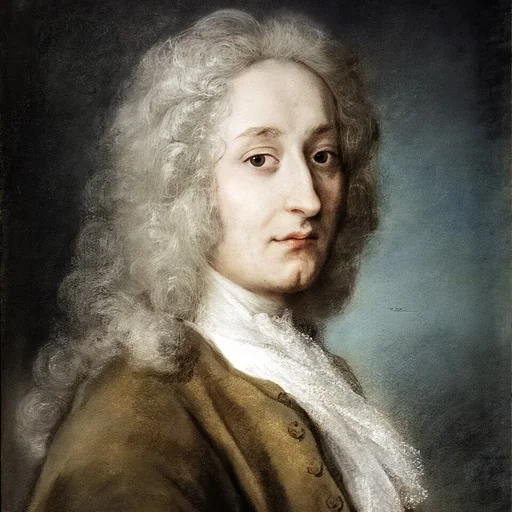
Jean-Antoine Watteau was a French painter and draughtsman whose brief career spurred the revival of interest in colour and movement, as seen in the tradition of Correggio and Rubens.