Artwork
Everard Benjamin
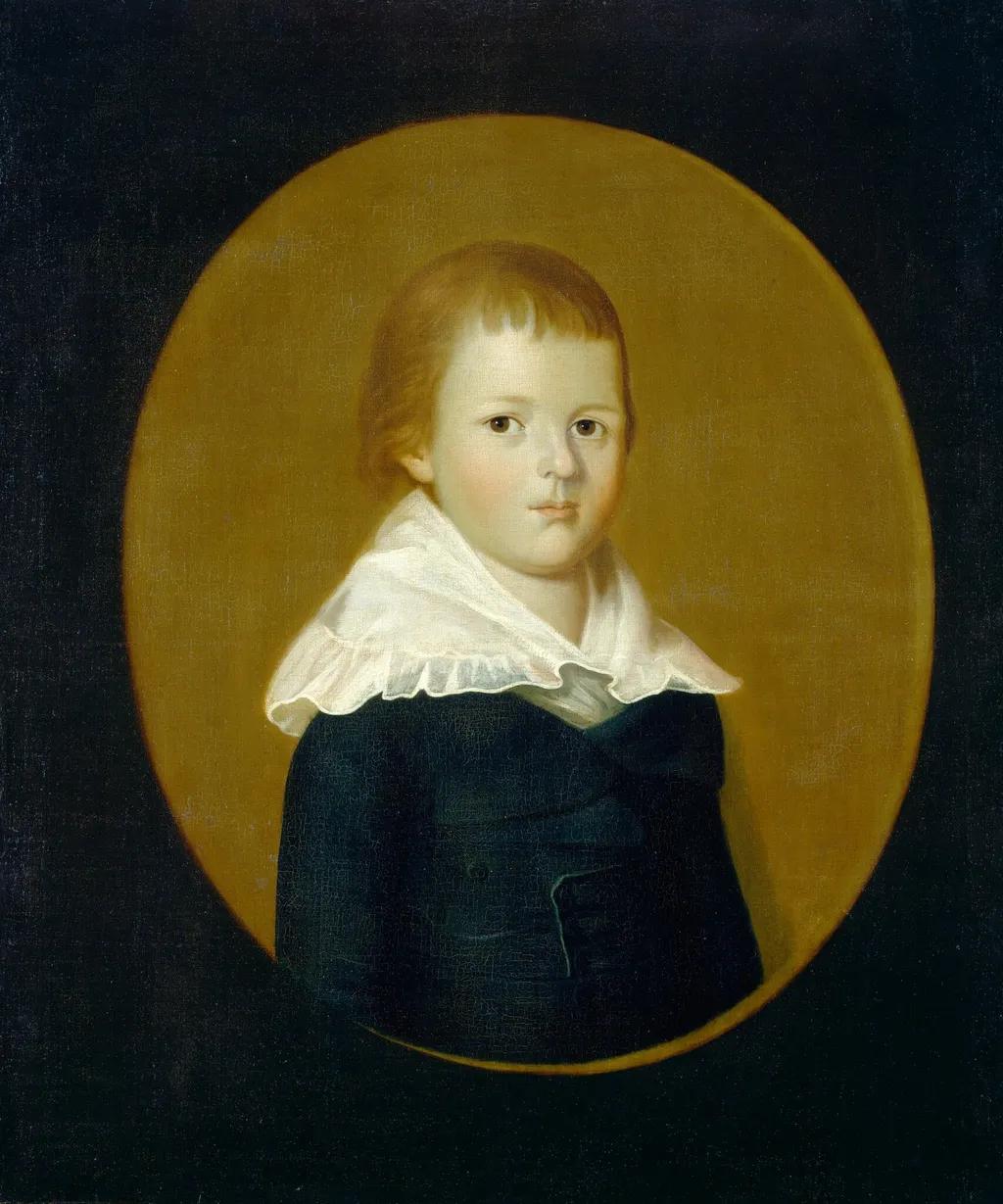
Everard Benjamin is an oil painting by the American Folk Art artist William Jennys. It dates from 1795 and is held in the collection of the National Gallery of Art.
- Inscription
- Inscribed:on original stretcher: Everard Benjamin Born Jan 2[ ] 1791 [ ] May [1?] 1795
About this work
Technique & Style
The sitter’s features are rendered with subtle gradations of tone rather than sharp linear definition, producing a quietly naturalistic likeness.
The portrait is painted in oil on canvas, a medium typical of late-eighteenth-century American portraiture. The handling is smooth and controlled, with careful attention to facial modeling and costume detail. The sitter’s features are rendered with subtle gradations of tone rather than sharp linear definition, producing a quietly naturalistic likeness.
The dark background and restrained palette emphasize the three-dimensional presence of the figure, while the costume, high-collared coat and cravat, anchors the work within Federal-era conventions. No evidence of later overpainting or significant damage is reported in the primary record.
History & Provenance
Painted by William Jennys in 1795, the oil-on-canvas portrait of Everard Benjamin remained within the sitter's family for over a century. The work was initially held by the subject's father, Asa Benjamin, in Stratford, Connecticut, before passing by descent to Hannah Maria Benjamin Russell and subsequently to her granddaughter, Frances B. Russell. Records indicate the painting was lent by Mrs. Russell for an exhibition in Stratford in 1889 and was still in the possession of Miss Russell by 1941.
The family retained ownership until the work was sold in 1952 to collectors Edgar William and Bernice Chrysler Garbisch, potentially facilitated by agent Frederick Fuessenich. It was then gifted to the National Gallery of Art in Washington, D.C., in 1953, where it remains in the collection.
Everard Benjamin has been in the collection of the National Gallery of Art in Washington, D.C., since 1953, when it was given by Edgar William and Bernice Chrysler Garbisch. The painting had been acquired by the Garbischs in 1952, possibly through Frederick Fuessenich acting as agent, from Mr. Aarons of Ansonia, Connecticut.
Before that sale, the work descended within the sitter's family: from the sitter's father, Asa Benjamin of Stratford, Connecticut, to his daughter Hannah Maria Benjamin Russell, and then to her granddaughter Frances B. Russell of Stratford, by 1941. The painting was exhibited in Stratford in 1889, when it was lent by Hannah M.B. Russell.
Context
The painting was first documented in Stratford, Connecticut, where it descended through the family of Asa Benjamin, the sitter's father, to Hannah Maria Benjamin Russell and then to her granddaughter Frances B. Russell by 1941.
Frederic F. Sherman reproduced the work in 1941, noting its ownership by Miss Russell and its presence in Stratford.
Robyn Asleson identified its inclusion in an 1889 exhibition at Stratford, based on correspondence indicating it remained in the family until loaned by Russell.
The work entered the National Gallery of Art collection in 1953, gifted by Edgar William and Bernice Chrysler Garbisch.
Legacy
Everard Benjamin, painted by William Jennys in 1795, has been recognized for its significance in early American portraiture and for preserving the visual heritage of Connecticut’s Federal-era families. Its provenance, traced from Asa Benjamin to Hannah Maria Benjamin Russell and subsequently to Frances B. Russell, underscores its familial continuity and institutional acquisition by the National Gallery of Art in 1953, affirming its scholarly and curatorial importance.
The work’s inclusion in an 1889 Stratford exhibition, documented through family correspondence, and its reproduction in Richard Jennys scholarship highlight its role in reviving interest in regional portraiture. As a representative example of Jennys’s naïve style, it contributes to narratives about early American artistic identity and the transmission of cultural memory through private collections.
Its legacy persists in academic discussions of 19th‑century New England portraiture and in exhibitions that explore the intersection of regional art and family history.
Overview
William Jennys painted Everard Benjamin in 1795 using oil on canvas. The work presents a young boy positioned against a warm yellow backdrop, his gaze turned to the right. The composition is modest in scale, focusing attention on the sitter’s face and attire.
Subject & Meaning
The portrait depicts a child with short, light‑brown hair and brown eyes, dressed in a dark blue jacket featuring a white ruffled collar. His neutral expression and steady look convey a quiet, contemplative presence, typical of portraiture intended to record personal identity rather than narrative drama.
Own this work as a print
Artist & collection

Artist
William Jennys (1774–1859), also known as J. William Jennys, was an American primitive portrait painter who was active from about 1790 to 1810. He traveled throughout New England seeking commissions in rural areas and…

- Portrait of William Frederick, Prince of Orange-Nassau, later King William I, as a Child
 Edward Dutilh
 Child with a Peach
 Childhood portrait of Jan Wołowicz (1778–?)
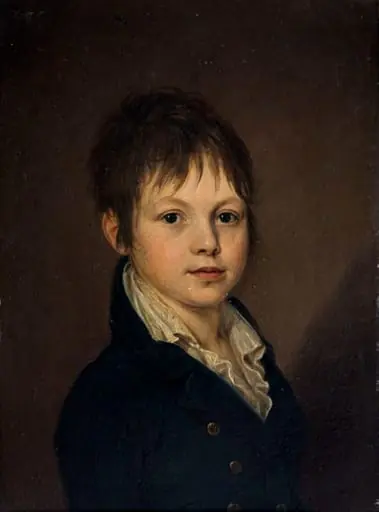 Copilul
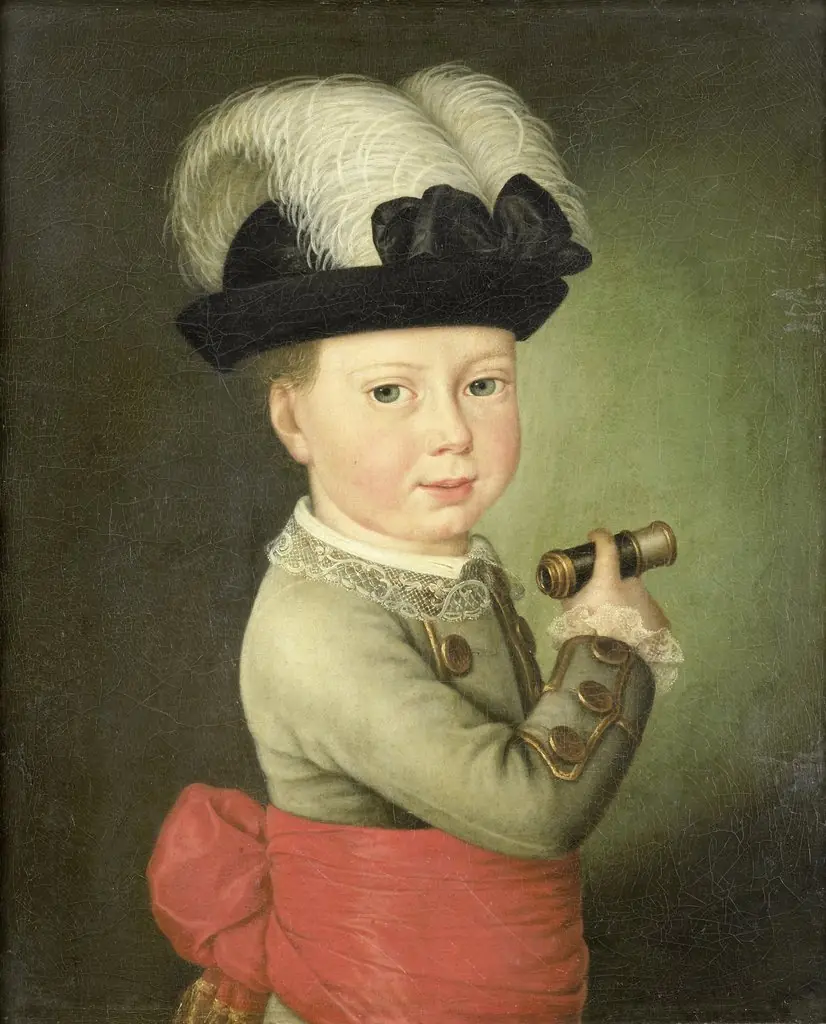 William George Frederick, Prince of Orange-Nassau, as a Child
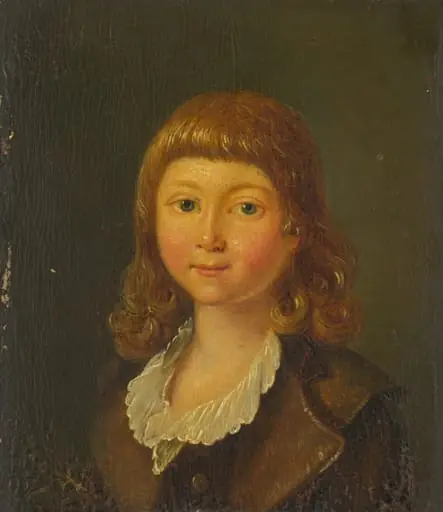 Portrait of a Young Boy
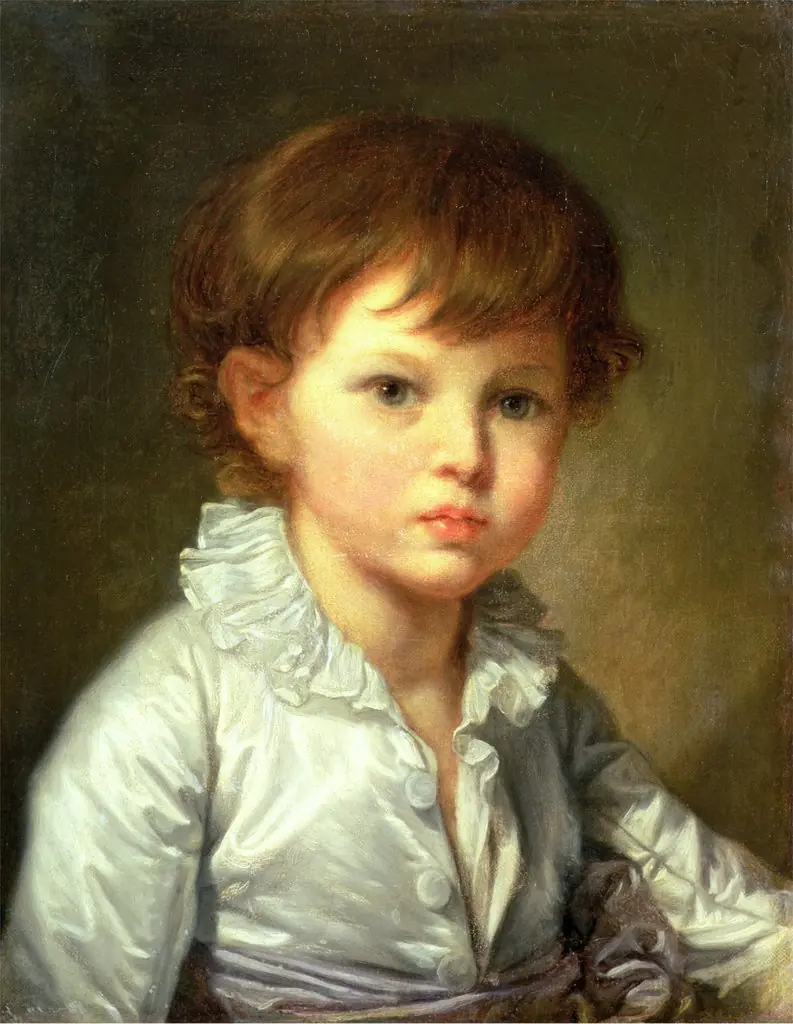 Portrait of Count Pavel Stroganov as A Child
 Taiteilijan poika Isak Edvard Wacklin
 Edmund G. Dutilh
 Portrait of a six-year-old Boy of the Bus Family
 Portrait of a Boy