Artwork
Salisbury Cathedral from the Bishop's Grounds
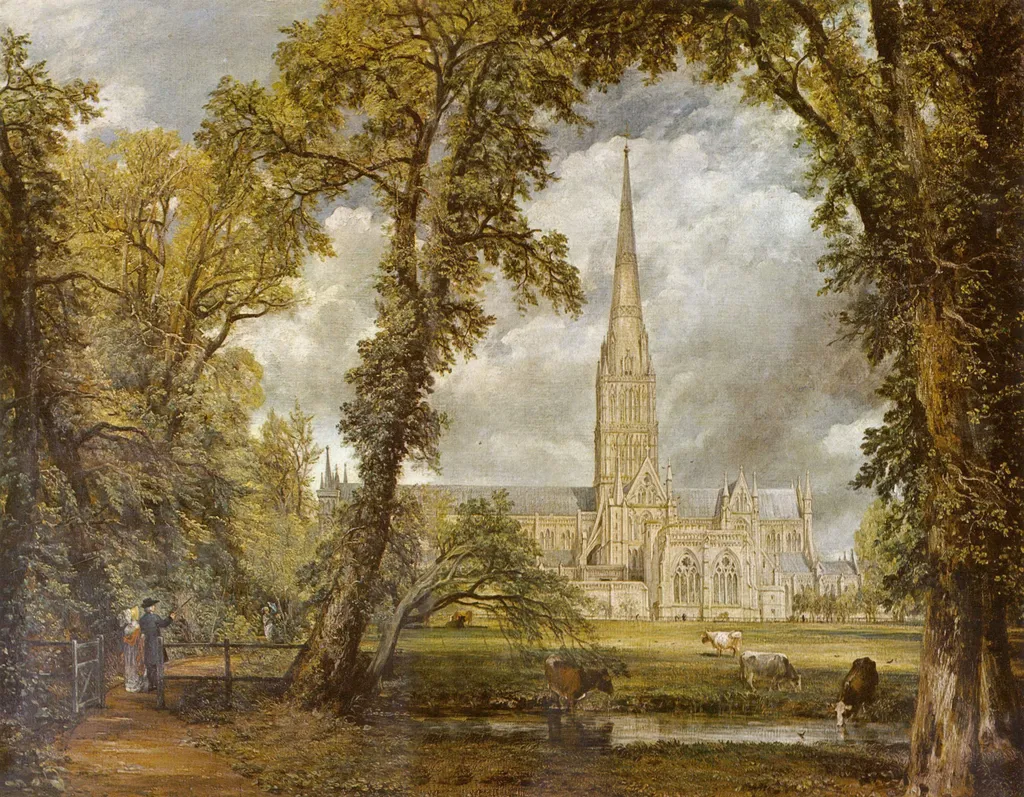
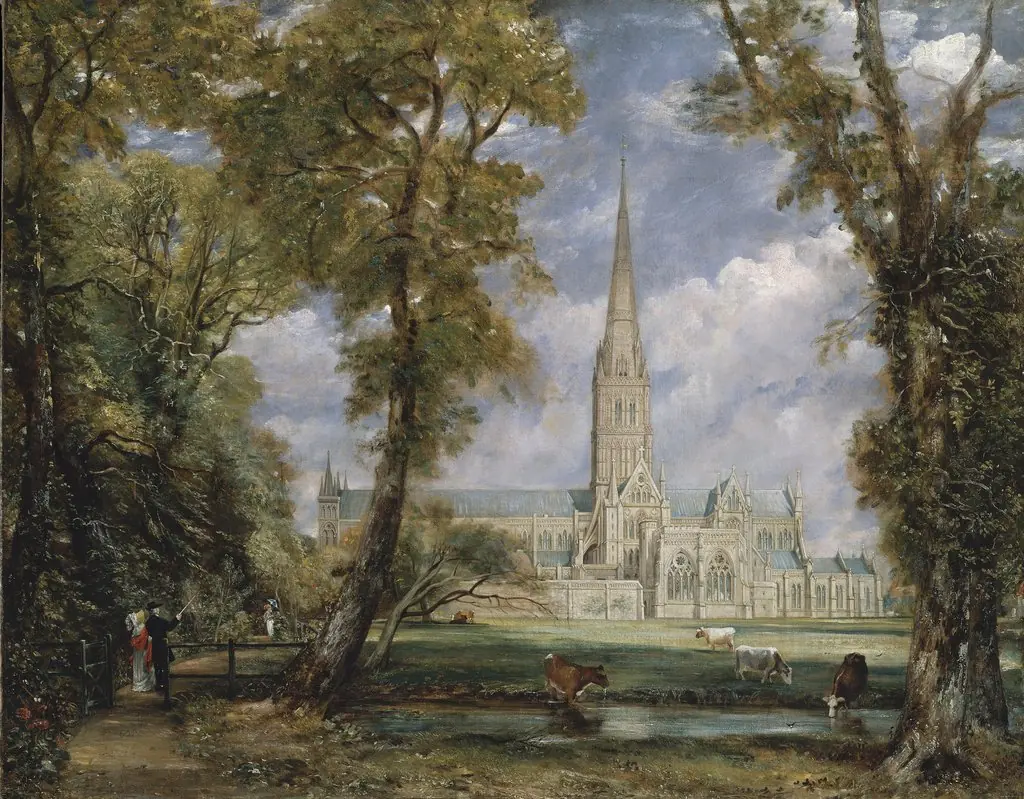
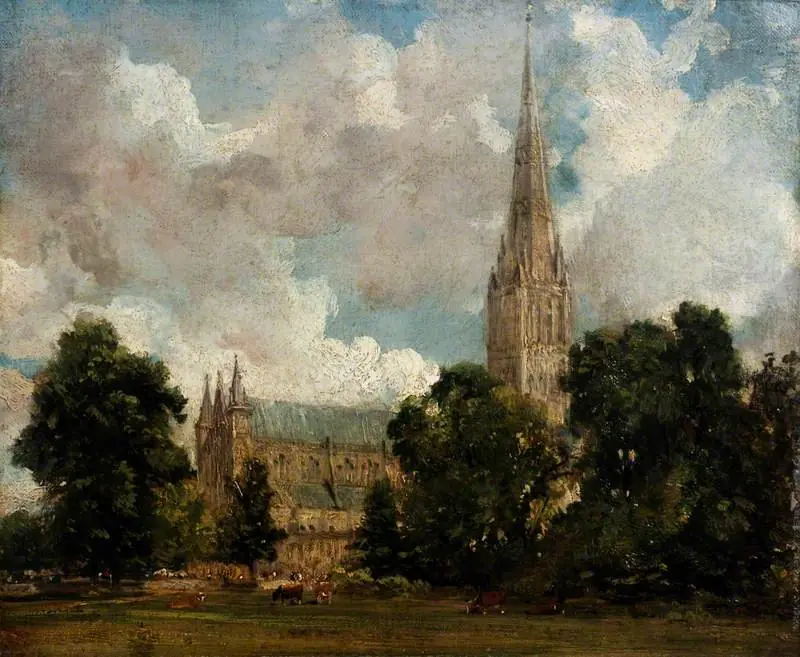
Salisbury Cathedral from the Bishop's Grounds is an oil painting by John Constable. It dates from 1823 and is held in the collection of the Victoria and Albert Museum.
About this work
Subject & Meaning
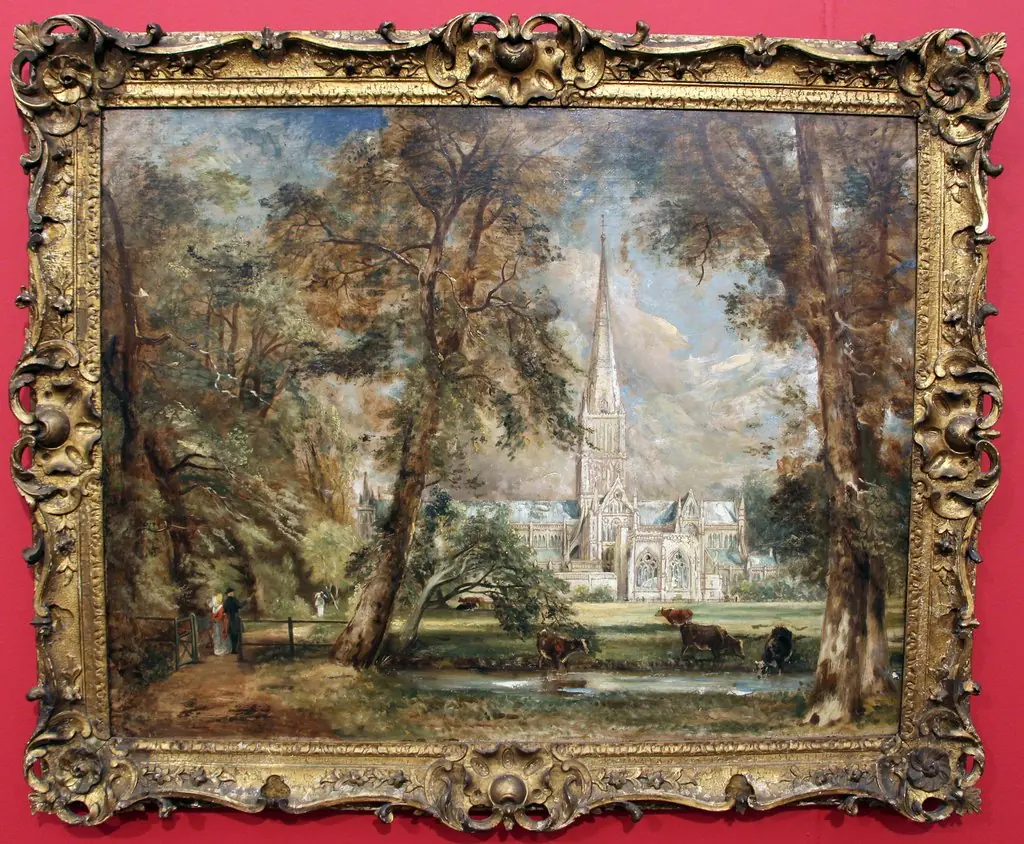
This perspective frames the Gothic structure, including its spire and buttresses, through a natural archway formed by dense foreground trees and vegetation.
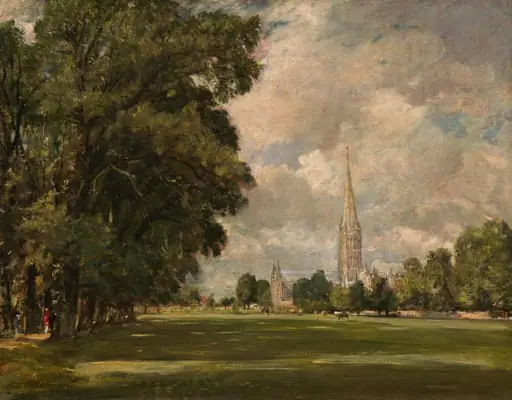
The painting depicts Salisbury Cathedral, a prominent medieval English church, viewed from the south-east within the Bishop's garden. This perspective frames the Gothic structure, including its spire and buttresses, through a natural archway formed by dense foreground trees and vegetation. The composition intentionally balances human presence with the natural world, featuring Dr. John Fisher, the Bishop of Salisbury, and his wife in the lower left corner.
Their inclusion, along with grazing cattle and a stream, symbolizes a harmonious coexistence between humanity, nature, and religious architecture. The work was commissioned by Fisher, who also selected the specific viewpoint, reflecting a personal appreciation for the site. While the London version features a dramatic, overcast sky that the patron initially found problematic, the imagery represents the artist's struggle to reconcile architectural precision with atmospheric effects, creating a scene where nature frames and elevates the man-made cathedral.
Technique & Style
Executed in 1823, this landscape is an oil painting on canvas measuring 87.6 by 111.8 cm. The composition features a naturalistic framing device where foreground trees arch over the scene, creating a Gothic-like enclosure for the cathedral spire while maintaining a clear view of its architectural details, including buttresses and windows. Figures of the Bishop and his wife appear in the lower left, integrated into a setting that balances human presence with grazing cattle and flowing water. Constable described the work as his most difficult landscape due to the complexity of rendering the architecture, yet he relied on the evanescence of chiaroscuro to unify the structure with the atmosphere.
The London version is characterized by an overcast sky filled with low, storm-laden clouds, contrasting with later replicas that feature brighter, clearer skies.
History & Provenance
The painting was commissioned by John Fisher, the Bishop of Salisbury, who was one of Constable's closest friends. Fisher also selected the viewpoint from the bishop's garden (south-east). Constable first visited Salisbury in 1811, making sketches from various angles, then returned in 1820 to create further drawings and an open-air oil sketch, now in the National Gallery of Canada in Ottawa, that served as the model for the prime version.
The 1823 prime version, measuring 87.6 × 111.8 cm in oil on canvas, was exhibited at the Royal Academy that year. It was gifted to the Victoria and Albert Museum in 1857 through the Sheepshanks Gift and remains there today. The painting includes portraits of Dr. Fisher and his wife in the lower left corner.
Fisher objected to the dark cloud over the cathedral in the original. He requested a replica with "a more serene sky," leading Constable to paint a full-scale version in 1825 (now at the Frick Collection, New York). Fisher died before its completion.
A smaller, sunnier version (1823–1826) was painted as a wedding present for Fisher's daughter Elizabeth and is now at the Huntington Library.
The painting is held by the Victoria and Albert Museum in London, where it has been part of the collection since being gifted by John Sheepshanks in 1857 under accession number FA.33. The work was commissioned by John Fisher, Bishop of Salisbury, and first exhibited at the Royal Academy in 1823. It is a landscape oil painting measuring 87.6 cm by 111.8 cm, created in the United Kingdom.
A full-scale replica is housed in the Frick Collection in New York, while a smaller version was gifted by Fisher to his daughter and is now in the Huntington Library. Additional related works by Constable include other depictions of Salisbury Cathedral, such as Salisbury Cathedral from the Meadows (1831).
Context
Salisbury Cathedral from the Bishop's Grounds is widely regarded as one of John Constable's most celebrated works, commissioned by his close friend and patron, John Fisher, the Bishop of Salisbury. The painting exemplifies Constable's struggle to balance artistic vision with patronal expectations; while the artist considered it the most difficult landscape subject he ever tackled, the Bishop initially rejected the London version due to an overcast sky, requesting a more serene atmosphere for a subsequent replica. This dialogue between creator and patron influenced the production of multiple versions, including a sunnier 1825 variant now held by the Frick Collection.
The work remains a cornerstone of English Romantic landscape painting, noted for its harmonious integration of human figures, specifically the Bishop and his wife, within a natural setting that frames the medieval architecture. Its enduring significance is reflected in its inclusion in major collections and its continued study as a prime example of Constable's mature style.
Legacy
Salisbury Cathedral from the Bishop's Grounds stands as one of John Constable's most celebrated works, frequently cited for its significance in his career and the broader canon of English landscape painting. The composition's enduring reputation is evidenced by the artist's creation of multiple versions and studies, including a full-scale replica held by the Frick Collection in New York City and an earlier oil sketch now in the National Gallery of Canada. The work has also been widely disseminated through various print reproductions, extending its reach beyond the original oil paintings.
Its legacy is further cemented by its inclusion in major cultural retrospectives, such as the 1980 BBC series "100 Great Paintings," which highlighted its status as a defining masterpiece of the Romantic era.
Overview
John Constable’s 1823 oil painting, Salisbury Cathedral from the Bishop’s Grounds, depicts the medieval cathedral set within a pastoral landscape. The composition balances the soaring spire against a verdant field, with foliage, a winding stream, and a few figures and cattle adding narrative depth. The work exemplifies Constable’s interest in the interplay of architecture and countryside.
Own this work as a print
Artist & collection
Artist
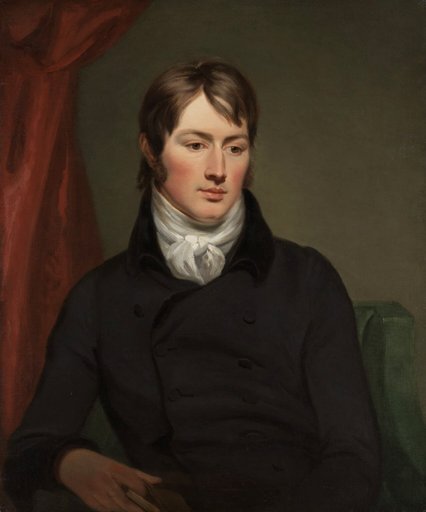
John Constable was an English landscape painter in the Romantic tradition. Born in Suffolk, he is known principally for revolutionising the genre of landscape painting with his pictures of Dedham Vale, the area on the…


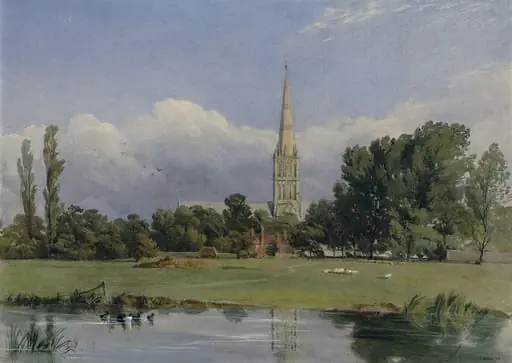 Salisbury Cathedral from West Harnham
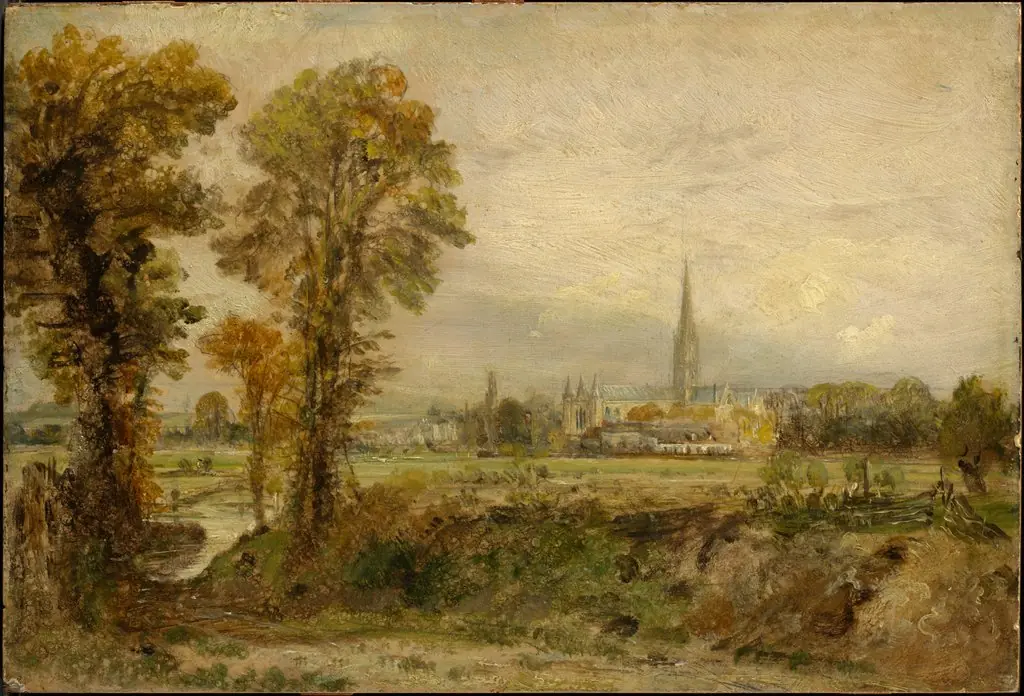 Distant View of Salisbury Cathedral
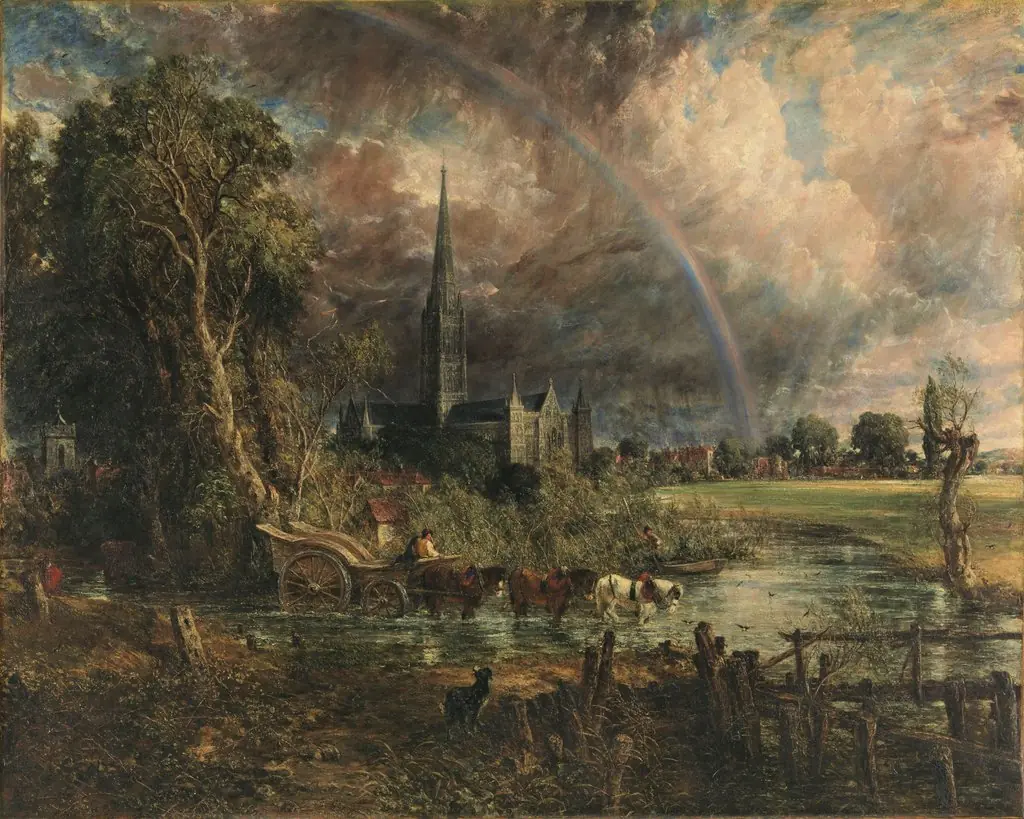 Salisbury Cathedral from the Meadows
 Salisbury cathedral
 Salisbury Cathedral from the Close
 Salisbury Cathedral from the Bishop's Garden
 Salisbury Cathedral from the Close
 Salisbury Cathedral from the South-West
 Salisbury Cathedral from the River Nadder
 Salisbury Cathedral