Artwork
The White Horse
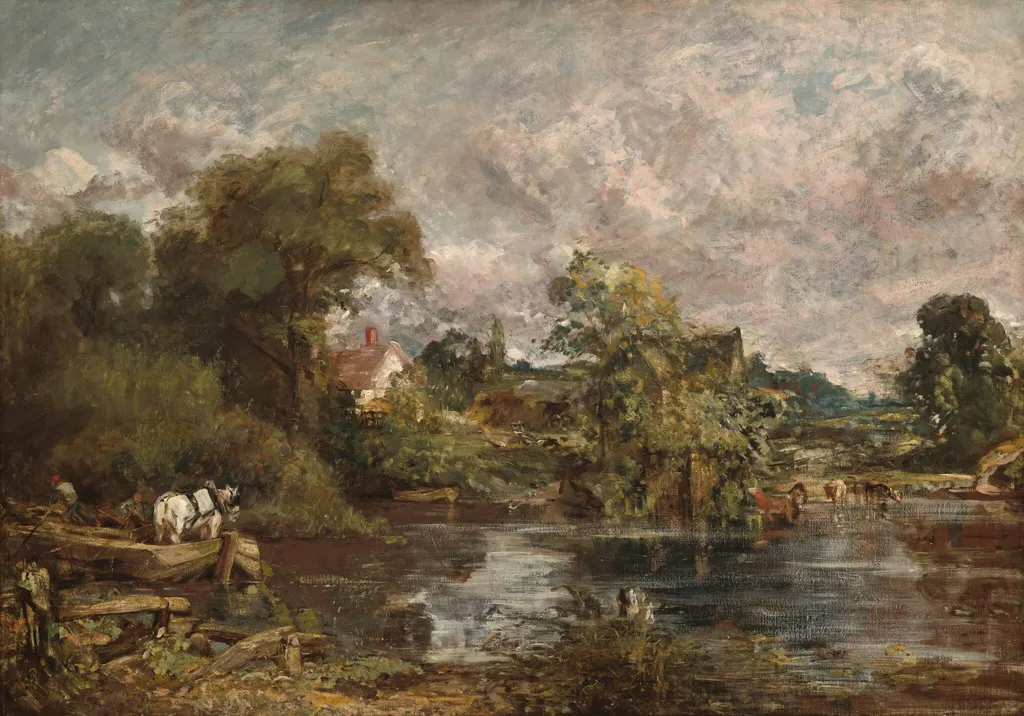
The White Horse is an oil painting by the Romanticist artist John Constable. It dates from 1818 and is held in the collection of the National Gallery of Art.
About this work
A brown-and-white horse stands still in a shallow river. The water ripples around its legs. Behind it, a big tree stretches up, its leaves catching the light.
Constable painted this in 1819 near his home in Suffolk, England. He loved how light moved on water. That’s why the river looks so real here.
Next time you’re in Washington, D.C., look for it at the National Gallery of Art, Washington.
Subject & Meaning
The White Horse depicts a white horse being ferried on a flat barge across the River Stour, a scene from the Suffolk countryside Constable knew from childhood.
The White Horse depicts a white horse being ferried on a flat barge across the River Stour, a scene from the Suffolk countryside Constable knew from childhood. The painting is the first of his full-scale studies for the series of "six-footers", large canal scenes, and was developed into the finished canvas of the same name now held by The Frick Collection in New York. This version remained in the artist's studio until his death in 1837.
It later entered the collection of Peter A. B. Widener in 1893 and was donated to the National Gallery of Art in 1942, where it is catalogued as accession number 1942.9.9.
Technique & Style
Executed in oil on canvas, the work measures 127 × 183 cm and belongs to a group of full-scale preparatory sketches Constable made for his six-foot canal scenes.
Handling emphasizes fluid, layered brushwork to capture fleeting light and atmosphere rather than precise detail. Foliage is indicated with quick, broken strokes, while the white horse is rendered with broad, simplified forms that prioritize silhouette and tonal contrast. The sketch-like quality persists in the unfinished passages, particularly along the margins and lower edges, where priming and underlayers remain visible.
History & Provenance
John Constable created The White Horse in 1818 as the first full-scale sketch for his series of six-foot canal scenes. The artist retained the work in his studio until his death in 1837. By 1872 it was owned by John Pender, who lent it to the Royal Academy's Winter Exhibition that year.
It subsequently passed through the E. Fox White Gallery and Wallis & Son before being purchased in 1893 by Peter A. B. Widener of Philadelphia.
Following Widener's death, the work remained at the Lynnewood Hall estate in Elkins Park, Pennsylvania, and was inherited by his son, Joseph E. Widener, who gave it to the National Gallery of Art in Washington, D.C., in 1942, where it is accessioned as 1942.9.9.
Context
Painted in 1818, The White Horse holds a pivotal position in John Constable's career as the first full-scale sketch created for his series of six-foot canal scenes. This large oil on canvas, measuring 127 by 183 cm, served as the preparatory study for the finished painting of the same name, currently held by The Frick Collection in New York. The work's significance lies in its role as a foundational experiment for Constable's ambitious, large-format depictions of the English countryside, a format that defined his major contributions to British art.
The sketch remained in the artist's studio until his death in 1837, underscoring its private function within his working process.
Legacy
The White Horse occupies a foundational place in John Constable's career as the first full-scale sketch for his six-foot canal scenes, directly informing the finished painting now held by The Frick Collection in New York. The sketch remained in the artist's studio until his death in 1837 before passing to John Pender by 1872. It was subsequently acquired by Peter A. B. Widener in 1893 and entered the National Gallery of Art in Washington, D.C., in 1942 as part of the Widener gift, where it is now preserved.
Overview
John Constable’s The White Horse is an oil on canvas executed in 1818. The work presents a quiet riverside scene in which a brown-and-white horse stands in shallow water, its legs creating gentle ripples. A large tree dominates the background, its foliage illuminated by daylight. The composition reflects Constable’s lifelong interest in the English countryside, particularly the area around his Suffolk home.
Own this work as a print
Artist & collection
Artist
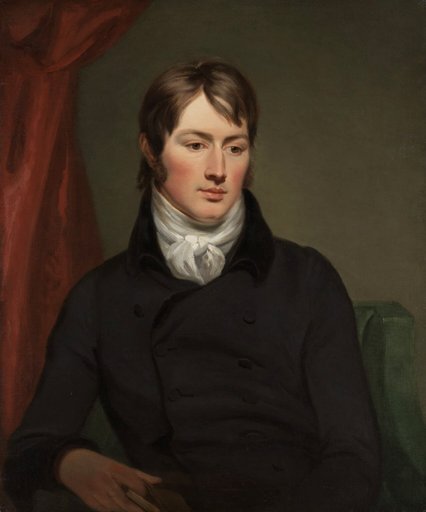
John Constable was an English landscape painter in the Romantic tradition. Born in Suffolk, he is known principally for revolutionising the genre of landscape painting with his pictures of Dedham Vale, the area on the…

- The Stour
 River Landscape
 The Hay Wain (full-scale study)
 A River Scene with a Farmhouse near the Water's Edge
 Stoke-by-Nayland
 Stoke-by-Nayland
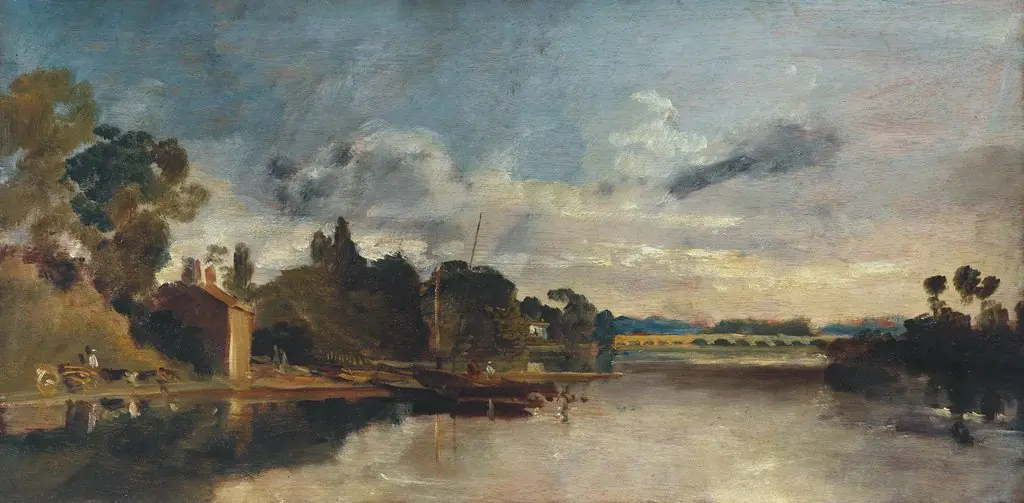 The Thames near Walton Bridges
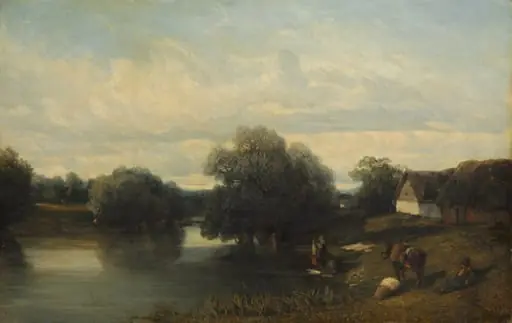 Cottage by the River with Washerwomen
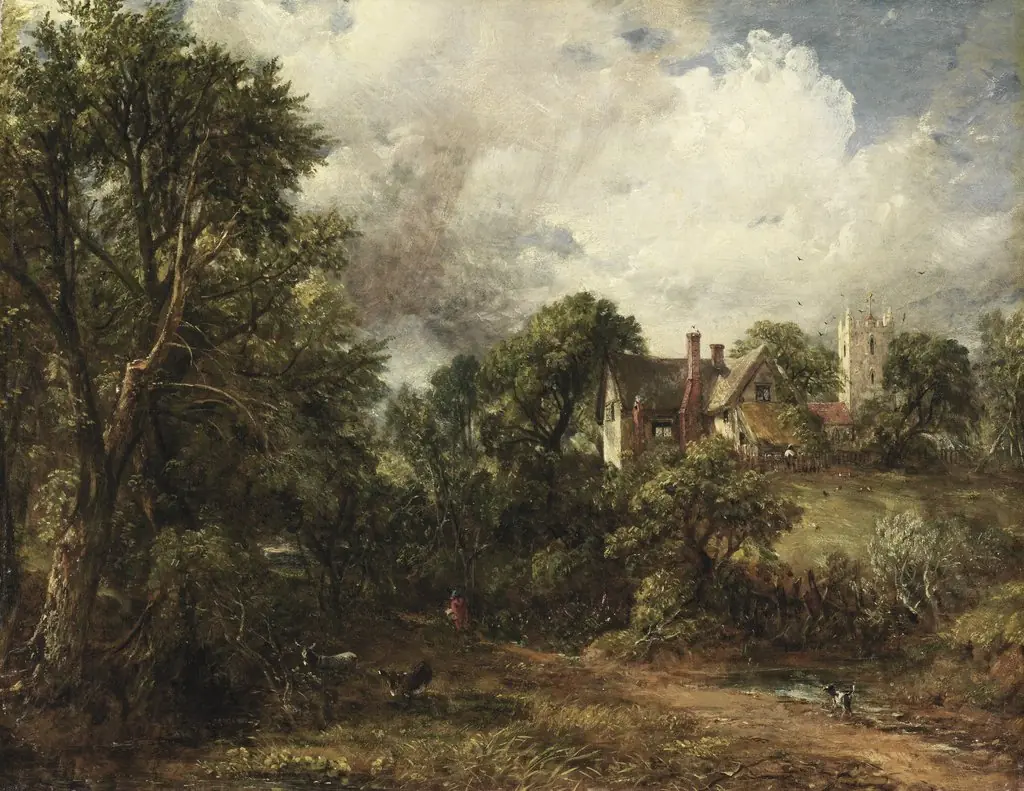 The Glebe Farm
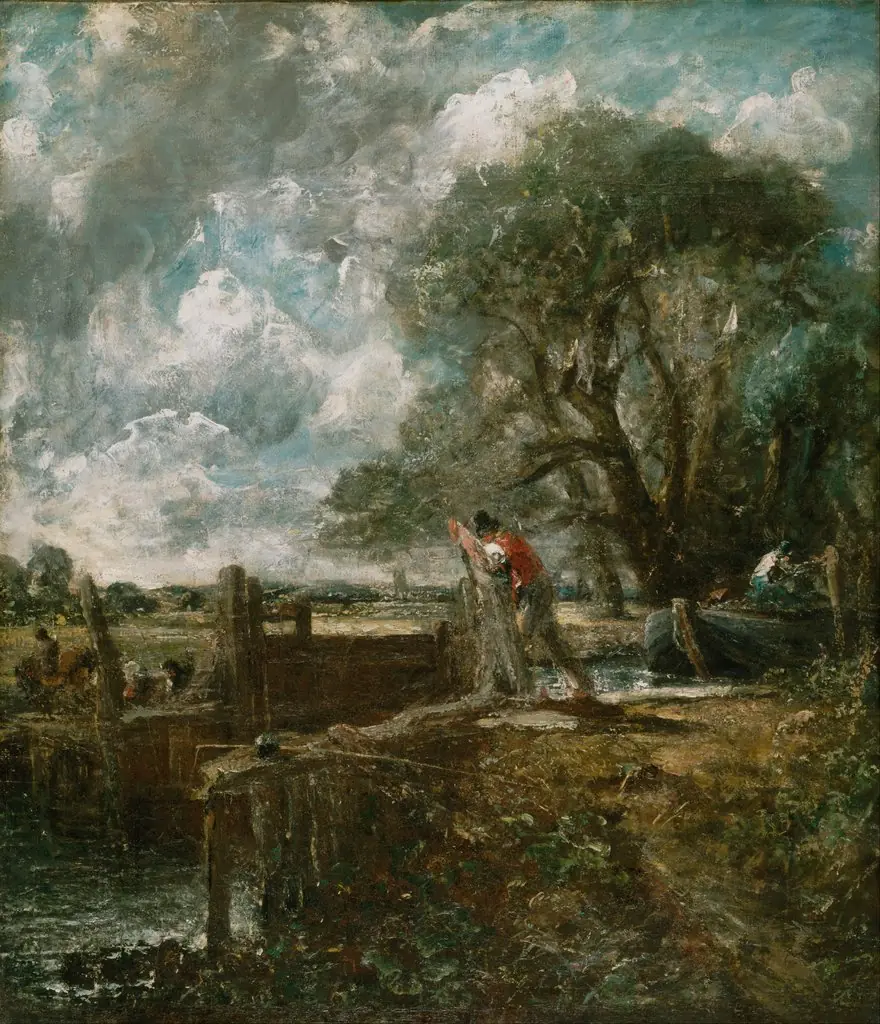 Sketch for A Boat Passing a Lock
 Cottage by the River with Washerwomen
 Study of A boat passing a lock