Artwork
Stoke-by-Nayland
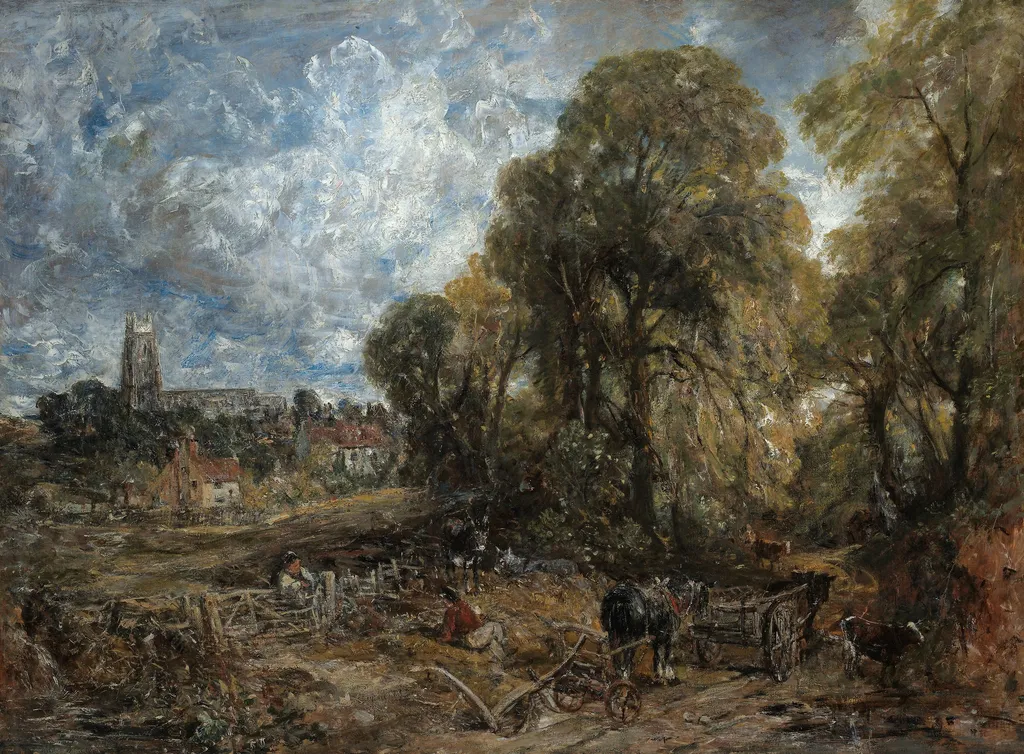
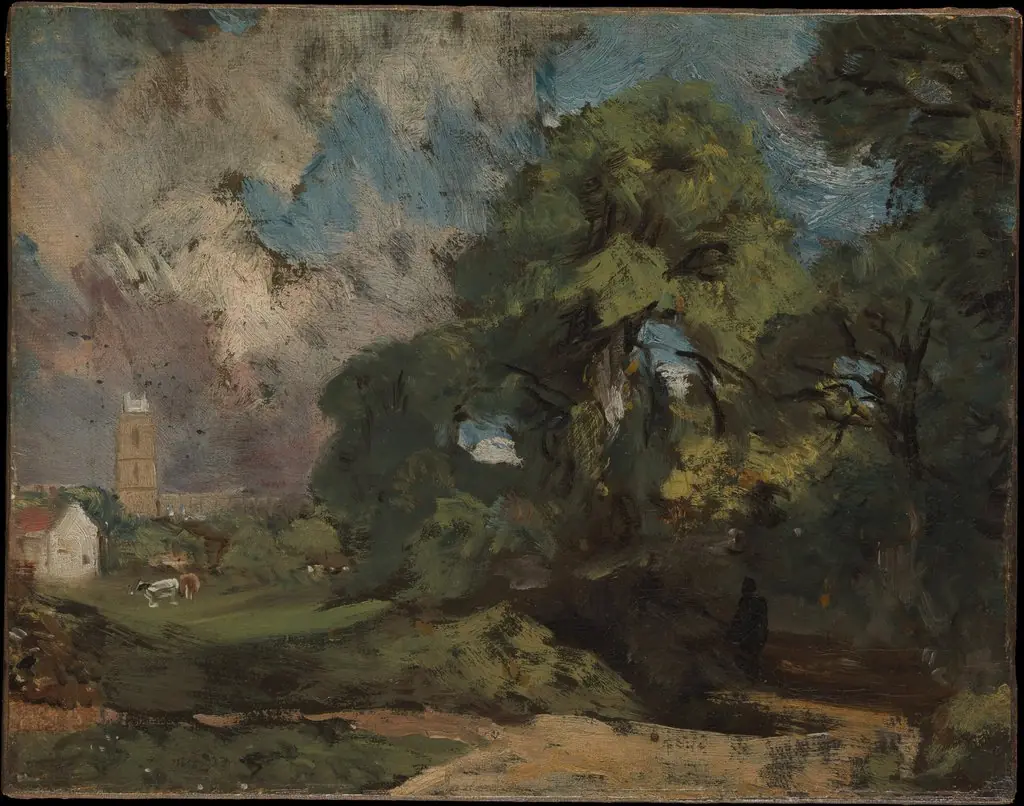
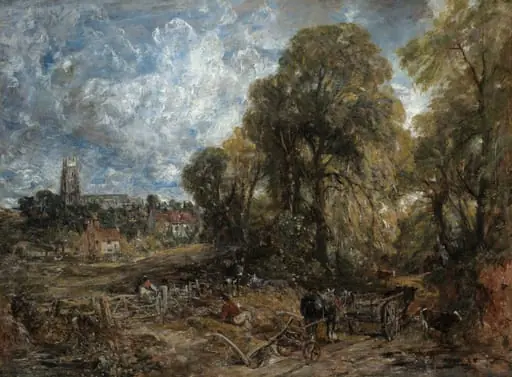
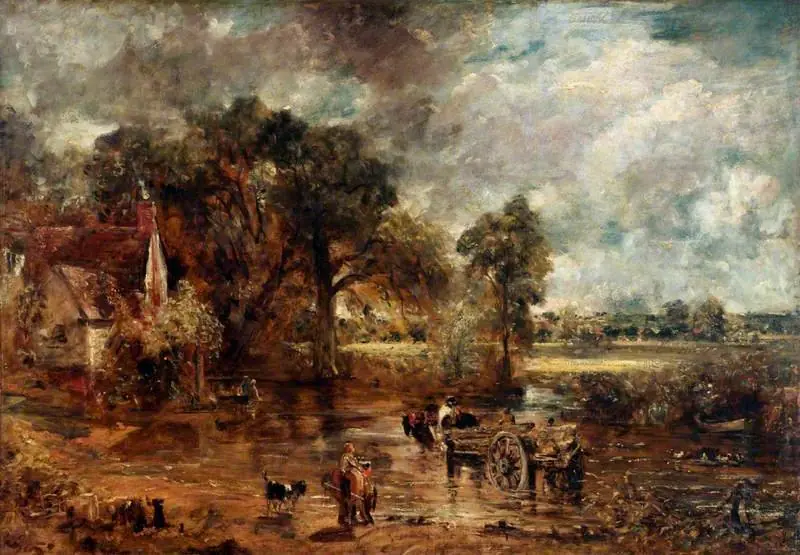
Stoke-by-Nayland is an oil painting by John Constable. It dates from 1836 and is held in the collection of the Art Institute of Chicago.
About this work
Subject & Meaning
Functioning as a large-scale oil sketch, the piece was prepared with the same dimensions as the artist's earlier monumental "six-footer" paintings.
The work depicts a landscape view near the village of Stoke-by-Nayland in Suffolk, close to the Essex border, a region frequently portrayed by the artist and later termed "Constable Country." Specific elements within the scene include St Mary's Church, which is visible on the left side of the composition, alongside natural features such as trees, a sky, and a horse, as well as human figures.
Functioning as a large-scale oil sketch, the piece was prepared with the same dimensions as the artist's earlier monumental "six-footer" paintings. It represents a preparatory stage in Constable's process, as he typically created full-size sketches before executing finished versions. The artist likely intended to develop this sketch into a completed painting for exhibition at the Royal Academy in 1837, but his death prevented the work from being finalized for that display.
Technique & Style
Stoke-by-Nayland is an oil painting on canvas created in 1836 by John Constable. The work depicts a landscape near the village of Stoke-by-Nayland in Suffolk, featuring the parish church, a horse, a tree, and surrounding sky. Constable prepared this full-size oil sketch at the same scale as his earlier "six-footers" before developing a finished Academy piece, though he died before exhibiting it.
The painting is now part of the Art Institute of Chicago’s collection. Its formal qualities include careful rendering of atmospheric effects and precise spatial depth, reflecting the artist’s mature landscape technique.
The work is executed in oil paint on canvas, a medium typical of Constable’s mature practice, with handling that emphasizes fluid brushwork to suggest light and weather. Formal stylistic qualities include a naturalistic treatment of terrain, attention to botanical detail, and a compositional balance that unites sky, land, and ecclesiastical architecture.
History & Provenance
John Constable created Stoke-by-Nayland in 1836 as an oil sketch, likely intending to develop it into a finished piece for the Royal Academy Exhibition of 1837. The work remained in Constable's possession until his death and was subsequently acquired by the Art Institute of Chicago in 1922. It has been part of the museum's permanent collection since acquisition, reflecting its significance within the artist's body of work and its enduring legacy in the study of British landscape painting and the Romantic movement.
The painting depicts a rural scene near Stoke-by-Nayland in Suffolk, featuring elements such as St Mary's Church, a horse, a tree, and the surrounding sky characteristic of Constable Country. Its creation process exemplifies Constable's practice of producing full-size oil sketches prior to completing major works, a method that underscored his innovative approach to capturing naturalistic detail and atmospheric effects.
The painting is held in the collection of the Art Institute of Chicago, with the accession number 1922.4453. It was acquired by the museum in 1922. Constable had likely intended to develop this large oil sketch into a finished work for display at the Royal Academy Exhibition of 1837, but he died before the exhibition took place.
Context
Stoke-by-Nayland is a c.1836 oil sketch by John Constable depicting the village of Stoke-by-Nayland in Suffolk, featuring St Mary's Church, a horse, a tree, and the surrounding sky. The work was prepared on the same scale as Constable's earlier "six-footers" and intended for potential inclusion in the 1837 Royal Academy Exhibition, though Constable died before it could be displayed. It remains in the collection of the Art Institute of Chicago.
The painting is recognized as part of the artist's mature landscape period and reflects his deep engagement with the topography and atmosphere of his native Suffolk, a recurring subject he helped elevate to a central focus in British art.
Scholarship emphasizes the work's role as a pivotal study within Constable's process, bridging his field observations and finished exhibition pieces. Its significance is underscored by its inclusion in major publications such as Concannon's 2025 analysis of Turner and Constable, which contextualizes it within broader 19th-century British landscape discourse.
Legacy
Stoke-by-Nayland exerted a quiet but lasting influence on landscape painting in Britain and beyond, shaping how later artists approached plein-air oil sketches and the expressive rendering of rural atmosphere. Its study of light and cloud, rooted in the Suffolk countryside, informed the techniques of artists such as John Constable’s younger contemporaries and later followers of the Norwich School, who valued its immediacy and fidelity to nature. The work’s compositional daring, particularly in its depiction of St Mary’s Church and the surrounding terrain, contributed to the evolving visual language of the English countryside in art.
Today it is celebrated as a pivotal study within Constable’s oeuvre, reflecting both his technical innovation and his deep connection to the landscapes of his youth. The painting is held in the collection of the Art Institute of Chicago.
Overview
John Constable’s c.1836 oil work titled Stoke‑by‑Nayland records a rural scene near the Suffolk village of the same name, close to the Essex border. The composition includes a church spire, a solitary tree, and a muddy lane traversed by a horse‑drawn cart, all set beneath a brooding sky. The piece is executed on a large canvas, matching the dimensions of Constable’s earlier monumental “six‑footers.”
Own this work as a print
Artist & collection
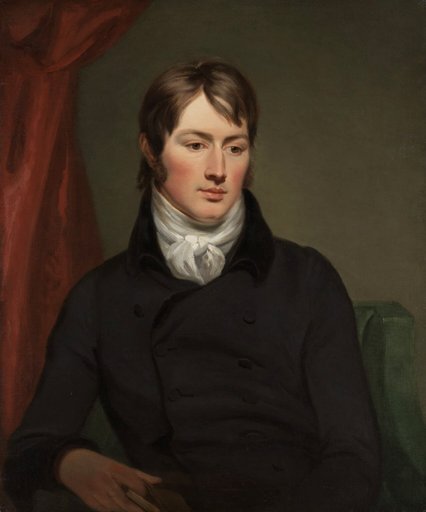
Artist
John Constable was an English landscape painter in the Romantic tradition. Born in Suffolk, he is known principally for revolutionising the genre of landscape painting with his pictures of Dedham Vale, the area on the…