Artwork
Flora and Zephyr
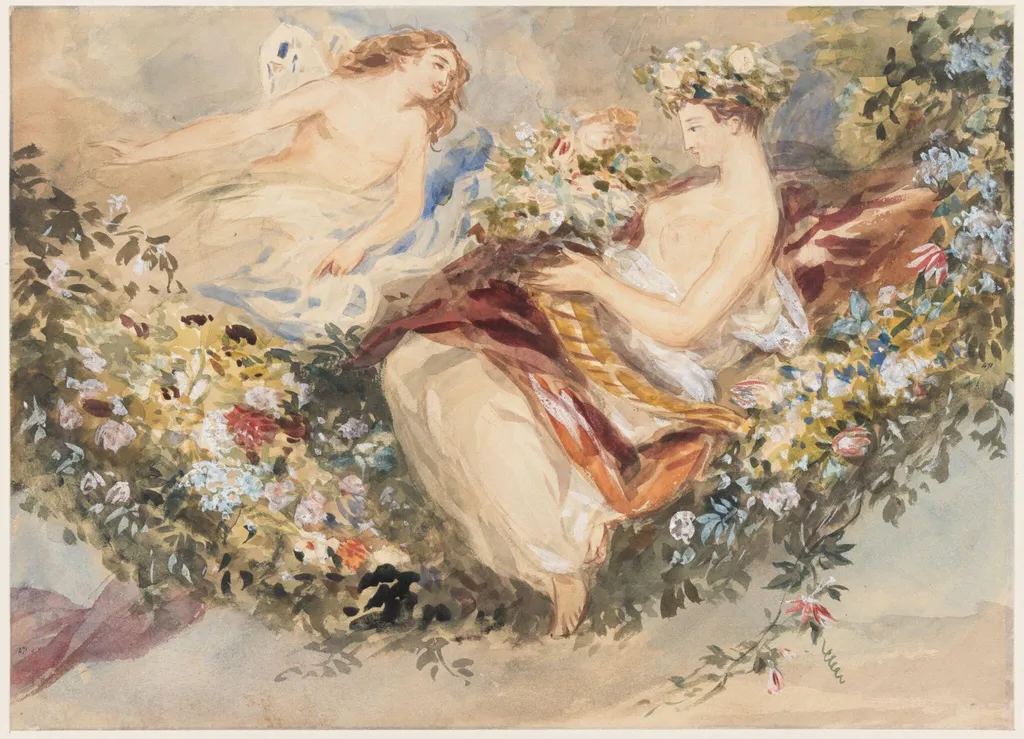
Flora and Zephyr is a watercolor work on paper by the Aestheticist artist John James Chalon. It dates from 1850 and is held in the collection of the Victoria and Albert Museum.
About this work
Overview
It was likely produced as a study for the Sketching Society, where artists explored classical themes through direct observation and imaginative interpretation.
Created in 1850 by John James Chalon, this watercolour depicts a mythological encounter between Flora, goddess of flowers, and Zephyr, the west wind. Executed in the delicate medium of watercolour, the work reflects Chalon’s frequent use of the technique for intimate, lyrical compositions. It was likely produced as a study for the Sketching Society, where artists explored classical themes through direct observation and imaginative interpretation.
Subject & Meaning
The scene portrays Flora seated amid blooming flora, crowned with a floral wreath and dressed in a pale gown, while Zephyr, winged and airborne, hovers nearby. Their interaction suggests a mythological moment of renewal, where the wind breathes life into the earth. The imagery draws from classical sources, aligning with 19th-century Romantic interests in nature’s personification and mythic harmony, though without overt narrative drama.
Technique & Style
Chalon employed transparent watercolour washes to achieve a luminous, airy quality. Delicate brushwork renders individual petals, leaves, and fabric folds with precision, while soft gradations of green, blue, and gold unify the composition. The light background, with faint cloud forms, enhances the sense of spatial depth without heavy shading, characteristic of the artist’s refined, illustrative approach to natural subjects.
History & Provenance
The work originated as a study for the Sketching Society, a group of British artists who met to refine their skills through thematic exercises. Its creation in 1850 places it within Chalon’s mature period, when he increasingly focused on mythological and pastoral subjects. No documented ownership history beyond the society is recorded, and it remains in private or institutional collections without public exhibition history.
Context
In mid-19th-century Britain, watercolour was elevated as a serious medium, particularly for landscape and literary subjects. Chalon’s work reflects this trend, blending academic training with Romantic sensibilities. His engagement with classical mythology paralleled broader cultural interests in antiquity, while the emphasis on natural detail aligned with contemporary botanical and horticultural fascination.
Legacy
Though not widely exhibited or reproduced, Flora and Zephyr exemplifies Chalon’s contribution to British watercolour traditions. It stands as a quiet testament to the era’s preference for lyrical, myth-infused naturalism. His approach influenced lesser-known illustrators of the period, though his broader legacy remains overshadowed by contemporaries who pursued more public or monumental subjects.
Own this work as a print
Artist & collection
Artist
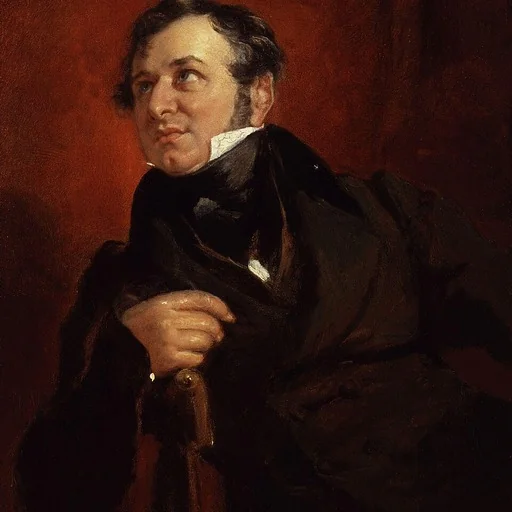
John James Chalon (27 March 1778 – 14 November 1854) was a Swiss painter active in England. He treated a wide range of subjects, landscapes, marine scenes, animal life, and figure-pieces.

 The Return of Persephone
 The Peri's First Pilgrimage
 Die Erziehung des Bacchus
 Central panel of a triptych
 Imperia la Belle
 Lake Scene with Fairies and Swans
 Poem of the Soul - The golden stairs
 Bacchus
 Lady with Fan, with attendant nymphs
 Sketch for the panel “Springtime” for the Bakhchi-Dere villa in Yalta
 Sketch for the painting “Procession around the Venus de Milo statue”
- Flora and Zephyr